

Biofilm Lyme treatment is still a research question: lab studies show Borrelia burgdorferi can form protective biofilm-like clusters, but this page found no controlled study showing a biofilm-targeted treatment works in people with Lyme. The CDC and the 2020 IDSA, AAN, and ACR guideline advise against more antibiotics for lingering symptoms, and our root-cause plan starts with rebuilding the body.
If you finished your antibiotics and still feel unwell, a word like “biofilm” can sound like the missing answer. One My Lyme Doc patient, Barbara W., wrote that she “got about 70% better but was still not happy with the joint and muscle pain” after earlier treatment elsewhere. Questions like hers deserve a straight answer, and the straight answer has two sides. This page sets the research beside the mainstream view of post-treatment Lyme disease syndrome, then shows how we plan care.
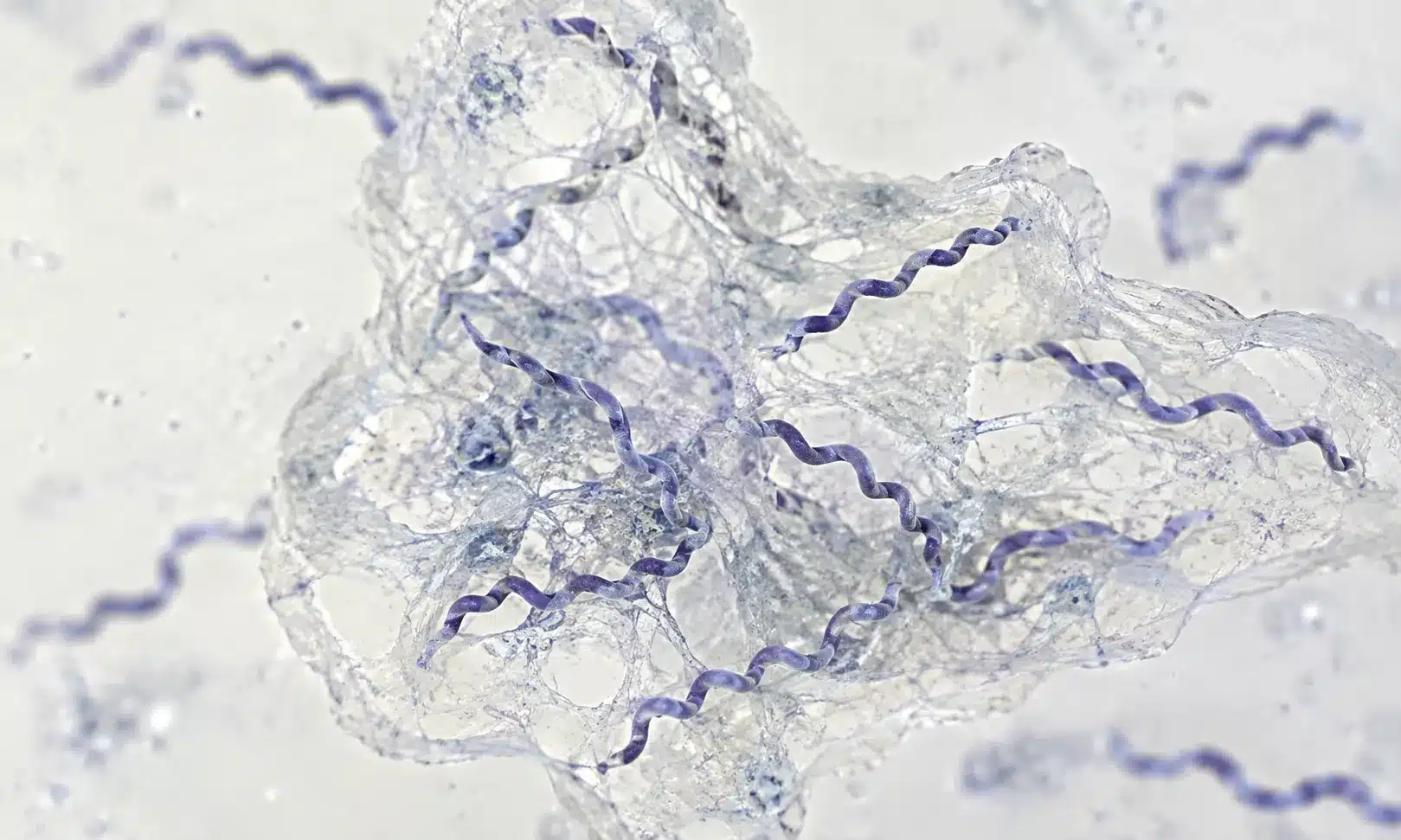
A biofilm is a community of bacteria held together by a sticky coating the bacteria make themselves, and that coating can help the group survive harsh conditions.
Biofilm is a community of microbes held together by a self-made extracellular matrix of sugars, proteins, and DNA, as described in Borrelia research. In Borrelia studies the matrix is made mostly of alginate, a sugar-based material that researchers use as a biofilm marker.
Persister cells are a small share of bacteria that survive antibiotics without being resistant and can regrow once the drug is gone.
In vitro means studied in a lab dish or tube, outside a living body.
Researchers who study Borrelia treat the two ideas as linked. A 2019 review notes that persisters are present in significant numbers in biofilms, which has been offered as one reason biofilms tolerate antibiotics. Whether that tolerance explains anything a Lyme patient feels is the unanswered part.
Lab and animal studies show that Borrelia burgdorferi forms biofilm-like clusters, but every finding in this section comes from dishes, tissue samples, or mice.
| Study | Where it was done | What it found | Evidence level |
|---|---|---|---|
| Sapi et al., 2012 | Lab culture | Floating and surface-attached clusters wrapped in a matrix made mostly of alginate, with calcium and DNA | In vitro |
| Timmaraju et al., 2015 | Lab culture | Two European Lyme species, B. afzelii and B. garinii, formed similar biofilms | In vitro |
| Torres et al., 2020 | Mouse skin samples kept in a dish | After two weeks, infected skin held live spirochetes and biofilm forms | Ex vivo |
| Feng et al., 2019 | Mice | Infection started from biofilm-like clusters caused more severe arthritis and resisted several standard antibiotics | Animal |
| Thippani et al., 2024 | Mice | Alginate-positive clusters appeared in heart tissue, with an inflammation marker nearby | Animal |
The Johns Hopkins mouse study matters most to people with lingering symptoms. In that paper, mice infected with biofilm-like clusters kept their infection after treatment with doxycycline, ceftriaxone, or vancomycin, alone or paired, and only a three-drug persister combination cleared it. The authors called for studies of whether persister-targeted combinations work better.
Published reports describe Borrelia clusters with biofilm markers in human tissue, and each involves very few patients. Three that bear on Lyme symptoms are below.
These reports are real signals with limits. Each relies on a marker stain plus microscopy, and none can show that the clusters cause symptoms or that clearing them would help.
The CDC lists the cause of post-treatment Lyme disease symptoms as unknown, and the human biofilm reports above do not settle it.
The CDC says extended antibiotic treatment is no better than placebo for prolonged symptoms, links long-term antibiotic use to serious complications such as sepsis, and says most people improve over time without more antibiotics. Recovery can take many months. The agency also discourages the term chronic Lyme disease, because the term implies ongoing infection.
Our chronic Lyme disease treatment guide covers how we approach long-running illness.
The 2020 guideline from the IDSA, AAN, and ACR recommends against additional antibiotic therapy for persistent nonspecific symptoms, such as fatigue, pain, or cognitive impairment. That applies when there is no objective evidence of reinfection or treatment failure, and the guideline rates it a strong recommendation based on moderate-quality evidence. It also states there is “no clinical evidence to support regimens intended to treat morphologic variants” of Borrelia. The guideline names cyst forms and persister cells and does not use the word biofilm.
Researchers who take persistence seriously point to animal data. In rhesus macaques treated with antibiotics, investigators found Borrelia DNA, RNA, and antigen in tissue and recovered a small number of intact spirochetes by feeding lab-raised ticks on the animals. Those findings concern persister cells, not biofilm, and the authors framed the open question as whether such cells contribute to symptoms.
The newest human test points the other way. A prospective cohort published in October 2026 used xenodiagnosis, in which lab-raised larval ticks feed on a person and are then tested for Borrelia. It covered 60 adults treated for Lyme, 20 of whom had symptoms lasting a year or more. All ticks tested negative except one, which came from a recovered patient. The study stopped early for futility, and its authors say the result may reflect no bacteria or a technique too insensitive in humans. That leaves the biofilm question open in both directions.
My Lyme Doc evaluates Lyme and mold illness together, and our guide to why Lyme treatment does not work covers more reasons treatment can stall.
Researchers have tested drugs, plant extracts, and essential oils against Borrelia biofilm forms, and the table below lists those results as lab findings only.
| Agent studied | What the lab tested | Lab result | Evidence in people with Lyme |
|---|---|---|---|
| Daptomycin or daunomycin plus doxycycline and cefuroxime (Feng 2016) | Biofilm-like microcolonies in culture | The add-ons eliminated the clusters with no regrowth at 7 and 21 days. The two antibiotics alone did not | Lab study only. A related combination cleared infection in mice (Feng 2019) |
| Dapsone with other antibiotics (Horowitz 2020) | Biofilm forms in culture | Reduced biofilm mass, its protective layer, and bacterial viability | This study is lab only. Its authors cite an earlier clinical report of their own, which this page did not review |
| Whole leaf stevia extract (Theophilus 2015) | Spirochetes, persisters, and attached biofilm | Reduced B. burgdorferi forms in biofilm assays | Lab study only |
| Baicalein and monolaurin (Goc 2015) | 15 plant compounds and micronutrients against three Borrelia forms | Only these two showed significant activity against biofilm | Lab study only |
| Oregano, cinnamon bark, and clove bud oils (Feng 2017) | 34 essential oils against stationary-phase Borrelia | Eliminated viable cells in culture, and some oils dissolved biofilm-like clusters | Lab study only. The authors say safety and pharmacokinetics need study first |
A dish result does not predict what happens in a body, where absorption, safety, and your other health conditions all matter. This page gives no doses or protocols for that reason.
Peptides have their own research story, and our LL-37 peptide guide covers it in full.
Our herbs for Lyme disease guide covers the herbs patients ask about most.
A root-cause plan treats persistent Lyme symptoms as a whole-body problem and sequences care in four phases, with microbe-directed work last.
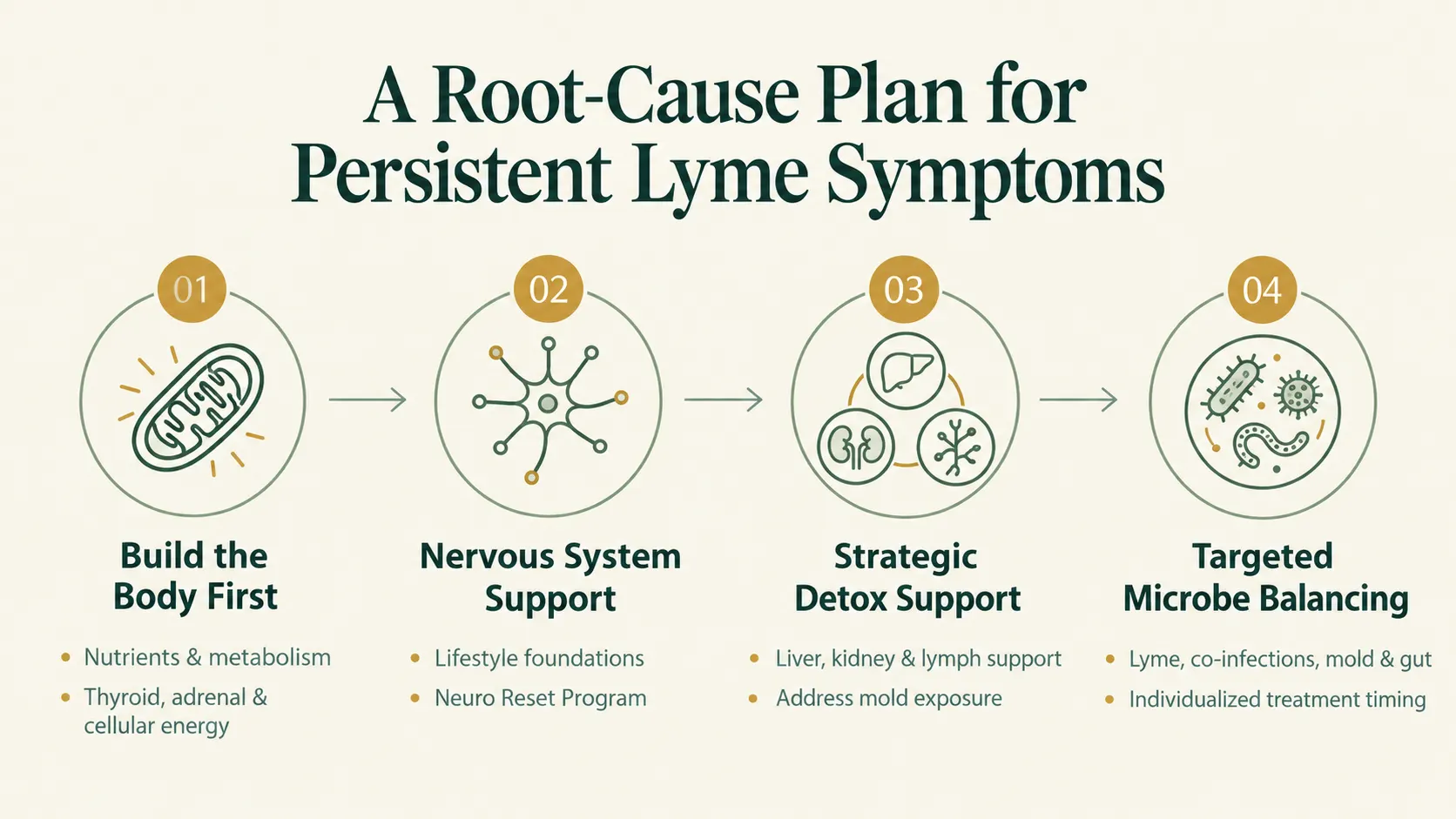
Dr. Diane Mueller’s 4-Phase Method builds the body before any microbe-directed step, because in our experience treating the pathogen first can leave patients crashing. In our practice, care is individualized and supervised.
In Dr. Mueller’s 4-Phase Method, persister cells are addressed in Phase 4, the last phase, after the body has been built up. The research above is the reason to treat biofilm as an open question. Our overview of natural treatment for Lyme disease shows how the phases connect.
Five questions can help you judge any biofilm protocol before you buy it or start it.
If you want a clinician to review your history and where you are in this process, My Lyme Doc sees patients by telehealth in 11 states. You can book a consultation with Dr. Mueller to talk through your timeline, your prior treatment, and which phase makes sense first.