


A lot of people notice the skin first. Not the fatigue, not the odd anxiety surges, not the foot pain when they stand up in the morning, but the strange red or purple streaks that look like stretch marks even when weight change doesn’t fit the story. And that’s where things get messy. These marks are easy to brush off, easy for a rushed visit to label as “normal,” and easy for you to second-guess at 2 a.m. while scrolling your phone. If you’ve felt that quiet panic, you’re not overreacting. Sometimes skin is the billboard for something deeper. And Bartonella can be one of those deeper clues.
A Bartonella rash can vary widely in appearance, often presenting as subtle red or purple streaks that may be mistaken for stretch marks or other skin conditions.
Recognizing Bartonella rash patterns requires attention to accompanying symptoms like neuropsychiatric or vascular issues and patient history, including exposure to cats or fleas.
Bartonella rashes commonly appear near bite or scratch sites but can also develop in less typical areas such as hips, thighs, and lower back without usual causes like weight change.
Bartonella rash should be differentiated from similar-looking conditions such as stretch marks, hives, cellulitis, and Lyme disease rashes through clinical evaluation and symptom correlation.
Diagnosis of Bartonella involves thorough clinical history, physical exam, and lab testing, but false negatives are common, making clinical judgment crucial.
Treatment varies by severity and may require antibiotics and supportive care; skin recovery is gradual and reflects broader improvements in inflammation and vascular health.
We have helped thousands of people in Colorado, Oregon, Wyoming, New Jersey, Pennsylvania, Texas, and Wisconsin restore their health and quality of life by diagnosing and treating their Lyme Disease.
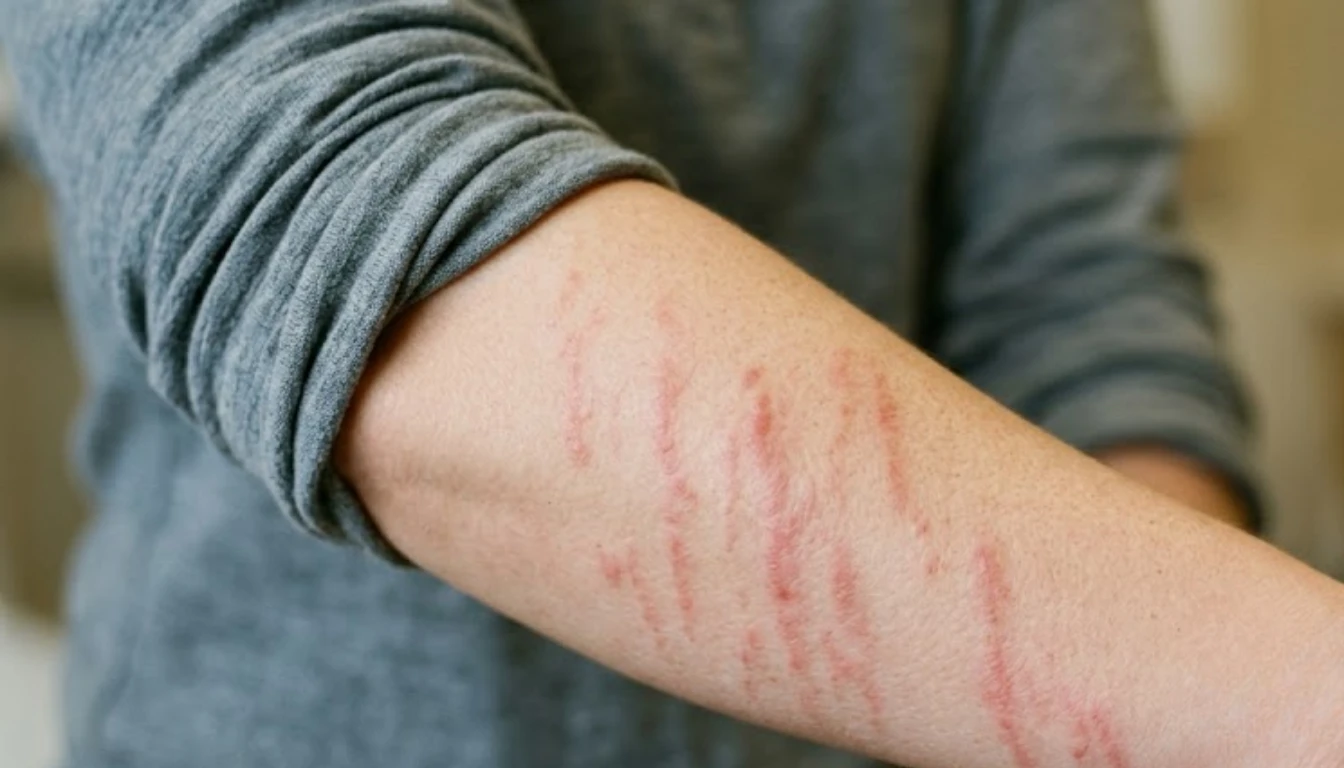
Bartonella rash isn’t one single, tidy rash pattern. That’s part of the problem.
Bartonella refers to infections caused by Bartonella species, including B. henselae and B. quintana. In medical literature, skin findings can include a small papule or pustule at the site of a scratch or bite, a more diffuse maculopapular rash, or vascular-looking nodules and plaques in more serious cases. Some people with chronic complex illness also report linear, red-to-purple streaks that get called “Bartonella rash,” even though ordinary stretch marks and Bartonella are not considered the same thing in major guideline sources.
So why is it missed? Because it can look ordinary. It may resemble irritation, striae, hives, or just “sensitive skin.” And if you already have a long list of symptoms, brain fog, insomnia, nerve pain, swollen nodes, weird mood shifts, skin changes can get pushed to the bottom of the visit.
That’s why pattern recognition matters. When these marks show up alongside other bartonella symptoms, they deserve a closer look, not a shrug.
The classic mistake is assuming every Bartonella-related skin change should look dramatic. Often, it doesn’t.
Documented Bartonella skin patterns include:
a small bump or pustule near the inoculation site after a scratch or bite
flat or slightly raised red spots in a broader rash
angioproliferative lesions, which are red-purple vascular papules, nodules, or plaques
less specific eruptions that can resemble purpura, hives, or inflammatory rashes
What many chronic illness patients focus on, though, are those linear streaks, red, pink, purple, sometimes brownish later, that don’t behave like typical stretch marks. They may appear suddenly, in unusual places, and without the expected context of pregnancy, puberty, rapid muscle gain, or major weight fluctuation.
That doesn’t prove Bartonella by itself. It does mean you should zoom out and ask: what else is happening in your body?
If the skin changes sit next to neuropsychiatric symptoms, vascular symptoms, or a known Lyme history, the overlap discussed in Bartonella and Lyme Co-infections guide becomes a lot more relevant.
Inoculation papules usually show up near the original scratch or bite. Those often appear around a week after exposure and may hang around for 7 to 21 days, sometimes longer.
The more debated stretch-mark-like lesions are often reported on the hips, thighs, lower back, abdomen, upper arms, or flanks. In my clinical experience, what makes people pause isn’t just the look, it’s the timing. They seem to arrive out of nowhere.
Other Bartonella skin lesions, especially vascular ones, may appear on the trunk, extremities, or even mucosal surfaces in severe disease. Some fade. Some multiply. Some leave pigment changes behind like a faint watercolor stain on the skin.
We have helped thousands of people in Colorado, Oregon, Wyoming, New Jersey, Pennsylvania, Texas, and Wisconsin restore their health and quality of life by diagnosing and treating their Lyme Disease.
This is where people get tangled up, and honestly, for good reason.
Stretch marks are common. They usually form when skin stretches and collagen shifts, pregnancy, growth spurts, steroid use, bodybuilding, weight change. They tend to be parallel, slightly indented over time, and follow predictable body areas. Bartonella has not been established in major guidelines as a routine cause of ordinary striae.
Hives are different. They’re itchy, raised, and transient. They come and go, often within hours. Bartonella-associated urticaria has been reported, but most hives are still caused by allergy, infection, or plain old mystery medicine being medicine.
Cellulitis is usually warm, tender, spreading, and painful. You often feel sick with it. Bartonella lesions are more likely to be focal papules, nodules, or odd vascular changes rather than classic diffuse skin infection.
Then there’s Lyme. A Lyme rash usually raises a different question entirely, and comparing with pictures of Lyme can help you separate erythema migrans from more ambiguous marks.
Bottom line: skin can hint, but it rarely settles the diagnosis alone.

If you’re dealing with Bartonella, the rash is often just one line in a much longer story.
Bartonella can affect blood vessels, the immune system, lymph nodes, the nervous system, and in some cases the eyes, heart, liver, or spleen. That’s why skin findings can show up next to fever, tender lymph nodes, burning feet, agitation, headaches, sleep disruption, and neurologic symptoms that feel downright bizarre. The body doesn’t read textbooks: it stacks patterns.
And yes, co-infections muddy the picture. People with chronic vector-borne illness may have overlapping symptoms from multiple infections. That said, it’s important to stay evidence-based: fleas, body lice, sand flies, and contact with flea-infested animals are established routes for Bartonella transmission, while tick transmission to humans remains an area of debate rather than settled CDC fact.
When symptom clusters blur together, comparisons like Babesia vs Bartonella vs Lyme can help you sort which patterns fit best.
Sequence matters here. If you’ve been told “it’s anxiety” while your skin, nerves, and energy are all waving red flags at once, that dismissal can delay real answers.
A good evaluation starts with history, not just labs.
Your clinician should ask about cat scratches or bites, flea exposure, lice exposure, animal contact, travel, immune status, timing of symptoms, and whether swollen lymph nodes or fever came before or after the skin changes. Details matter. The weird little scratch you forgot about? Sometimes that’s the breadcrumb.
Physical exam may include looking for regional lymphadenopathy, vascular skin lesions, spleen or liver issues, neurologic signs, and other systemic clues. Testing can involve serology, PCR from blood or tissue, and in selected cases, biopsy with special stains.
But here’s the honest part: Bartonella testing is not perfect. False negatives happen. Clinical judgment still matters, especially in complex chronic illness where the full Lyme symptoms and coinfection picture may be broader than one lab slip suggests.
At My Lyme Doc, that root-cause lens matters because a rash without context is just a photo. A rash plus history, symptom pattern, exposures, and response over time, that’s where the roadmap starts to get clearer.
Treatment depends on which Bartonella presentation you actually have.
In uncomplicated cat scratch disease, many immunocompetent people improve on their own, though antibiotics such as azithromycin may shorten lymph node symptoms. More severe or systemic Bartonella infections can require longer therapy, often doxycycline, a macrolide, rifampin, or other combinations depending on the case.
For people in the chronic Lyme and mold world, treatment is rarely just “take one thing and call it a day.” You may need a broader Bartonella treatment plan that looks at detoxification, nervous system regulation, gut support, inflammation, sleep, and other infections that are keeping your system stuck.
As treatment works, skin findings often fade gradually rather than overnight. The color may soften from angry red or purple to brownish or pale. Some lesions flatten. Some leave lingering pigment changes or scars. That slow recovery can be frustrating, I know, it’s like watching paint dry while your nervous system keeps asking for receipts.
Still, improvement in the skin often mirrors a bigger shift underneath: less inflammation, calmer vascular reactivity, and a body that’s finally getting out of survival mode.
We have helped thousands of people in Colorado, Oregon, Wyoming, New Jersey, Pennsylvania, Texas, and Wisconsin restore their health and quality of life by diagnosing and treating their Lyme Disease.
A Bartonella rash includes various skin patterns such as papules, nodules, or red-to-purple streaks that can resemble stretch marks. It is often missed because the rash can look ordinary and mild, resembling irritation or common skin issues, causing it to be overlooked during medical visits.
Bartonella rash streaks often appear suddenly in unusual places without typical triggers like weight changes, unlike common stretch marks. Unlike hives, Bartonella-associated skin changes are usually not itchy or transient; they may present as vascular-like lesions or persistent papules near a scratch or bite site.
Bartonella rashes such as inoculation papules occur near cat scratches or bites, appearing about a week after exposure. Linear streak-like lesions often show up on hips, thighs, lower back, or arms suddenly. Vascular lesions may appear on the trunk or extremities and can fade or leave pigment changes gradually.
Bartonella affects multiple systems including blood vessels, nerves, and immune function, leading to symptoms like swollen lymph nodes, neurological issues, and fever. Its transmission involves fleas and lice, and co-infections with Lyme and other vector-borne diseases are common, contributing to overlapping symptoms.
Diagnosis involves thorough history-taking about animal exposure and symptom timing, physical exams for lymphadenopathy or systemic signs, and lab tests including serology and PCR. Because Bartonella rash patterns are nonspecific, clinical judgment alongside these evaluations is essential for diagnosis.
Treatment depends on severity; mild cat scratch disease often resolves on its own or with antibiotics like azithromycin. Severe infections require longer antibiotic courses. Skin lesions typically fade slowly, with colors softening and lesions flattening, but some pigment changes or scars may remain.
We have helped thousands of
people restore their health
and quality of life by diagnosing
and treating their Lyme Disease.
“Dr. Mueller’s approach to medicine is refreshing! There is only so much you can do with western medicine and in my life I was needing a new approach. By addressing the whole body, nutritional diet factors, environmental factors, blood work, and incorporating ideas I had not previously known, I was able to break through with my conditions. I am not only experiencing less pain in my life, but through the process of healing guided by Dr. Diane Mueller, I am now happy to say I have more consciousness surrounding how I eat, what to eat and when things are appropriate. Living by example Dr. Mueller has a vibrancy that makes you want to learn and know more about your body and overall health. I highly recommend her to anyone looking for new answers, a new approach to health, or in need of freedom from pain and limitations.”
-Storie S.
Kihei, HI