


You’ve been told your gut is “fine” because your colonoscopy came back clean. But you still bloat after almost everything you eat, you react to foods that never bothered you before, and your brain fog gets worse an hour after meals. If a gut barrier problem has never been on the table, you are not imagining the connection between what you eat and how you feel.
That barrier problem has a name: intestinal permeability, or what patients call leaky gut. And one of the more researched tools for repairing it is a peptide called larazotide.
Larazotide (larazotide acetate, brand-stage name AT-1001) is a synthetic peptide made of eight amino acids that blocks the zonulin receptor in the gut lining, helping the tight junctions between intestinal cells stay closed rather than pulling apart.
Larazotide was not designed as a wellness supplement. It came out of celiac disease drug development, where researchers were looking for a way to protect the gut barrier from gluten-triggered damage. That origin matters: unlike many peptides that circulate mostly in biohacker forums, larazotide has been through multiple human clinical trials, which gives us real data instead of theory. (Leffler et al., 2015)
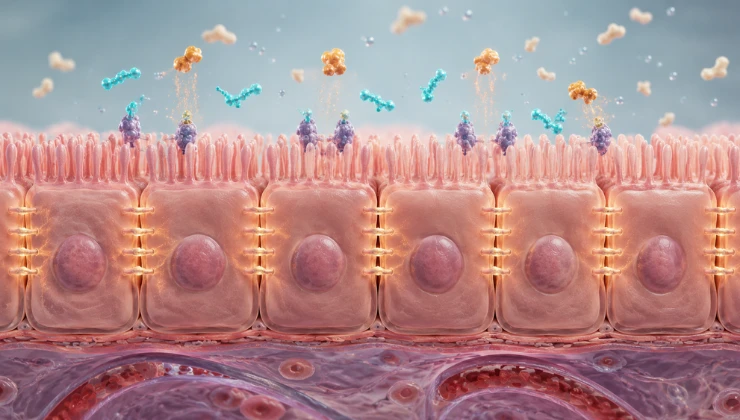
The direct answer: larazotide works by getting in the way of a signaling protein called zonulin before it can pull your tight junctions open.
Zonulin is released by the cells lining your gut in response to triggers like gluten, certain bacteria, and inflammatory stress. When zonulin binds to its receptor, it tells the tight junctions between intestinal cells to loosen. In small, controlled amounts, that is a normal part of gut function. In chronic illness, zonulin release can become excessive and near-constant, and the junctions stay too loose for too long. That is intestinal permeability: undigested food particles, bacterial fragments, and inflammatory compounds cross into the bloodstream more easily than they should.
It binds to the zonulin receptor first, so zonulin cannot. Animal studies have shown this translates into measurable repair. Researchers using a porcine model of intestinal injury found larazotide increased transepithelial electrical resistance (a direct measure of barrier tightness) and significantly reduced the movement of lipopolysaccharide, a bacterial toxin, across the gut wall. (Slifer et al., 2021) A separate 2025 study found larazotide preserved the tight junction proteins occludin and ZO-1 during oxidative injury to intestinal cells, one of the clearer mechanistic explanations for why the barrier holds together better with the peptide on board. (Biomedicines, 2025)
We have helped thousands of people in Colorado, Wyoming, New Jersey, Pennsylvania, Texas, Wisconsin restore their health and quality of life by diagnosing and treating their Lyme Disease.
Larazotide’s research history is almost entirely in celiac disease. But zonulin-driven intestinal permeability is not unique to celiac patients, and this is where the niche gets overlooked by most of what you’ll find written about this peptide.
In patients dealing with Lyme disease, mold illness (CIRS), and chronic infection, a chronically activated immune system keeps zonulin signaling elevated for reasons that have nothing to do with gluten. Persistent inflammation, dysbiosis, and biotoxin exposure all drive the same tight-junction breakdown. The result: expanding food sensitivities, bloating that does not track with any one food, and a gut barrier that keeps letting inflammatory triggers through faster than the immune system can settle down.
This is why we do not think of larazotide as “a celiac drug used off-label.” We think of it as a tight-junction repair tool that happens to have its best evidence in celiac patients, and that mechanism applies just as directly to a chronic Lyme or CIRS patient whose gut has been under sustained inflammatory pressure. If mold exposure is part of your picture, our page on CIRS and biotoxin illness covers how that inflammatory load compounds gut permeability.
Here is where honesty matters more than hype. Larazotide has real human trial data, and the results are genuinely mixed, not a clean success story.
The Phase 2 randomized controlled trial (2015): A multicenter, double-blind, placebo-controlled study enrolled 342 adults with celiac disease who had been gluten-free for at least 12 months but still had persistent symptoms. Patients received larazotide at 0.5 mg, 1 mg, or 2 mg three times daily, or placebo, for 12 weeks. The 0.5 mg dose met its endpoints: a 26% decrease in symptomatic days, a 50% or greater reduction in weekly average abdominal pain scores from baseline, and a measurable decrease in non-GI symptoms including headache and tiredness. The 1 mg and 2 mg doses performed no better than placebo. Safety at all doses was comparable to placebo. (Leffler et al., 2015)
The Phase 3 trial (discontinued, 2022): A larger follow-up trial, CedLara, was designed to confirm the 0.5 mg finding in a bigger population. In 2022, the drug’s developer discontinued the trial after an interim analysis showed the number of additional patients needed to reach statistical significance was larger than the company could support. This was a business and statistical decision, not a finding that larazotide caused harm. (Celiac.com, 2022)
What this means for you: Larazotide is not an FDA-approved drug for celiac disease, leaky gut, or any other condition. It remains investigational. The mechanism is well-documented in cellular and animal research, and the strongest human dose-response data (0.5 mg) is genuinely encouraging, but it has not cleared the bar for drug approval. Any responsible clinician recommending it should tell you this plainly, not gloss over it.
We have helped thousands of people in Colorado, Wyoming, New Jersey, Pennsylvania, Texas, Wisconsin restore their health and quality of life by diagnosing and treating their Lyme Disease.
The direct answer: reported side effects are generally mild, with nausea and headache the two most consistently reported.
In the 2015 trial, safety at the 0.5 mg dose was comparable to placebo, which is reassuring. In practice, we still see occasional nausea and headache in patients starting treatment, usually in the first days as the gut adjusts. These typically resolve without stopping treatment, but any new or worsening GI symptom, or a headache that does not resolve, should be reported to your prescribing clinician.
The bigger safety consideration is not the peptide itself. It is sourcing.
Sourcing safety note: Larazotide obtained from research-only, non-compounded suppliers is not manufactured to the same purity and sterility standards as compounded pharmacy peptides. Research-grade material can carry lipopolysaccharide (LPS) and other endotoxin contamination, which is directly counterproductive here. You would be introducing the exact inflammatory trigger that damages tight junctions and disrupts the blood-brain barrier, all while trying to repair your gut lining. We only prescribe larazotide through licensed compounding pharmacies, never from research-chemical vendors.
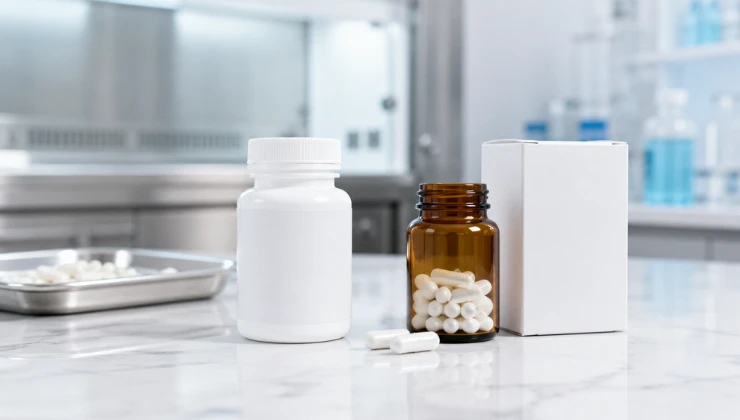
Larazotide is taken orally, which sets it apart from many peptides that cannot survive stomach acid and require injection. Its site of action is the gut lining itself, so oral delivery is actually the right route rather than a limitation. Trial dosing (0.5 mg, three times daily before meals) reflects how compounding pharmacies typically prepare it for off-label use, though your individual protocol should be set by your prescribing physician based on your case.
| Consideration | Larazotide |
|---|---|
| Route | Oral capsule |
| Trial dose with best results | 0.5 mg, three times daily |
| FDA status | Investigational, not approved |
| Most common side effects | Nausea, headache (typically mild) |
| Required sourcing | Compounding pharmacy, physician-prescribed only |
| Best-fit patient | Confirmed or suspected intestinal permeability, Phase 04 of treatment |
We place larazotide in Phase 04 of treatment, targeted microbe balancing and repair. It is introduced only after the body has been built back up (Phase 01), the nervous system has been supported (Phase 02), and any necessary detox has been paced deliberately (Phase 03).
Peptides get marketed as if you can start with them on day one. In our experience, that backfires. A patient whose adrenal function, blood sugar, and nervous system are still destabilized will not hold onto gut repair gains. The underlying drivers keep re-opening the tight junctions faster than any peptide can close them. Introducing tight-junction repair too early, before the inflammatory load driving zonulin release has been addressed, tends to produce a smaller and less durable response.
For patients doing broader peptide-supported gut repair, our overview of the peptide therapy cluster for Lyme disease walks through how it fits alongside other options in the 4-Phase Method.
BPC-157 works through a different mechanism, more on tissue and pain repair than tight-junction closure. See our BPC-157 page for how the two compare.
If mold exposure or biotoxin illness is part of what has kept your gut inflamed, treating that exposure alongside gut barrier repair matters. Our page on natural approaches to mold illness covers that piece of the picture.
No. Larazotide remains an investigational compound. A Phase 2 trial showed benefit at a low dose in celiac patients, but the follow-up Phase 3 trial was discontinued in 2022 for statistical reasons before it could confirm approval-level evidence. It is available only through compounding pharmacies, prescribed off-label by a licensed physician.
The mechanism is well-supported: larazotide blocks the zonulin receptor, and multiple animal studies show it measurably strengthens tight junctions and reduces the passage of bacterial toxins across the gut wall. In humans, the strongest evidence is symptom reduction in celiac patients at a 0.5 mg dose, not a formal “leaky gut” diagnosis endpoint, since intestinal permeability testing is not yet standardized in mainstream medicine. We use it as one part of a broader gut repair protocol, not a standalone fix.
The most commonly reported side effects are nausea and headache, usually mild and often resolving within the first days of use. The 2015 randomized trial found safety at the 0.5 mg dose comparable to placebo. Any persistent or worsening symptom should be discussed with your prescribing clinician.
You can find it sold by research-chemical vendors, but we do not recommend this route. Non-compounded, research-only sources are not held to pharmaceutical purity standards and can carry endotoxin contamination that works against the goal of gut repair. Larazotide should come from a licensed compounding pharmacy with physician oversight.
Both support gut healing, but through different mechanisms. Larazotide blocks the zonulin receptor to keep tight junctions closed, addressing barrier permeability directly. BPC-157 works more broadly on tissue repair and has data suggesting it can heal the intestinal lining itself when taken orally. Many patients use them as complementary tools rather than a choice between one or the other. See our BPC-157 page for that comparison.
Patients with confirmed or strongly suspected intestinal permeability, especially those with chronic infections, mold exposure, or autoimmune activity keeping their gut inflamed, tend to be the best fit. It is generally introduced once foundational health (Phase 01-03 in our framework) is stabilized, not as a first intervention for a newly diagnosed patient.
We have helped thousands of
people restore their health
and quality of life by diagnosing
and treating their Lyme Disease.
“Dr. Mueller’s approach to medicine is refreshing! There is only so much you can do with western medicine and in my life I was needing a new approach. By addressing the whole body, nutritional diet factors, environmental factors, blood work, and incorporating ideas I had not previously known, I was able to break through with my conditions. I am not only experiencing less pain in my life, but through the process of healing guided by Dr. Diane Mueller, I am now happy to say I have more consciousness surrounding how I eat, what to eat and when things are appropriate. Living by example Dr. Mueller has a vibrancy that makes you want to learn and know more about your body and overall health. I highly recommend her to anyone looking for new answers, a new approach to health, or in need of freedom from pain and limitations.”
-Storie S.
Kihei, HI