

Written and medically reviewed by Dr. Diane Mueller, ND, LAc, DAOM, founder of MyLymeDoc. Last reviewed September 16, 2026.
You were told your thyroid is normal, and you still feel like you are moving through wet sand. That mismatch shows up often enough in chronic Lyme disease that it is worth sorting through carefully. The connection between Lyme disease and thyroid dysfunction is documented but thin, limited mostly to a single case report, and that is worth saying plainly before anything else. What is well established is something more useful in practice. A standard TSH-only thyroid panel misses real dysfunction. Chronic infection and inflammation can plausibly affect autoimmune thyroid disease through general mechanisms that are not Lyme-specific. And Lyme symptoms overlap heavily with thyroid symptoms in ways that make the two genuinely hard to tell apart without a fuller workup. This page separates what the research actually shows from what gets repeated online without a source behind it.

One pediatric case report. That is the entire direct evidence base for a Lyme-thyroid connection, and it complicates the story more than it confirms it. That case described a child whose thyroid function shifted from hyperthyroid to hypothyroid while being treated for Lyme disease, and the authors noted plainly that “this phenomenon has never been described in a pediatric patient.”
Here is the detail that matters most. The child’s thyroid peroxidase, thyroglobulin, and thyroid-stimulating immunoglobulin antibodies all came back negative, which is atypical for the autoimmune mechanism usually proposed to explain a Lyme-thyroid connection. A single case with negative antibodies does not confirm molecular mimicry. It shows that even the one documented case does not fit the clean story that gets repeated online. Even a commercial thyroid-telehealth company, with a business incentive to make this connection sound strong, stops short of claiming it is established. It writes only that “research is still unclear on the extent to which Lyme disease affects the thyroid.”
Could a Lyme infection train the immune system to attack the thyroid by mistake? The proposed mechanism is molecular mimicry, real biology and a general one, not proof that Borrelia specifically triggers thyroid autoimmunity. Understanding that difference matters for reading any claim about infection-triggered thyroid disease.
Molecular mimicry describes a situation where a microbe carries a protein structure similar enough to one of the body’s own tissues. Once the immune system is trained to attack the microbe, it can mistakenly attack the tissue too.
The concept is defined in the literature as “a shared immunologic epitope with a microbe and the host.” This is a well-studied immunological concept, demonstrated in conditions ranging from multiple sclerosis to viral myocarditis to type 1 diabetes, that applies to many infections and many autoimmune conditions. It is not, on its own, evidence that Borrelia burgdorferi specifically triggers thyroid autoimmunity. The mechanism is plausible. The Lyme-specific application of it is inferred, not directly demonstrated.
Unlike the direct Lyme-thyroid connection, Hashimoto’s thyroiditis has a solid, independently established evidence base, and it is worth understanding on its own terms before connecting it to anything else. The American Thyroid Association states directly that “in the United States, Hashimoto’s thyroiditis is the most common cause of hypothyroidism.” It is driven by an autoimmune process in which “you develop antibodies that damage your thyroid gland,” specifically thyroid peroxidase and thyroglobulin antibodies.
That mechanism is not in dispute. What remains genuinely open is what triggers it in any given person, infection, other autoimmune conditions, genetic predisposition, or some combination. Lyme disease is one plausible trigger among several, not a uniquely identified cause. A Lyme-literate clinician should be comfortable saying that plainly rather than presenting Lyme as the default explanation.
Why does a “normal” TSH sometimes still leave someone feeling unwell? Standard thyroid screening relies on TSH alone, and formal endocrinology guidelines themselves acknowledge a real gray zone that a single number cannot resolve. It is the part of the thyroid story that gets buried in most competing content on either side of the debate.
The 2012 AACE and ATA clinical practice guidelines for hypothyroidism call for individualizing treatment for patients with TSH levels ranging from 4.5 mIU/L to 10 mIU/L. That is a formal acknowledgment: a TSH in that range does not give a clean answer on its own. The standard lab reference range runs roughly 0.4 to 4.0 or 4.5 mIU/L. A result inside that range is genuinely normal by conventional standards. It can still leave real questions unanswered, which is why a fuller panel, free T3, free T4, and thyroid antibodies, sometimes tells a different story than TSH alone. Our guide to reading functional lab ranges covers how we interpret that fuller panel in practice.
Some clinicians push for a narrower “optimal” TSH target than the standard lab range, and endocrinology has not settled the argument. It is a genuine, unresolved dispute, not a settled fact in either direction, and both sides deserve to be represented honestly.
At a professional debate on the topic, one endocrinologist put it bluntly: “a consensus may not be reached; the groups are polarized on this subject.” Another endocrinologist on the opposing side of that same debate argued against treating older, asymptomatic patients in the disputed range. He put it directly: “there is no evidence that treatment is going to help them. In fact, it may even hurt those people in their 80s.” That caution was specifically about elderly, asymptomatic patients, not the chronically ill, symptomatic readers this page is written for, and the distinction matters. Neither position has won. Presenting the narrower range as simply correct, which some functional-medicine content does, overstates how settled this question actually is.
Ask someone with untreated hypothyroidism to describe their symptoms, and you will hear fatigue, brain fog, and joint pain, the same trio that shows up in chronic Lyme disease. That overlap is exactly why a careful workup matters more than guessing from symptoms alone.
Post-treatment Lyme disease syndrome (PTLDS) is the clinical term for fatigue, widespread pain, or cognitive difficulty that persists for six months or longer after standard Lyme treatment, in someone with a documented infection.
A prospective cohort study formally defines it by “fatigue, widespread musculoskeletal pain or complaints of cognitive difficulties within 6 months of a proven B. burgdorferi infection… persisting for at least 6 months.” That is nearly the same symptom cluster hypothyroidism produces.
No published study has directly compared how often Lyme-related symptoms get mistaken for thyroid disease or the reverse. What is documented is that both conditions share a fatigue-brain fog-joint pain presentation closely enough that clinical judgment, not a single lab value, is what separates them.
There is a second thread worth pulling on here: mold exposure. A real peer-reviewed connection exists between chronic mold exposure and thyroid hormone abnormalities, though it comes from a small study and should be sized accordingly. Since this practice treats both Lyme disease and mold-related illness, the finding is worth including honestly rather than skipping.
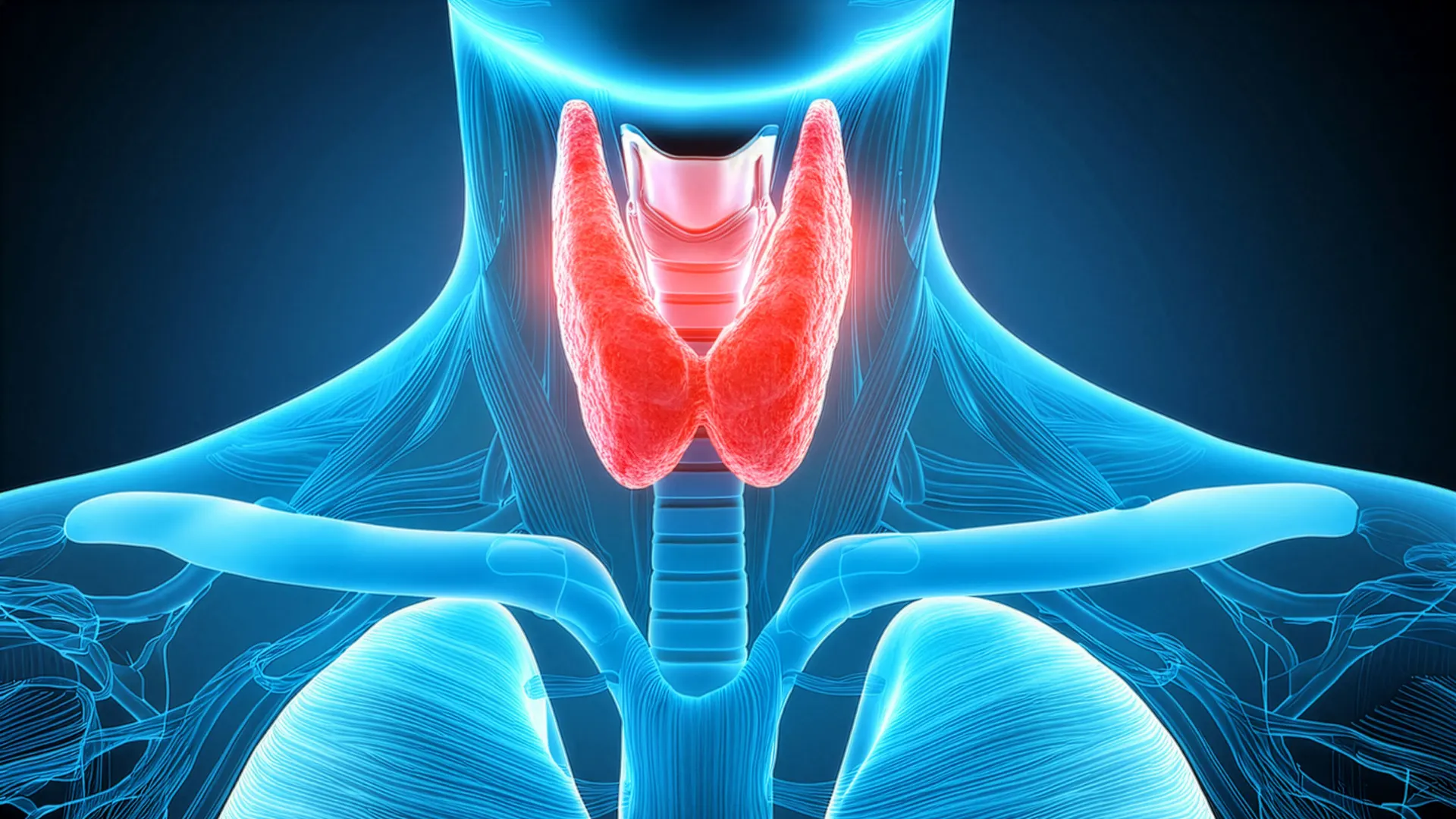
Non-thyroidal illness syndrome (NTIS) describes abnormal thyroid hormone levels that appear during a separate serious illness, without the thyroid gland itself being diseased. The abnormal pattern reflects the body’s overall illness burden rather than a primary thyroid problem.
A 2017 study in Frontiers in Immunology found that “long-term exposure to dampness microbiota induces multi-organ morbidity,” including a pattern of NTIS. That pattern was documented in a case series of nine patients with abnormal free T3 to reverse T3 ratios. Nine patients is a real finding worth taking seriously and not enough to generalize broadly. If you have a history of water-damaged building exposure alongside thyroid-type symptoms, it is a thread worth raising with your clinician, sized as what it is: a documented but narrow finding, not an established syndrome. We see this combination often enough in patients with both a tick-borne and a mold-exposure history that we screen for it routinely rather than waiting for a patient to raise it first.
A thorough evaluation runs beyond TSH alone and looks at your whole clinical picture, not just one number against one reference range. In our practice, that typically means free T3, free T4, reverse T3, and thyroid antibodies alongside a review of your infection and exposure history, not a search for a single answer that explains everything. Brain fog that overlaps with thyroid-type fatigue is one of the patterns we see most often in patients carrying both a Lyme and a mold history.
Has your fatigue, brain fog, or joint pain persisted despite a “normal” thyroid panel? If your history also includes a tick bite, an unresolved illness, or exposure to a water-damaged building, that combination is worth a structured conversation rather than another isolated test. Book a consultation if you want help sorting through which pieces of your history matter here.
The direct evidence is limited to a single pediatric case report, and even that case had negative thyroid antibodies. A plausible general mechanism exists, molecular mimicry from chronic infection, but it has not been specifically demonstrated for Borrelia and the thyroid in a larger study.
Hashimoto’s is a well-established autoimmune condition with several possible triggers. Infection is one plausible trigger among others, including genetic predisposition and other autoimmune conditions. Lyme disease has not been uniquely identified as a cause.
TSH alone can miss real dysfunction. Formal endocrinology guidelines acknowledge a genuine gray zone between 4.5 and 10 mIU/L, and a fuller panel including free T3, free T4, and thyroid antibodies sometimes reveals what TSH alone does not.
There is significant symptom overlap, and no study has directly compared the two conditions to identify reliable distinguishing features. A structured evaluation of your full history and a complete lab panel is more useful than trying to tell them apart by symptoms alone.
A small peer-reviewed study documented thyroid hormone abnormalities in patients with chronic exposure to water-damaged buildings. It is a real but narrow finding from nine patients, not an established, widely studied connection.
Free T3, free T4, reverse T3, and thyroid antibodies (TPO and thyroglobulin) give a fuller picture than TSH alone. Ask your clinician whether a complete panel makes sense given your symptoms and history.
We have helped thousands of people in Colorado, Oregon, Wyoming, New Jersey, Pennsylvania, Texas, and Wisconsin restore their health and quality of life by diagnosing and treating their Lyme Disease.
We have helped thousands of
people restore their health
and quality of life by diagnosing
and treating their Lyme Disease.
“Dr. Mueller’s approach to medicine is refreshing! There is only so much you can do with western medicine and in my life I was needing a new approach. By addressing the whole body, nutritional diet factors, environmental factors, blood work, and incorporating ideas I had not previously known, I was able to break through with my conditions. I am not only experiencing less pain in my life, but through the process of healing guided by Dr. Diane Mueller, I am now happy to say I have more consciousness surrounding how I eat, what to eat and when things are appropriate. Living by example Dr. Mueller has a vibrancy that makes you want to learn and know more about your body and overall health. I highly recommend her to anyone looking for new answers, a new approach to health, or in need of freedom from pain and limitations.”
-Storie S.
Kihei, HI