


A Lyme disease doctor in Texas should start with one question: which tick bit you? In Texas, the tick behind your illness may not be a deer tick, and that changes what your tests can and cannot show. Texas A&M AgriLife entomologist Pete Teel names two common Texas ticks, the lone star tick and the Gulf Coast tick. He adds that “perhaps the most iconic human biting tick for Texas is the Lone Star tick.” CDC states that “lone star ticks have not been shown to transmit B. burgdorferi,” the Lyme bacterium. My Lyme Doc sees Texas patients by video visit for Lyme disease, lone star tick illness, alpha-gal syndrome and related mold illness.
Lyme disease is an infection caused by Borrelia burgdorferi bacteria. In Texas, the black-legged tick is thought to be its principal carrier.
You may have been told that Lyme is not a Texas problem. Maybe a Lyme test came back negative, and the fatigue, joint pain and brain fog stayed anyway.
Lyme “is not commonly acquired in Texas,” Texas DSHS does say. That is where many workups stop, and it is the wrong place to stop. Texas has plenty of ticks, and Texas DSHS lists six tick-borne diseases, only one of them Lyme. One of the two common ticks in Texas is the lone star tick.
What you need is a doctor who asks which tick, which illness and which test.
Lone star tick (Amblyomma americanum) is a hard tick common in the southeastern quarter of the United States. Its adult female carries a single pale spot on her back.
The lone star tick is easy to spot once you know the mark. CDC says “the adult female has a white dot or ‘lone star’ on her back.” The Texas A&M Tick App adds that the spot “may vary in color from white to cream, or gold to bronze.” Unfed females average 4 to 6 mm.
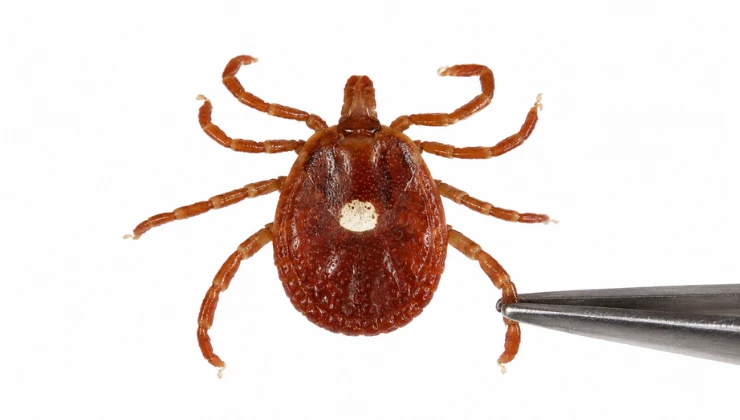
Lone star ticks “aggressively bite people throughout their life stages as larvae, nymphs, and adults,” CDC reports. Teel notes that ticks “can detect heat, carbon dioxide, shadows and vibrations.”
The Tick App says lone star adults become active in January and February and peak from March through May. Nymphs follow from April to June and again in July and August. Teel describes the species as “most active in late spring and throughout the summer.”
Texas A&M AgriLife counts “11 common species of ticks found in Texas.” Five are the ones “most likely to be encountered,” and only one is a known Lyme carrier. A wider guide to each species is on types of ticks.
Rocky Mountain spotted fever is a bacterial infection spread by tick bites. Texas DSHS warns it “can be deadly if not treated early with the right antibiotic.”
Tularemia is a bacterial infection that ticks can spread. Texas DSHS notes it also spreads through “handling infected animals, particularly wild rabbits and rodents.”
| Tick | Illnesses linked to it (per the cited sources) | How to recognize it |
|---|---|---|
| Lone star tick (Amblyomma americanum) | Ehrlichiosis, STARI, alpha-gal syndrome | Adult female has a single white to bronze spot on her back |
| Gulf Coast tick (Amblyomma maculatum) | Rickettsia parkeri, a type of spotted fever | Reddish-brown markings over pale cream; longer, narrower mouthparts than the American dog tick |
| American dog tick (Dermacentor variabilis) | Rocky Mountain spotted fever, tularemia | Female has a dark brown body with a cream-colored shield |
| Brown dog tick (Rhipicephalus sanguineus) | Rocky Mountain spotted fever in the southwestern US and Mexico; Ehrlichia chaffeensis, a cause of human ehrlichiosis | Plain brown, no markings; lives in and around homes and kennels |
| Black-legged tick (Ixodes scapularis) | Lyme disease | No distinguishing markings; males are mostly black |
| Soft ticks (Ornithodoros) | Tick-borne relapsing fever | Soft-bodied; DSHS links the illness to caves and rustic cabins |
Pairings come from the Texas A&M Tick App, Texas DSHS and CDC.
Gulf Coast tick (Amblyomma maculatum) is a hard tick of grassland prairies and wooded edges near the Gulf.
Teel names the Gulf Coast tick as the other common Texas tick. He says it is “active year-round, especially in South Texas.” Coastal and South Texas adults peak in August and September, per the Tick App.
Rickettsia parkeri rickettsiosis is a type of spotted fever. The Texas A&M Tick App names the Gulf Coast tick as the tick that spreads it to people.
American dog tick (Dermacentor variabilis) is a hard tick whose females have a cream-colored shield. Per the Tick App, it ranges west to the Texas Panhandle and Trans-Pecos.
The Tick App calls the American dog tick the “primary vector of Rocky Mountain Spotted Fever” in the eastern, central and southern US.
Brown dog tick (Rhipicephalus sanguineus) is a plain brown hard tick that lives mainly around homes, pens and kennels, according to the Tick App.
The brown dog tick is the one most likely to be found indoors. The Tick App describes it “crawling up the walls” of infested homes, and says all stages “occasionally” bite humans.
Alpha-gal syndrome is the lone star tick illness many Texans have not heard of. CDC states that “in the United States, the lone star tick is most often associated with AGS.”
Alpha-gal syndrome is an allergy to alpha-gal, a sugar molecule found in most mammals but not in people. After a tick bite, some people react to red meat and other mammal products.

Between 2010 and 2022, “more than 110,000 suspected cases of AGS were identified,” according to CDC. Because AGS cases “are not nationally notifiable,” no reliable Texas count exists.
Hunters get a direct warning from CDC: “you’re at heightened risk.” Teel says you meet ticks when “hiking, camping, trail riding or even ranching.”
Diagnosis is not a Lyme test. It rests on “a detailed patient history,” per CDC, and a blood test for antibodies to alpha-gal. More on the allergy itself is on alpha-gal syndrome.
A negative Lyme test can miss what a lone star tick gave you. A positive one can point to Lyme when the real cause is a different Texas infection.
The negative side comes from the tick. CDC says lone star ticks have not been shown to transmit B. burgdorferi, and “their saliva has been shown to kill Borrelia.” A Lyme test looks for Lyme, not for ehrlichiosis or alpha-gal, and STARI has no blood test at all.
STARI (southern tick-associated rash illness) is a rash illness linked to lone star tick bites. The expanding red rash looks like the Lyme rash, and CDC says it “usually appears within 7 days of tick bite.”
No one knows what causes STARI, Texas DSHS confirms. With “no diagnostic blood tests for STARI,” in CDC’s words, your history carries the diagnosis.
Ehrlichiosis is a bacterial infection that usually starts with fever, chills, headache and malaise. Texas DSHS says symptoms usually begin “around 12 days after the tick bite.”
Evidence points to the lone star tick as its carrier, according to DSHS. Texas reports fewer than 10 cases a year, and DSHS adds that “some cases are also misdiagnosed.”
The positive side is a Texas-specific trap.
Tick-borne relapsing fever (TBRF) is an infection caused by Borrelia bacteria spread by soft ticks. CDC describes fever episodes “separated by roughly a week of feeling well.”
Per Texas DSHS, “patients with TBRF will typically test positive for Lyme disease.” Clinicians are asked to consider TBRF when a Lyme test is positive and there is “no history of travel to high incidence areas.”
TBRF is tied to “cave exploration or sleeping in rustic cabins,” per DSHS. In 2017, Austin Public Health found five cases of febrile illness among employees who worked in caves. The CDC report adds that several of those caves “were opened for tours.”
Yes, though it is uncommon, and how uncommon is still argued. Texas is “a low incidence state for Lyme disease,” per DSHS, which reports an average of 85 cases a year from 2000 to 2020, ranging from 11 to 276.
Most of those cases, DSHS adds, were “acquired in a high incidence state or country,” mostly in the Northeast.
Texas A&M AgriLife experts read the same numbers more cautiously. In 2016, entomologist Mike Merchant said reported cases “likely underestimate” Texas Lyme, because Lyme “is less frequently tested in Texas.” He placed most Texas cases “within the triangular region between Houston, Dallas and Austin.”
His colleague Wizzie Brown said the drop in reports was “most likely” due in large part to “people not being tested for it or possibly being misdiagnosed.” Merchant reported that the black-legged tick had been found in “71 of the 254 Texas counties.”
So Lyme is rare in Texas, and a Texas case can still be local and still be missed.
Texas tick illnesses overlap in how they feel, which is why they get missed.
Erythema migrans is the expanding red rash at a tick bite in early Lyme disease. STARI causes a similar rash, so the rash alone cannot settle which illness is present.
Texas DSHS advises calling your healthcare provider if rash, fever, headache, aches or swollen lymph nodes appear “within 30 days of a tick bite.” Because DSHS warns that RMSF can be deadly without early treatment, a high fever, confusion or a spotted rash after a bite needs same-day care.
Acute ehrlichiosis and spotted fever need prompt antibiotic care from a local clinician. My Lyme Doc usually comes in later, when symptoms persist or the cause was missed. Dr. Mueller then uses a 4-Phase Method, in a deliberate order.
Dr. Mueller sees clinics going after the microbe first as a common reason patients crash during treatment. More detail is on Lyme disease treatment.
Yes. My Lyme Doc sees Texas patients only by video visit, and has no Texas office.
What that means in practice. In Texas, the tick species and travel history carry so much weight that a long conversation does most of the diagnostic work. Labs are drawn near you, and prescriptions go to your pharmacy.
What a video visit cannot do. It cannot include a hands-on exam, so that gets coordinated with local care when needed.
Texas is one of eleven states where My Lyme Doc sees patients. The full list is on where we practice.
Patients arrive having seen twenty or more specialists on average. Rose M. from Austin wrote, “I had gone to 20 top specialists over 3 years and was not able to get a correct diagnosis.”
The initial visit is $300 and runs long on purpose, so years of results get read together. Ongoing care is a membership from $400 to $1,100 per month, depending on the support your case needs. Labs, supplements and treatments are billed separately.