

By Dr. Diane Mueller, ND, LAc, DAOM
Thymosin alpha 1 is a naturally occurring immune-signaling peptide used off-label to support T-cell function and antiviral defense in patients with chronic infections. It shows up often in the Epstein-Barr virus (EBV) and cytomegalovirus (CMV) reactivation seen in long-standing Lyme disease and mold illness. It is not a cure and it is not without risk: because it stimulates the immune system, it can trigger a Herxheimer reaction and needs real caution in patients with autoimmune disease. Here is what the evidence actually supports, and where it does not.
If you have been dismissed with “your labs are normal” while your body keeps losing to the same infections, you already know something is off with your immune system’s ability to finish the fight. That is exactly the mechanism thymosin alpha 1 was designed to influence.
Thymosin alpha 1 is a 28-amino-acid peptide, originally isolated from the thymus gland, that signals immune cells (T cells, dendritic cells, and natural killer cells) to mature and respond more effectively to infection.
Thymosin alpha 1 is a signaling molecule, not a growth hormone and not an antibiotic. It does not attack a pathogen directly. It works by improving the immune system’s own coordination, the same re-signaling logic behind most peptide therapy. Outside the United States, a synthetic version is sold under the brand name Zadaxin and used for hepatitis B, hepatitis C, and as an immune-support adjunct in some cancer protocols (Tao et al., 2023). In the US, it is available through compounding pharmacies as a prescribed, physician-supervised therapy, one piece of a broader approach covered in peptide therapy for Lyme disease.
Mechanistically, thymosin alpha 1 binds Toll-like receptors on dendritic cells (TLR2, TLR3, TLR5, and TLR9). This triggers those cells to mature, present antigens more effectively, and direct T cells toward a stronger, more coordinated antiviral response (Tao et al., 2023). It also modulates natural killer cell activity and helps balance the cytokine signals that determine whether the immune system mounts an appropriate response or an excessive one (Romani et al., 2006).
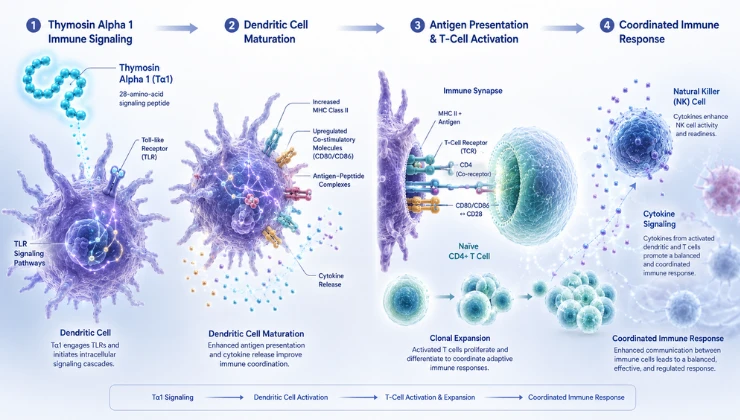
The clinical literature on thymosin alpha 1 is strongest in three areas: chronic viral hepatitis, sepsis, and cancer-adjuvant immune support. A 2023 mechanistic review in Molecules summarizes decades of research showing thymosin alpha 1 enhances antiviral immunity through dendritic cell maturation and CD8+ T-cell differentiation. The clearest clinical benefit is documented in hepatitis B and hepatitis C (Tao et al., 2023).
In sepsis, a 2025 systematic review and meta-analysis of 11 randomized controlled trials (1,927 patients) found thymosin alpha 1 reduced 28-day mortality (OR 0.73, 95% CI 0.59-0.90) (Gu et al., 2025). Worth saying plainly: when the researchers isolated only the highest-quality trials, that mortality benefit lost statistical significance (OR 0.82, 95% CI 0.65-1.03) (Gu et al., 2025). The signal is real and worth taking seriously, but it is not settled science, and it should be presented to patients that way rather than oversold.
Researchers have also explored thymosin alpha 1 in other areas: autoimmune modulation, as an adjunct alongside some cancer immunotherapy protocols, and in antiviral support during acute respiratory viral infections. Evidence in these areas is preliminary and sits outside the direct scope of chronic-infection care, but it reflects the same underlying mechanism, helping T cells communicate and respond more effectively.
There is no published clinical trial of thymosin alpha 1 in Lyme disease or tick-borne illness specifically. What exists is a mechanistic rationale: chronic Lyme and mold-illness patients frequently show evidence of immune dysregulation alongside reactivated Epstein-Barr virus or cytomegalovirus. These viruses stay dormant in a well-functioning immune system but resurface when T-cell coordination breaks down (King & Tuthill, 2016). Supporting that coordination is the theory behind using thymosin alpha 1 in this population. This is an extrapolation from mechanism and hepatitis/sepsis data, not a claim that Lyme-specific trials exist, and patients deserve to hear that distinction clearly before they start.
We have helped thousands of people in Colorado, Wyoming, New Jersey, Pennsylvania, Texas, Wisconsin restore their health and quality of life by diagnosing and treating their Lyme Disease.
Thymosin alpha 1’s role in chronic infection is to restore the T-cell surveillance that normally keeps Epstein-Barr virus (EBV) and cytomegalovirus (CMV) dormant, not to kill the virus directly. That distinction matters for patients who have been through the chronic-illness gauntlet: the normal labs, the “it’s probably just stress,” the year of being told nothing is wrong. Many have never been tested for EBV or CMV reactivation at all.
EBV/CMV reactivation occurs when Epstein-Barr virus or cytomegalovirus, both of which stay dormant in most healthy adults for life, becomes active again because T-cell surveillance has weakened.
Reactivation labs (EBV early antigen IgG, CMV IgG) sometimes surface a piece of the puzzle that explains the crushing fatigue and low-grade immune chaos that Lyme treatment alone did not resolve. That picture often includes the brain fog that travels with it. See lyme disease and brain fog for how that connection plays out.
When that surveillance is intact, these viruses stay dormant, as they do in most healthy adults who carry them silently for life. When chronic infection, prolonged stress, or mold exposure has worn immune coordination down, reactivation becomes more likely. A signaling peptide that helps re-establish that coordination is a reasonable, if unproven, tool in a broader recovery plan.
This is why thymosin alpha 1 fits into Phase 04 of a structured chronic-infection protocol, targeted microbe balancing and repair, and never into Phase 01. Most clinics reach for an immune-stimulating peptide first. That is often why patients crash. The body has to be built first: nutrient status corrected, adrenal and thyroid function supported, blood sugar and mitochondrial function stabilized, before an immune-activating tool like this one gets introduced.
A Herxheimer reaction is a temporary worsening of symptoms, fatigue, flu-like feelings, brain fog, that happens when treatment causes dying or dormant pathogens to release inflammatory signals faster than the body can clear them.
Thymosin alpha 1 is not a gentle peptide. Immune-stimulating tools like this one, and like LL-37, are the ones most likely to trigger a Herxheimer reaction in patients carrying a chronic microbial load. As the immune system gets better at recognizing and responding to dormant EBV, CMV, or Borrelia, that increased activity can produce a temporary flare before it produces relief.
None of the major consumer or clinic resources on thymosin alpha 1 currently mention this risk in a chronic-infection context. That gap matters. A patient who starts this peptide without being told to expect a possible flare will assume something has gone wrong. In some cases it actually means the immune system is finally doing the job it had stopped doing. The goal is not to avoid this response entirely. The aim is to introduce the peptide at a pace, and only once the body is prepared, that keeps any flare manageable rather than debilitating.
We have helped thousands of people in Colorado, Wyoming, New Jersey, Pennsylvania, Texas, Wisconsin restore their health and quality of life by diagnosing and treating their Lyme Disease.
If your immune system is already over-firing, whether that is Hashimoto’s, rheumatoid arthritis, lupus, or another autoimmune process, adding a peptide whose entire job is to amplify immune signaling is not automatically a good idea. Thymosin alpha 1 works through the same T-cell and cytokine pathways that drive autoimmune flares (Romani et al., 2006). The peptide itself is not inherently dangerous, but pushing more signal into a system that is already producing too much signal can move things in the wrong direction.
This does not rule out thymosin alpha 1 for every autoimmune patient. Some patients with well-controlled autoimmune disease and a clear underlying infection may still be reasonable candidates under close physician supervision. It does mean this decision cannot be made from a research-chemical website with no medical oversight, which is exactly why evaluating peptide safety and sourcing matters before starting. Anyone with an autoimmune diagnosis considering this peptide needs bloodwork, a full history, and a provider watching for a flare, not a self-directed protocol.
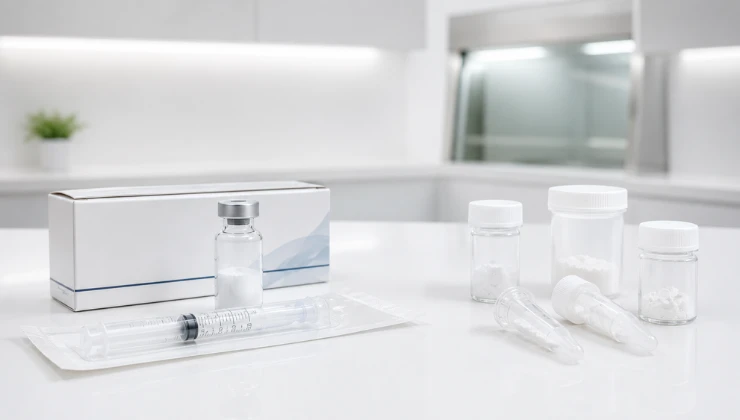
Where thymosin alpha 1 comes from changes its safety profile as much as the decision to use it at all. Compounding-pharmacy sourcing is prescribed, tested, and physician-supervised. Research-only vendor sourcing is none of those things, and the difference is one of the most overlooked safety issues in peptide therapy. Peptides sold through research-only, direct-to-consumer chemical websites are manufactured for laboratory use, not human injection. They are not held to the sterility, purity, or endotoxin-testing standards required of compounded pharmaceutical products.
LPS (lipopolysaccharide) contamination is a bacterial endotoxin byproduct that can survive in poorly manufactured research peptides and is capable of disrupting the blood-brain barrier.
This is the specific risk behind research-grade sourcing. LPS contamination drives the exact leaky-gut, systemic-inflammation picture that chronic-infection patients are already fighting to resolve. Injecting a contaminated research peptide into a body already struggling with immune dysregulation can make the underlying problem worse, not better. For a full breakdown of what to check before starting any peptide, see are peptides safe.
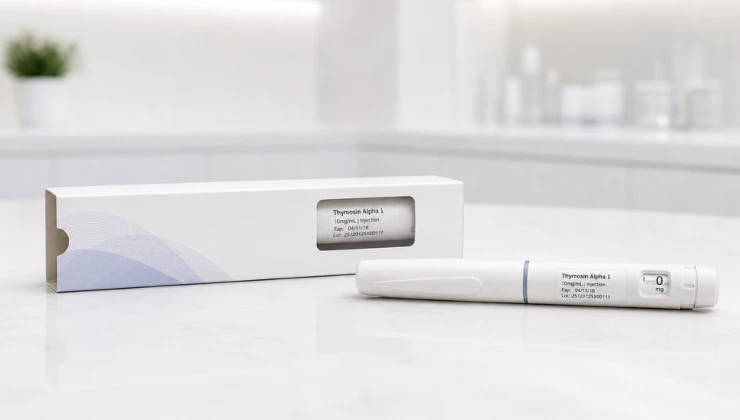
Thymosin alpha 1 prescribed through a licensed compounding pharmacy is dispensed under physician oversight and tested for sterility and endotoxin levels. That is a fundamentally different product than the same peptide name sold online with no chain of custody. This is not a minor technicality. That distinction is the difference between a therapeutic tool and an unregulated risk.
| Compounding pharmacy (prescribed) | Research-only chemical vendor | |
|---|---|---|
| Requires a prescription | Yes | No |
| Sterility/endotoxin testing | Required, documented | Not required, rarely disclosed |
| Physician oversight | Built into the process | None |
| LPS contamination risk | Low, tested for | Unknown, unregulated |
| Legal status for human use | Prescribed medical use | Labeled “research use only” |
| Dosing guidance | Individualized by provider | Self-directed, no monitoring |
We have helped thousands of people in Colorado, Wyoming, New Jersey, Pennsylvania, Texas, Wisconsin restore their health and quality of life by diagnosing and treating their Lyme Disease.
Peptides are protein signaling molecules, tools that re-signal a body that already knows how to heal but has lost the coordination to do it. Thymosin alpha 1 is not a first move and it is not a standalone fix. In practice, it belongs in Phase 04 of a structured chronic-infection recovery plan, after the body’s baseline (nutrients, adrenal and thyroid function, blood sugar, mitochondrial support) has already been addressed. Nervous system regulation and a deliberate, gentle detox phase come next, reducing the overall inflammatory load before an immune-stimulating tool is introduced. Introducing an immune-stimulating peptide before that groundwork is done is a common reason patients report crashing on peptide therapy elsewhere. See how peptide therapy is sequenced inside a full chronic-infection treatment plan.
Thymosin alpha 1 is a legitimate immune-signaling tool with real evidence behind it in hepatitis and sepsis, and a reasonable, mechanism-based rationale for chronic-infection patients dealing with EBV or CMV reactivation. It is also a peptide that deserves respect: it can trigger a Herxheimer reaction, it needs real caution in autoimmune disease, and its safety depends heavily on where it comes from.
If you have been fighting a chronic infection that conventional medicine keeps calling normal, book an initial visit to find out whether your immune system needs this kind of support. That conversation is where you find out whether thymosin alpha 1 fits, and if so, where it fits in a full recovery plan.
Thymosin alpha 1 is not a peptide to start on your own, and it should never be the first move in a chronic-infection recovery plan. Used at the right time, with the right sourcing, and under real physician oversight, it can be one part of getting an immune system back to doing the job it already knows how to do.
No. Thymosin alpha 1 is an immune-signaling peptide with no effect on growth hormone. It is unrelated to growth-hormone-signaling peptides like CJC-1295 and ipamorelin, which signal the pituitary to release the body’s own growth hormone.
It is typically given as a subcutaneous injection, prescribed and dosed individually by a physician based on lab findings, symptom picture, and treatment goals. There is no universal over-the-counter protocol, and dosing should never be self-directed.
Yes, this is a real possibility with an immune-stimulating peptide, especially in patients carrying a chronic microbial or viral load. It is one reason this peptide is introduced carefully and later in a treatment plan, not as a first step.
It requires caution and physician oversight. Because it amplifies immune signaling, it is not automatically appropriate for every autoimmune patient, and the decision should involve bloodwork and a full clinical history, not self-directed use.
From a licensed compounding pharmacy, prescribed and monitored by a physician, never from a research-only online vendor. Research-grade products are not tested for the sterility and endotoxin standards required for human injection.
We have helped thousands of
people restore their health
and quality of life by diagnosing
and treating their Lyme Disease.
“Dr. Mueller’s approach to medicine is refreshing! There is only so much you can do with western medicine and in my life I was needing a new approach. By addressing the whole body, nutritional diet factors, environmental factors, blood work, and incorporating ideas I had not previously known, I was able to break through with my conditions. I am not only experiencing less pain in my life, but through the process of healing guided by Dr. Diane Mueller, I am now happy to say I have more consciousness surrounding how I eat, what to eat and when things are appropriate. Living by example Dr. Mueller has a vibrancy that makes you want to learn and know more about your body and overall health. I highly recommend her to anyone looking for new answers, a new approach to health, or in need of freedom from pain and limitations.”
-Storie S.
Kihei, HI