

Written and medically reviewed by Dr. Diane Mueller, ND, LAc, DAOM, founder of MyLymeDoc. Last reviewed September 7, 2026.
Hyperbaric oxygen therapy for Lyme disease rests on one unpublished clinic series, a single published case report, and a patient survey in which 22% of people who tried it called it effective. It is not FDA approved for Lyme disease, and it carries physical risks that range from a burst eardrum to a chamber fire. Almost every clinic page selling hyperbaric oxygen therapy for Lyme disease quotes an 84% success rate. The number is real in the sense that it comes from a document you can read. This page shows you exactly which document, because the provenance changes what the number is worth.
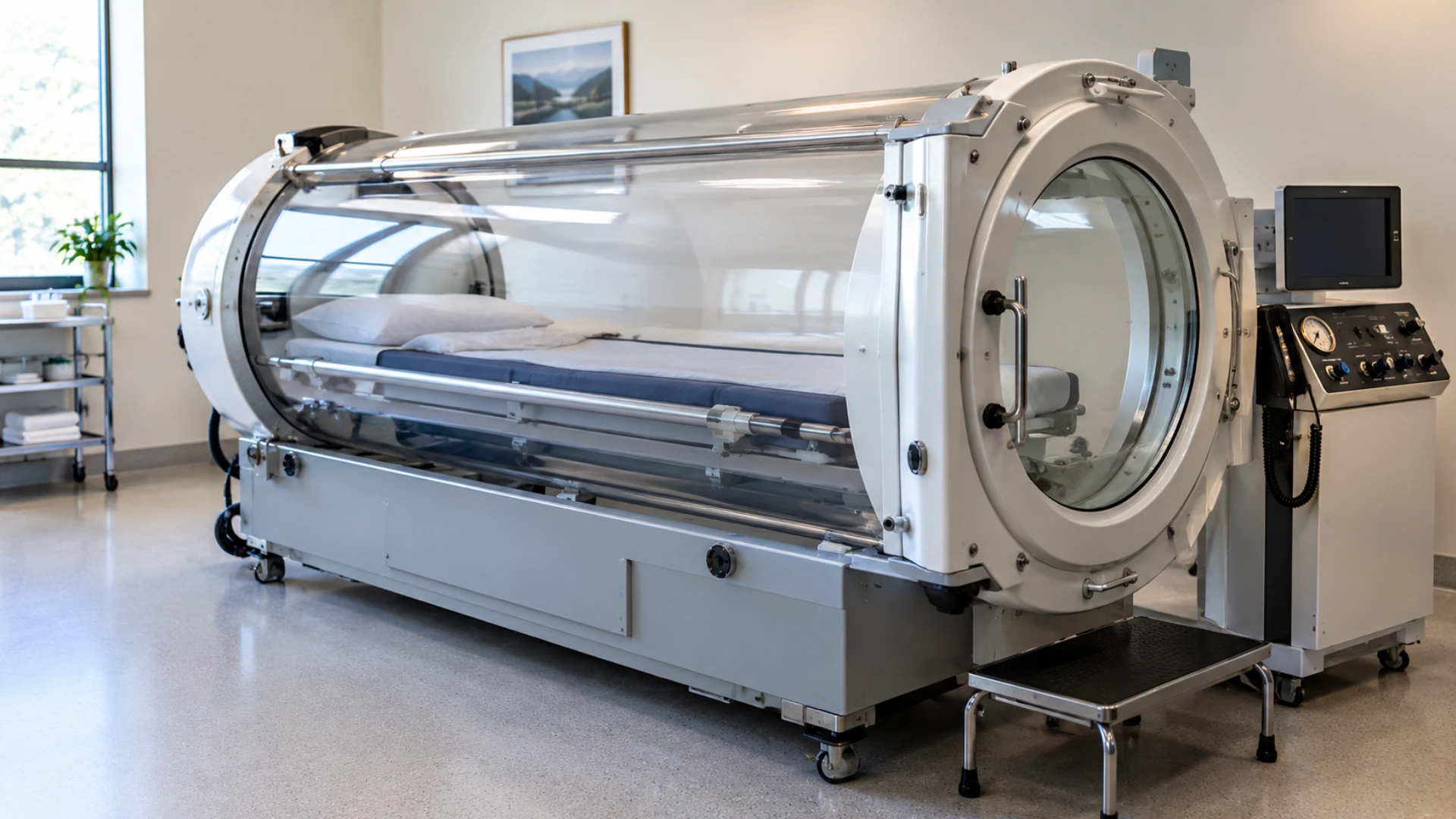
Hyperbaric oxygen therapy (HBOT) means breathing oxygen at a concentration and pressure higher than normal air inside a sealed chamber. Pressure is measured in atmospheres absolute, or ATA. Normal air at sea level is 1 ATA and about 21% oxygen.
Two very different products share the name, and both get marketed alongside the sequence described on Lyme disease treatment. Medical HBOT uses 100% oxygen at roughly 2 to 2.4 ATA in a chamber built for it, usually in a hospital or accredited center. Mild hyperbaric therapy uses soft chambers at around 1.3 ATA, often with only modestly enriched air, and is what most wellness clinics and home units deliver. They are not interchangeable, and evidence for one does not transfer to the other. When a page quotes a study, the first question is which of the two it used.
The 84% figure, precisely 84.8%, comes from a 1998 conference abstract by W.P. Fife and D.M. Freeman at Texas A&M University, presented at the Undersea and Hyperbaric Medical Society annual meeting. It was a meeting abstract. No full peer-reviewed paper of this series has been located, and the copy clinics link to today is hosted on a hyperbaric clinic’s website.
What the abstract reports: 91 subjects, all with CDC-criteria Lyme disease and all of whom “had failed intravenous antibiotics,” were treated at 2.36 ATA breathing 100% oxygen for 60 minutes, usually twice a day, in series of 10 to 30 treatments, 1,995 treatments in total. The study was approved by the university’s institutional review board. Outcome was a symptom questionnaire scored by the patients themselves, zero for no symptoms and ten for severe. The abstract states that “approximately 84.8% of those treated showed significant improvement by a decrease or elimination of symptoms,” that 12 subjects (13.1%) “claimed no apparent benefit,” and that average scores fell from 114.12 to 49.27, a statistically significant change.
Two more things the abstract says that clinic pages leave out. “All except one of the 91 subjects developed severe Jarisch-Herxheimer reaction,” the temporary worsening that follows bacterial die-off, often lasting the whole series and up to a month afterward. And nine subjects were later excluded for other conditions found during treatment, including babesiosis, ehrlichiosis and hepatitis C, plus two for IV-catheter septicemia.
There is a second document, an undated PDF titled “Hyperbaric Oxygenation for Lyme Vasculitis” by Fife and R.A. Neubauer, also hosted by a clinic and also never peer reviewed. It describes the same Texas A&M series differently: 91 begun, 75 completed, 40 to 120 sessions, “all except 7” improved, which is 91%, and 67% of patients “remained on antibiotics during and after.” It adds 12 SPECT-imaged cases from Neubauer’s own center. The two documents do not agree with each other on completion or on the improvement rate.
What both share: no control group, no blinding, and a large share of patients on antibiotics at the same time, so the improvement cannot be separated from the antibiotics. None of that makes the observation worthless. It makes it an uncontrolled, unpublished clinic series, which is what it should be called when a clinic quotes it to you.
For Lyme disease specifically, the published human literature we could locate is one case report.
The first is Huang and colleagues, 2014, in the Journal of the Chinese Medical Association. A 31-year-old man with persistent symptoms after years of antibiotic treatment received 30 HBOT sessions at 2.5 ATA for 90 minutes and reported resolution of neurological and joint symptoms. The abstract itself says that “reported information regarding the effectiveness of HBOT for CLD is still limited.” One patient, no control.
The closest thing to a measured result is the 2025 mold case described below, which is not Lyme at all.
That is the list. One person. Anyone telling you HBOT is “proven” for Lyme disease is either quoting the unpublished series or quoting nothing.
Chronic inflammatory response syndrome (CIRS) is a persistent inflammatory illness triggered in susceptible people by biotoxin exposure, most often from a water-damaged building. Visual contrast sensitivity (VCS) is an inexpensive screening test of the eye’s ability to detect fine contrast, used in CIRS evaluation.
For people whose illness involves mold exposure, there is one recent report with actual numbers in it.
In 2025, Frontiers in Immunology published a case report of a 60-year-old woman with chronic inflammatory response syndrome triggered by mold. She received 40 sessions of mild-pressure HBOT, 1.3 ATA at 24% oxygen for 90 minutes, over 10 weeks. Several measured changes were substantial. Visual contrast sensitivity, or VCS, a standard CIRS screening test, improved from 68% to 93%. MMP-9 fell from 920 to 354 ng/mL. C4a fell from 1,948.7 to 611 ng/mL, and C3a from 611 to 174.5 ng/mL. The author reports resolution of all 22 symptoms the patient had listed. Not every marker moved the same way: TGF-beta1 rose, from 10,313 to 12,869 pg/mL, and the before and after labs were run by different laboratories, which limits the comparison.
The author’s own limitations are the right ones to repeat: a single subject “limits generalizability,” and “the absence of a control group precludes definitive causal conclusions.” There was no blinding and no long-term follow-up.
Still, it is one person with most objective inflammatory markers improving under a protocol that used mild pressure, the cheaper and more accessible form. That is a reason to want a real trial, and it is more than exists for Lyme disease. What those markers are and what CIRS looks like is on CIRS symptoms.
The largest dataset on HBOT in Lyme disease is not a study at all. It is the MyLymeData patient registry run by LymeDisease.org, summarized in 2019. Of 347 people who reported trying hyperbaric oxygen, 22% rated it effective, and the group also reported some moderate to severe side effects.
Patient registries have their own biases. People who are still sick are more likely to be enrolled, and there is no way to check what anyone actually received. But 22% is a long way from 84%, it comes from nearly four times as many people, and it comes from the patients rather than the clinics.
There is a plausible mechanism. Borrelia burgdorferi is microaerophilic, meaning it prefers low-oxygen conditions, and the rationale in both Fife documents was that raising tissue oxygen in chronic Lyme might suppress it. HBOT is used for its effects on tissue oxygenation in the conditions it is approved for.
A plausible mechanism is where a treatment’s story starts, not where it ends. The 1998 abstract cites laboratory work by Austin showing the spirochete survived when transferred in 4% oxygen but not in air, and reasons from that to a lethal oxygen level for the organism. Whether raising tissue oxygen in a chamber changes the course of a persistent infection in a person is exactly what the studies above did not establish. If your cognitive symptoms are the main problem, how those are evaluated is covered on mold brain fog, and the same reasoning applies to Lyme.
HBOT’s documented risks are barotrauma to the ears and lungs, oxygen toxicity, and fire. Per the Global Lyme Alliance’s summary, the side effects include middle ear injuries up to and including eardrum rupture, temporary nearsightedness, lung collapse, seizures from oxygen toxicity, and low blood sugar in people with insulin-treated diabetes. Early oxygen toxicity was noted in the Neubauer cases treated at 2.4 ATA, where pressure had to be reduced to 2.2 ATA, and the 1998 abstract reports a severe Herxheimer reaction in 90 of 91 subjects.
The larger risk is fire. In August 2025 the FDA wrote to health care providers stating that it was “aware of recent reports of fires that occurred with HBOT devices that resulted in serious injuries and deaths.” The letter attributes the “heightened risk of fire” to “use of oxygen at a high concentration,” which is why accredited facilities control what enters the chamber. The FDA says serious adverse events with these devices are rare and that their root cause is not yet known.
People with an untreated collapsed lung must not undergo HBOT. People with seizure disorders, certain lung conditions, or who are pregnant need specialist assessment first.
HBOT chambers are FDA-cleared Class II medical devices with approved indications. Lyme disease is not one of them. In the Global Lyme Alliance’s words, “HBOT has not been FDA-approved to treat Lyme disease, but some doctors use it off-label.”
Off-label use is legal and common in medicine. It also means insurance will not pay, the clinic is not bound by an approved protocol, and the evidence standard is whatever the clinic decides it is.
Medical HBOT is priced per session and a Lyme protocol is typically dozens of sessions. Prices vary widely by facility and pressure, so this page does not quote one. Before committing:
A Lyme-literate doctor should welcome every one of those.

MyLymeDoc does not operate a hyperbaric chamber, and nothing on this page is a referral to one.
Most people who look at HBOT have already been through antibiotics and are still unwell. In that group, which is described on post-treatment Lyme disease syndrome, the problem is rarely a single organism waiting for a single intervention. It is a depleted body: broken sleep, unstable blood sugar, an inflamed gut, a nervous system stuck on alert, often with mold exposure and co-infections nobody has looked for.
Dr. Mueller’s approach runs in sequence: build the foundations, settle the nervous system, support detoxification gently, and only then do targeted antimicrobial work. HBOT, where it fits at all, is an adjunctive option considered late in that sequence for chronic Lyme, not a foundation.
We do not publish an outcome rate for that approach, because we do not have one that would survive the scrutiny this page applies to the 84%.
No published evidence shows that it does. The human evidence is one unpublished clinic series, one single-patient case report, one mold-illness case report, and a patient survey with 22% reporting benefit.
From a 1998 conference abstract by Fife and Freeman at Texas A&M: 91 patients who had failed IV antibiotics scored their own symptoms before and after HBOT, and 84.8% reported significant improvement. No control group, never published as a full paper. A second unpublished write-up of the same series by Fife and Neubauer gives a different figure, 91%, and notes 67% stayed on antibiotics.
No. HBOT chambers are cleared for a specific list of conditions and Lyme disease is not on it. Use for Lyme is off-label.
No. Mild soft-chamber therapy uses far lower pressure and often only enriched air. The 2025 mold case report used 1.3 ATA; the Lyme series used 2.36 ATA. Evidence for one does not transfer to the other.
Ear injury including eardrum rupture, temporary nearsightedness, lung collapse, oxygen toxicity seizures, low blood sugar, and fire. The FDA warned providers in 2025 about chamber fires causing deaths.
One 2025 case report showed large improvements in inflammatory markers and symptoms in one patient with mold-triggered CIRS after mild-pressure HBOT. It is a reason for a trial, not proof.
Every source below was checked against the specific claim it supports. Where a source is not peer reviewed, that is stated.
Written and medically reviewed by Dr. Diane Mueller, ND, LAc, DAOM. Dr. Mueller is a naturopathic doctor and licensed acupuncturist who has worked with more than 1,000 patients across the seven states where MyLymeDoc is licensed. Read more about the team.
Last reviewed: September 7, 2026
If you are considering HBOT because nothing else has worked, the more useful first step is a full look at what is still driving symptoms. You can book an initial visit.
If you decide to try HBOT anyway, use an accredited facility, get the fire protocol and the total cost in writing, and agree on the outcome you will measure before the first session.
This page is for general educational purposes and is not medical advice. It does not create a doctor and patient relationship, and it is not a substitute for diagnosis or treatment from your own clinician. Do not start or stop any therapy based on this page. If you are experiencing a medical emergency, call 911 or go to the nearest emergency room.
We have helped thousands of people in Colorado, Oregon, Wyoming, New Jersey, Pennsylvania, Texas, Wisconsin, New Hampshire, Alabama, South Dakota, and Vermont restore their health and quality of life by diagnosing and treating their Lyme Disease.
We have helped thousands of
people restore their health
and quality of life by diagnosing
and treating their Lyme Disease.
“Dr. Mueller’s approach to medicine is refreshing! There is only so much you can do with western medicine and in my life I was needing a new approach. By addressing the whole body, nutritional diet factors, environmental factors, blood work, and incorporating ideas I had not previously known, I was able to break through with my conditions. I am not only experiencing less pain in my life, but through the process of healing guided by Dr. Diane Mueller, I am now happy to say I have more consciousness surrounding how I eat, what to eat and when things are appropriate. Living by example Dr. Mueller has a vibrancy that makes you want to learn and know more about your body and overall health. I highly recommend her to anyone looking for new answers, a new approach to health, or in need of freedom from pain and limitations.”
-Storie S.
Kihei, HI