

There is no single best Lyme disease doctor, because the right fit depends on your stage of illness, your symptoms, and the kind of care you want. Dr. Diane Mueller, ND, LAc, DAOM, treats long-lasting Lyme symptoms by video visit for patients in 11 states, and My Lyme Doc has worked with more than 1,000 patients.
A false negative Lyme test can leave you with years of symptoms and no plan, which is why the choice of doctor matters. This guide gives you a way to judge any Lyme doctor yourself.

No single Lyme disease doctor is best for every patient, because patients arrive at very different points in the illness. Someone with a fresh tick bite and an expanding rash needs different care than someone with five years of fatigue, pain, and brain fog.
The CDC says most cases of Lyme disease can be treated with 10 days to 4 weeks of antibiotics. For symptoms that last after treatment, the choice of doctor can matter more.
A list that crowns one doctor for the whole country cannot know your stage, your state, or your budget. Use the criteria below to compare candidates on the points that affect your care.
Three types of clinicians commonly treat Lyme disease: infectious disease specialists, ILADS-trained clinicians, and integrative or functional medicine doctors.
ILADS is the International Lyme and Associated Diseases Society, a nonprofit medical society focused on the diagnosis and treatment of Lyme and its associated diseases. It publishes its own treatment recommendations and runs a provider search of its members.
Lyme-literate is a term for a clinician with experience diagnosing and treating Lyme disease. Ask each clinician what experience and training sit behind the label.
| Type | Often a fit when | Guidance it follows for lasting symptoms | Ask about |
|---|---|---|---|
| Infectious disease specialist | Early or newly diagnosed Lyme, or a clear infection to confirm or rule out | Often the 2020 AAN/ACR/IDSA guideline, which recommends against additional antibiotics for nonspecific lasting symptoms without objective evidence of treatment failure | Board certification, and how they look for other causes |
| ILADS-trained clinician | You want a clinician who works from ILADS recommendations | ILADS’s own published treatment recommendations | Which ILADS guidance they follow, what training they completed, and how they monitor treatment |
| Integrative or functional medicine doctor | Symptoms span several body systems and you want gut, hormones, mold, and nervous system reviewed together | Varies by practice | License type, how they work with your other doctors, and what is billed separately |
ILADS has a sister organization, ILADEF, that runs a training program for clinicians. Its page describes one-on-one mentorship with at least 20 hours of shadowing and at least five supervised cases over six months. The page does not describe the program as a certification. 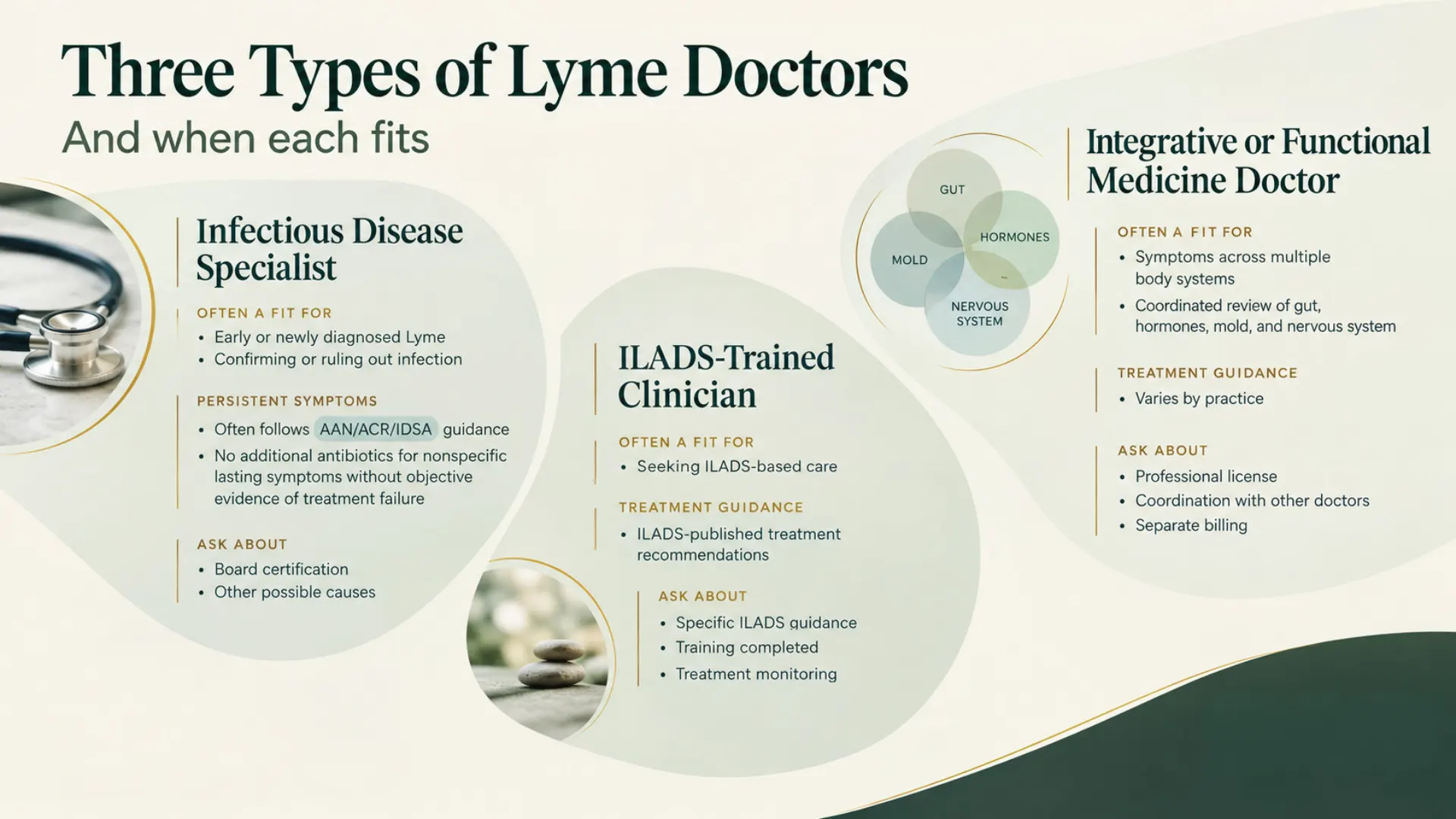
The two sets of guidance are separate documents, so ask which one a clinician follows. For a longer walk-through of the label itself, see our guide to finding a Lyme-literate doctor.
Each type of Lyme doctor follows its own guidance for symptoms that last after standard antibiotics.
The CDC calls these symptoms post-treatment Lyme disease syndrome and says six months after treatment they are 5 to 10% more common in people who had Lyme. It adds that studies of extended antibiotic courses found them no better than placebo for prolonged symptoms. It also links long-term antibiotic use to serious complications.
Post-treatment Lyme disease syndrome (PTLDS) is the CDC’s name for fatigue, pain, or thinking problems that continue after a recommended course of Lyme treatment. The CDC says its cause is currently unknown.
The 2020 guideline reaches a similar position for patients without objective evidence of treatment failure. ILADS-trained clinicians work from ILADS recommendations instead, and some integrative doctors start by supporting the body before treating microbes.
All three types share one piece of common ground. The CDC tells patients to work with a provider to evaluate all possible causes of their symptoms, and a good doctor of any type keeps looking.
A strong Lyme doctor checks for other causes of illness, including tick-borne co-infections and mold exposure.
Co-infections are other tick-borne infections, such as Babesia, that can cause symptoms overlapping with Lyme disease.
The CDC notes that ticks in the United States can spread bacteria, viruses, and parasites, and that many tickborne diseases have similar signs and symptoms. A symptom list alone cannot separate them. Our guide to co-infection testing explains how testing works.
Mold needs the same question. The CDC says the health effects of mold are different for different people, so your home and work history matters as much as any lab. Our guide to doctors who treat mold illness covers that side.
Eight questions can help you compare any Lyme doctor on the points that affect your care.
To work out whether you need a specialist at all, read our guide to signs you need a Lyme disease specialist.
Seven red flags should slow you down when you compare Lyme doctors, whichever type they are.
Cost and access often decide which Lyme doctor you can actually see, so ask about both before you book.
Video visits can widen your choices beyond your area. A practice can only see you if you are in a state it serves, so confirm your state first. Insurance policies differ by practice, so ask whether they bill insurance, give you documents to submit, or take direct payment.
For a walk-through of how a video visit works, see our guide to an online functional medicine doctor for Lyme and mold.
My Lyme Doc is a Lyme and mold illness practice led by Dr. Diane Mueller, ND, LAc, DAOM, author of “It’s Not in Your Mind,” and it has worked with more than 1,000 patients.
The practice fits patients who want an integrative doctor and care by video visit. Dr. Mueller is a naturopathic doctor and licensed acupuncturist, not a medical doctor (MD). You can read her background on the About page.
Care is by video visit for patients in Colorado, Oregon, Wyoming, New Jersey, Pennsylvania, Texas, Wisconsin, New Hampshire, Alabama, South Dakota, and Vermont.
Dr. Mueller’s 4-phase method sets the order of care:
You can read more about how this looks in practice in our guide to Lyme disease treatment.
“I had gone to 20 top specialists over 3 years and was not able to get a diagnosis.” Rose M., Austin, Texas, My Lyme Doc patient
The first visit is a $300 video visit. Ongoing care is a membership from $400 to $1,100 per month. Labs, supplements, and prescription medications are billed separately, and costs are shown before anything is ordered. Details are on the pricing page.
My Lyme Doc is not the right first stop for everyone:
If this approach sounds like the fit you want, you can book a video visit with Dr. Mueller.