


By Dr. Diane Mueller, ND, LAc, DAOM
SS-31 peptide, known clinically as elamipretide, is a mitochondria-targeted compound that concentrates in the inner mitochondrial membrane and stabilizes cardiolipin, the lipid molecule that keeps the cell’s energy-production machinery organized. In practice, that means SS-31 helps damaged or aging mitochondria produce ATP more efficiently. Researchers study it for fatigue, muscle weakness, and tissue repair in conditions where energy production has broken down. That includes chronic fatigue syndrome, fibromyalgia, and the long-haul exhaustion patients describe after Lyme disease and mold illness.
If you have been told your labs are normal but you still cannot get through a day without crashing, that exhaustion is not in your head. It is very often mitochondrial, and mitochondrial dysfunction does not reliably show up on a standard metabolic panel.

SS-31 is a synthetic tetrapeptide, a chain of just four amino acids, developed by researchers Hazel Szeto and Peter Schiller at Cornell University. Its clinical name is elamipretide, and researchers have also called it Bendavia and MTP-131 in earlier literature. Unlike growth hormone peptides, SS-31 does not signal a gland to release a hormone. It works directly at the level of the mitochondria, the structures inside nearly every cell that convert food and oxygen into usable energy.
SS-31 (elamipretide) is a mitochondria-targeted peptide that binds to cardiolipin in the inner mitochondrial membrane, stabilizing the structure responsible for efficient ATP production and reduced cellular oxidative stress.
Patients researching peptide options for Lyme-related or mold-related fatigue often see SS-31 listed alongside BPC-157, thymosin alpha-1, and growth hormone peptides like CJC-1295 and ipamorelin. The distinction matters. Those peptides work on gut repair, immune signaling, or hormone release. SS-31 works one level deeper, at the mitochondrial membrane itself, which is why it is discussed specifically for fatigue that has an energy-production component rather than an inflammatory or hormonal one.
The direct answer: SS-31 concentrates inside mitochondria and binds cardiolipin, the phospholipid that holds the electron transport chain in its correct configuration. That binding improves ATP output and reduces the reactive oxygen species (ROS) that leak out of a struggling mitochondrion.
Cardiolipin is a specialized phospholipid found almost exclusively in the inner mitochondrial membrane, where it organizes the protein complexes responsible for the final stages of ATP production. When it is damaged or peroxidized, those complexes lose efficiency.
Cardiolipin sits on the inner mitochondrial membrane and organizes the protein complexes responsible for the final stages of energy production. When cardiolipin becomes damaged or peroxidized, which happens with chronic infection, chronic inflammation, and oxidative stress, those complexes lose efficiency. Less ATP gets made. More ROS leaks out as a byproduct, which damages surrounding tissue and perpetuates the cycle. This is a documented pathway in aging research. A 2023 study in aged mouse muscle tissue found that elamipretide restored ADP sensitivity in aged mitochondria. It did this by improving uptake through the adenine nucleotide translocator, a transport protein that had accumulated oxidative damage over time. That restoration measurably improved ATP output and muscle force (Pharaoh et al., 2023).
That mechanism is why SS-31 gets discussed differently from other peptides in the chronic illness space. It is not an immune modulator and it is not a repair signal for a specific tissue type. It is a stabilizer for the power supply every cell depends on, which is also why the benefits reported cross so many systems: muscle, brain, cardiovascular, and retinal tissue all depend heavily on mitochondrial output.
We have helped thousands of people in Colorado, Wyoming, New Jersey, Pennsylvania, Texas, Wisconsin restore their health and quality of life by diagnosing and treating their Lyme Disease.
Patients ask specifically about peptides for fibromyalgia and peptides for nerve pain. Mitochondrial dysfunction is one of the more consistent findings in fibromyalgia and chronic fatigue syndrome research: muscle biopsies from fibromyalgia patients have repeatedly shown reduced mitochondrial density and impaired oxidative capacity compared to healthy controls. That does not mean SS-31 is an approved fibromyalgia treatment. It is not. It means the underlying cellular problem, mitochondria that cannot keep up with energy demand, is the same category of problem SS-31 was designed to address.
For patients with chronic Lyme disease, mold illness, or post-infectious fatigue, this angle matters. Standard fatigue labs (thyroid panel, CBC, basic metabolic panel) routinely come back normal while the patient is still crashing after minimal exertion, what many describe as post-exertional malaise. Mitochondrial impairment does not reliably appear on those panels. It is a functional, cellular-level problem, and it is a major reason “everything looks normal but I feel terrible” is one of the most common phrases we hear in intake calls.
This is also exactly why SS-31 sits in Phase 04 of the 4-Phase Method, not Phase 01. Most clinics jump straight to targeted interventions like this one before the body has the foundational support to use them well. If adrenal function, blood sugar regulation, and baseline nutrient status (Phase 01) are not addressed first, a mitochondrial-support peptide is working against an unstable foundation. We build the body first, then bring in tools like SS-31 once the terrain can actually respond to them.
SS-31 has been studied in aging research, cardiovascular disease models, and one confirmed human clinical program: a phase 2/3 randomized, placebo-controlled crossover trial in Barth syndrome, a rare genetic disorder of mitochondrial cardiolipin metabolism.
Barth syndrome is a rare, X-linked genetic disorder that disrupts cardiolipin metabolism, leading to cardiomyopathy, skeletal muscle weakness, and profound fatigue from birth.
The honest picture from that trial matters. In the initial 12-week randomized phase, elamipretide did not produce a statistically significant improvement over placebo on the primary endpoint, a six-minute walk test (Thompson et al., 2020). In the longer open-label extension that followed, known within the research literature as TAZPOWER, results changed. By week 168, patients showed a cumulative 96.1-meter improvement in walk distance and sustained improvement in fatigue scores compared to their extension baseline (Thompson et al., 2024). Ten patients entered that extension; eight completed the week 168 visit.
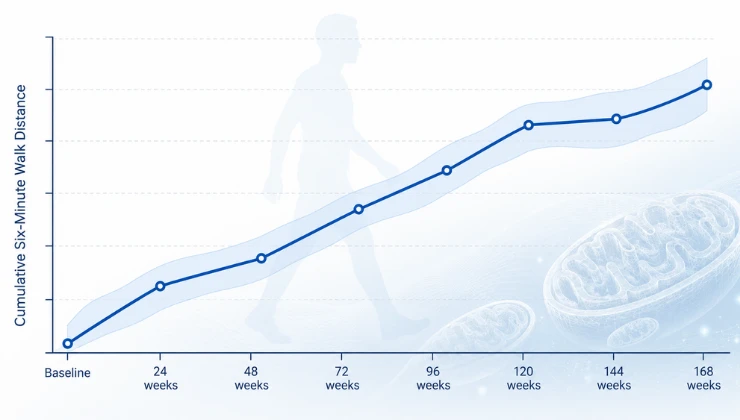
That pattern, no significant short-term effect but meaningful long-term improvement, is common with mitochondrial-repair compounds, because rebuilding cellular energy machinery is a slow biological process, not a fast pharmacological one. It also means anyone telling you SS-31 produces dramatic, immediate results is overstating the data. Separately, animal research has shown SS-31 restores working memory and reverses age-related cerebrovascular dysfunction in aged mice by reducing mitochondrial oxidative stress in brain blood vessel cells (Tarantini et al., 2018). Human data for the fatigue and cognitive applications functional medicine patients ask about most, chronic infection, mold illness, general chronic fatigue, remains limited. Most of what supports its off-label use is mechanistic and preclinical, extrapolated from the Barth syndrome and aging literature, not condition-specific trials in Lyme or CIRS patients. We say this plainly because patients researching peptides deserve the real state of the evidence, not marketing language dressed up as certainty.
We have helped thousands of people in Colorado, Wyoming, New Jersey, Pennsylvania, Texas, Wisconsin restore their health and quality of life by diagnosing and treating their Lyme Disease.
SS-31, like most therapeutic peptides, is a chain of amino acids that stomach acid and digestive enzymes will break down before it ever reaches the bloodstream intact. That is why it is administered by injection rather than taken as a pill. This is a structural fact about peptide chemistry, not a marketing choice. BPC-157 is the recognized exception in this category because its structure allows it to survive the gut and act directly on intestinal tissue. Peptides like Semax and Selank, by contrast, are formulated for intranasal delivery to cross the blood-brain barrier. SS-31, working at the mitochondrial level throughout the body, is administered by subcutaneous injection under physician supervision.
We have helped thousands of people in Colorado, Wyoming, New Jersey, Pennsylvania, Texas, Wisconsin restore their health and quality of life by diagnosing and treating their Lyme Disease.
The direct answer: SS-31 has shown a generally favorable safety profile in clinical trials, with injection-site reactions as the most common adverse event. But the bigger safety issue for most patients is not the peptide itself. It is where it comes from.
You should source SS-31, like the other peptides discussed in chronic illness care, from a licensed compounding pharmacy filling a physician’s prescription, not from an online research-chemical vendor. Research-only peptide facilities are not held to pharmaceutical manufacturing standards, and products from that channel can carry lipopolysaccharide (LPS) and other endotoxin contamination left over from the bacterial fermentation process used to produce the peptide. LPS is a potent inflammatory trigger. In a patient whose blood-brain barrier is already compromised from chronic infection or mold exposure, an LPS-contaminated peptide can worsen the exact problem it was meant to help. It drives further gut permeability and immune activation instead of repair. This is a sourcing issue almost no other site discussing SS-31 addresses directly, and it is one of the first things we screen for before recommending any peptide protocol.
A second consideration: SS-31 is not a growth hormone peptide, so the cancer caution that applies to compounds like tesamorelin and CJC-1295/ipamorelin does not apply here in the same way. It is still a compound with limited human safety data outside the Barth syndrome trial population, which is why physician oversight, not self-directed dosing, is the standard we recommend.
| Peptide | Primary target | Best-fit patient profile |
|---|---|---|
| SS-31 (elamipretide) | Mitochondrial membrane / cardiolipin | Fatigue, muscle weakness, and tissue repair rooted in cellular energy dysfunction |
| BPC-157 | Gut lining, soft tissue | Leaky gut, joint or tendon injury, oral or injectable |
| Thymosin Alpha-1 | Immune / antiviral signaling | EBV/CMV reactivation, chronic viral load |
| CJC-1295/ipamorelin | Growth hormone signaling | Sleep depth, pain reduction, body composition |
If you have spent years hearing “your labs are normal” while your body tells you something different, that gap between the paperwork and how you feel is often exactly where mitochondrial dysfunction lives. SS-31 is one tool among several we consider once your body’s foundational systems, adrenal, thyroid, blood sugar, nutrient status, are stable enough to respond to it. If you are ready to talk through whether mitochondrial support fits your case, schedule a visit with our team.
Mitochondrial exhaustion rarely shows up alone, and understanding where SS-31 fits is only useful once you know what is actually driving your fatigue. That is a conversation worth having with a physician who treats the whole picture, not just the peptide.
Yes. SS-31 is the research name (short for Szeto-Schiller peptide 31); elamipretide is its clinical/generic name, and researchers have also called it Bendavia and MTP-131 in earlier literature. They refer to the same compound.
BPC-157 works primarily on gut and soft-tissue repair and can be taken orally because its structure survives digestion. SS-31 works at the mitochondrial membrane level throughout the body, targets cardiolipin specifically, and requires injection because it does not survive stomach acid intact.
In the Barth syndrome open-label extension data, meaningful improvement in walk distance and fatigue scores emerged over months, not days, with gains still building at 168 weeks. Mitochondrial repair is a gradual process; expect a measured timeline, not an immediate effect.
It is not FDA-approved or condition-specifically studied for Lyme disease or mold illness. Physicians use it off-label based on the shared mechanism, mitochondrial dysfunction, that shows up in fibromyalgia, chronic fatigue syndrome, and post-infectious fatigue research. Any use should be part of a broader plan that has already addressed foundational body systems.
SS-31/elamipretide is a research and investigational compound, not an FDA-approved medication for general use. Physicians should prescribe it for clinical use and have it filled through a licensed compounding pharmacy, never purchased directly from a research-chemical website for self-administration.
We have helped thousands of
people restore their health
and quality of life by diagnosing
and treating their Lyme Disease.
“Dr. Mueller’s approach to medicine is refreshing! There is only so much you can do with western medicine and in my life I was needing a new approach. By addressing the whole body, nutritional diet factors, environmental factors, blood work, and incorporating ideas I had not previously known, I was able to break through with my conditions. I am not only experiencing less pain in my life, but through the process of healing guided by Dr. Diane Mueller, I am now happy to say I have more consciousness surrounding how I eat, what to eat and when things are appropriate. Living by example Dr. Mueller has a vibrancy that makes you want to learn and know more about your body and overall health. I highly recommend her to anyone looking for new answers, a new approach to health, or in need of freedom from pain and limitations.”
-Storie S.
Kihei, HI