


By Dr. Diane Mueller, ND, LAc, DAOM
Selank is a synthetic peptide, studied since the 1990s in Russia, that modulates the GABA system in the brain in a way researchers have compared to a benzodiazepine, without binding the same receptor site benzodiazepines do. It is administered intranasally, is not FDA-approved in the United States, and is most often discussed for anxiety, stress resilience, and mild cognitive support. For patients dealing with chronic infection, mold illness, or unexplained nervous-system symptoms, it is one tool, used carefully and sourced correctly, inside a much larger picture of nervous-system repair.
If you’ve been told your anxiety is “just stress” while your body has been fighting Lyme, mold, or an unresolved infection for months, that explanation already falls short. Chronic illness can rewire the nervous system into a state that will not turn off, no matter how much you rest. That is the population this peptide gets discussed for most inside our peptide therapy program.
Selank is a synthetic peptide, structurally derived from tuftsin, a naturally occurring immune peptide your body produces from an antibody fragment. Selank was developed at the Institute of Molecular Genetics of the Russian Academy of Sciences and is studied primarily for anxiolytic (anti-anxiety) and mild cognitive effects.
Selank’s parent molecule, tuftsin, already exists in your bloodstream. Researchers extended it with a short, stabilizing amino acid tail so it would survive longer before breaking down. The result behaves less like a foreign drug and more like a longer-acting version of a signal your body already uses.
Selank is not a sedative in the way a sleeping pill is a sedative, and it is not growth hormone or a hormone replacement of any kind. It is a signaling molecule, designed to nudge existing brain chemistry, not override it.
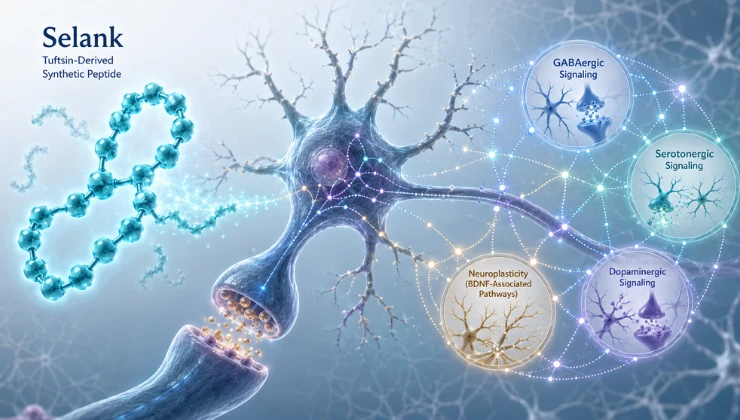
Selank’s anxiolytic effect is most often attributed to its interaction with the GABA system, the brain’s primary inhibitory (calming) neurotransmitter pathway. Animal research shows Selank enhances the anxiety-reducing effect of diazepam, a benzodiazepine, in stressed rats, without the two drugs simply adding their effects together *. Cell-based research found something more specific: Selank alone did not change the expression of the GABAergic genes studied, but it did modulate the expression changes produced when GABA or olanzapine was present, suppressing GABA’s effect and enhancing olanzapine’s *. In plain terms, Selank appears to work alongside other signals in the GABA system rather than acting on those genes by itself.
Benzodiazepines work differently: they bind directly to the benzodiazepine site on the GABA-A receptor (the receptor complex behind the brain’s primary calming response), forcing calm even when the system is not asking for it. Selank instead appears to modulate GABA activity indirectly, alongside serotonin, dopamine, and brain-derived neurotrophic factor (BDNF), a protein tied to memory and neuroplasticity, working with the brain’s existing calming machinery rather than forcing a separate one open.
That distinction is why Selank gets discussed as a gentler option, though “gentler” is a mechanistic description, not a guarantee of safety or interchangeability with prescribed medication.
We have helped thousands of people in Colorado, Wyoming, New Jersey, Pennsylvania, Texas, Wisconsin restore their health and quality of life by diagnosing and treating their Lyme Disease.
Selank for anxiety has one meaningful human data point: a 2008 Russian trial of 62 patients with generalized anxiety disorder and neurasthenia, comparing Selank against medazepam, a benzodiazepine. Patients receiving Selank showed anxiolytic effects comparable to the benzodiazepine group, with the added observation of reduced asthenia (fatigue and weakness), a symptom cluster medazepam does not typically touch *.
That is a real finding, and also a small, single, Russian-language trial with no Western replication since, not blinded to Western regulatory standards. No large-scale randomized controlled trial has confirmed the result outside Russia. The animal and cell-line research on GABA modulation ** supports a plausible mechanism, but mechanism is not proven clinical outcome in humans at scale.
Patients researching peptides deserve honesty about where the evidence stands, not marketing language dressed up as science. Selank is reasonably well-studied by research-compound standards, but it lacks the large human trial base that would let anyone promise a specific result.
This is an angle almost nobody writing about this peptide addresses, and it is where Selank’s real relevance to my patients comes in.
Patients with Lyme disease, mold illness, or other chronic infections frequently develop a nervous system locked in a sympathetic, threat-detecting state for years. This is not “anxiety” as a standalone psychiatric diagnosis. It is a limbic system that adapted to a genuine physiological threat and never got the signal to stand down, even once other symptoms improve.
In our 4-Phase Method, we address the nervous system directly in Phase 02, before targeted microbe balancing in Phase 04, where most peptide therapy lives. A dysregulated limbic system amplifies every other symptom: pain, sleep, and stress response all drain resources the body needs for healing. Skip this step and jump straight to killing pathogens, and patients frequently crash.
Selank, used in this population, is one supportive tool for that recalibration, alongside nervous system retraining approaches and the foundational work of Phase 01. It is never the whole plan.
The fatigue and pain that so often go alongside chronic-illness anxiety need their own attention in the same sequence, not an afterthought.
We have helped thousands of people in Colorado, Wyoming, New Jersey, Pennsylvania, Texas, Wisconsin restore their health and quality of life by diagnosing and treating their Lyme Disease.
Selank and benzodiazepines like Xanax are not interchangeable, and work through related but different mechanisms with very different evidence bases behind them. The comparison below clarifies mechanism, not a case for swapping one for the other without medical guidance.
| Selank | Benzodiazepines (Xanax, Ativan, Valium) | |
|---|---|---|
| Mechanism | Modulates GABA indirectly; also affects serotonin, dopamine, BDNF | Binds directly to the benzodiazepine site on GABA-A receptors |
| Onset | Reported gradual to moderate onset in trial data | Rapid, often within 30-60 minutes |
| Regulatory status | Not FDA-approved; Russia-approved for GAD and neurasthenia | FDA-approved, controlled substance |
| Dependency profile in available data | No dependency signal reported in existing trials, long-term data limited | Well-documented tolerance and dependence with regular use |
| Sedation | Trial data reports no significant sedation | Common, dose-dependent |
| Evidence base | One Russian human trial, animal and cell-line mechanism studies | Decades of large-scale RCTs |
Selank is not positioned here as a benzodiazepine replacement. It is a different class of compound with a far thinner evidence base, and stopping a prescribed medication to try a research peptide instead is a decision we do not recommend making without a physician.
Selank, like most peptides, is a chain of amino acids that does not survive stomach acid intact. Swallow it, and digestive enzymes break it apart before it can do anything useful. That is why Selank, along with its cousin peptide Semax, is administered intranasally rather than orally.
Intranasal delivery lets the peptide cross into the central nervous system through pathways connected to the nasal cavity, bypassing much of the digestive breakdown that would otherwise destroy it. That logic differs from BPC-157, one of the few peptides stable enough to survive oral administration for gut-specific applications. Injectable routes for Selank exist in the research literature too, though intranasal is used most.
Herxheimer reaction (Jarisch-Herxheimer reaction) is a temporary worsening of symptoms, fever, fatigue, and inflammation, that can occur when large numbers of pathogens die off during treatment, releasing inflammatory byproducts faster than the body can clear them.
Available trial data describes Selank as generally well-tolerated: mild nasal irritation is the most common side effect, with no significant sedation or dependency signal. Long-term safety data beyond these trials does not exist, a limitation we state plainly.
Selank is not one of the immune-stimulating peptides, like LL-37 or thymosin alpha-1, that carry a meaningful Herxheimer risk on their own. But patients on active microbe-balancing treatment often manage Herxheimer symptoms from other parts of their protocol. Any addition, including Selank, should be sequenced by a provider who knows the full picture, not layered in independently.
Patients with autoimmune conditions should flag this before starting any peptide. An immune system already over-stimulated needs a different sequencing approach than one that is under-functioning, and that is a conversation for your doctor, not a decision made alone from an article.
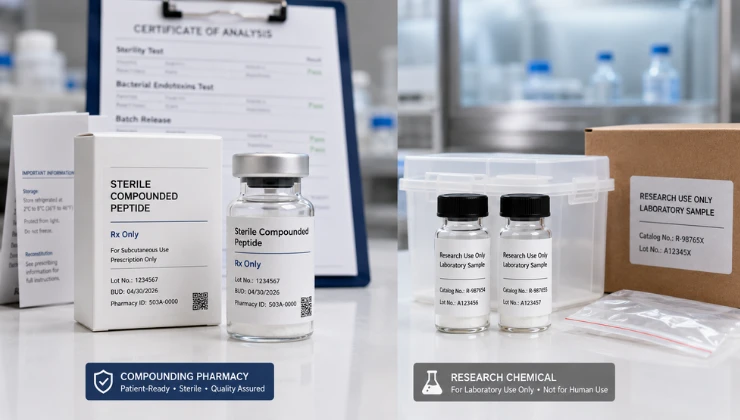
Where your Selank comes from matters more than the peptide itself: unregulated research-chemical vials can carry contamination that compounding-pharmacy Selank does not. It is the single most important safety factor patients overlook.
Online research-chemical vendors are not held to pharmaceutical manufacturing standards. Standard purity tests like HPLC and mass spectrometry check chemical identity and concentration, but do not reliably detect bacterial endotoxin (lipopolysaccharide, or LPS) contamination, a byproduct of some manufacturing processes. A vial can test “99% pure” and still carry a meaningful endotoxin load.
That matters because endotoxin exposure has been shown, at sufficient doses, to disrupt the blood-brain barrier *, the barrier a patient using Selank for nervous-system support is relying on. In a body already dealing with chronic infection, leaky gut, or mold-driven inflammation, an added endotoxin burden is not a minor inconvenience.
Compounding pharmacies producing peptides under physician prescription are held to a different standard: USP sterility and endotoxin testing, verified potency, accountability to the FDA and the prescribing physician. That is why we source exclusively through licensed compounding pharmacies, with physician oversight rather than a self-directed order. Read more on how we evaluate peptide safety.
Selank is part of a larger picture, never a standalone decision. See what treatment actually looks like before assuming this is the right first step.
Selank may be worth discussing with your provider if:
Selank is not the right starting point if:
Selank is not FDA-approved. Its compounding status is unresolved, not settled: it briefly sat on the FDA’s interim 503A Category 2 list, was removed in late 2024 at the nominator’s request, and has no scheduled committee review since. It is approved in Russia for generalized anxiety disorder and neurasthenia. Confirm current sourcing status with a licensed provider.
Both are intranasal, Russian-developed peptides, but targets differ. Semax is studied for cognitive support and brain fog. Selank is studied for anxiolytic effects through GABA modulation. Some patients use both, under physician guidance.
Existing trial data reports no dependency or withdrawal signal comparable to benzodiazepines, but long-term human safety data is limited. That is a different risk profile, not a guarantee of zero risk.
No. Selank should never replace a prescribed anxiety medication without your prescribing physician’s direct involvement.
Because endotoxin contamination from unregulated sources can, at sufficient exposure, disrupt the same blood-brain barrier a patient is trying to protect. Compounding-pharmacy sourcing under physician oversight is the safer path.
Only as part of a sequenced plan, not a first move. Our phased peptide therapy approach builds the body’s foundation first, because patients who skip straight to advanced interventions tend to feel worse, not better.
Kasian D, Zhdanova N, Voronina T, et al. Peptide Selank Enhances the Effect of Diazepam in Reducing Anxiety in Unpredictable Chronic Mild Stress Conditions in Rats. Behavioural Neurology. 2017.
Filatova EV, Shadrina MI, Slominsky PA, et al. GABA, Selank, and Olanzapine Affect the Expression of Genes Involved in GABAergic Neurotransmission in IMR-32 Cells. Frontiers in Pharmacology. 2017.
Zozulya AA, Neznamov GG, Siuniakov TS, et al. Efficacy and possible mechanisms of action of a new peptide anxiolytic Selank in the therapy of generalized anxiety disorders and neurasthenia. Zh Nevrol Psikhiatr Im S S Korsakova. 2008.
Banks WA, Gray AM, Erickson MA, et al. Lipopolysaccharide-induced blood-brain barrier disruption: roles of cyclooxygenase, oxidative stress, neuroinflammation, and elements of the neurovascular unit. Journal of Neuroinflammation. 2015.
We have helped thousands of
people restore their health
and quality of life by diagnosing
and treating their Lyme Disease.
“Dr. Mueller’s approach to medicine is refreshing! There is only so much you can do with western medicine and in my life I was needing a new approach. By addressing the whole body, nutritional diet factors, environmental factors, blood work, and incorporating ideas I had not previously known, I was able to break through with my conditions. I am not only experiencing less pain in my life, but through the process of healing guided by Dr. Diane Mueller, I am now happy to say I have more consciousness surrounding how I eat, what to eat and when things are appropriate. Living by example Dr. Mueller has a vibrancy that makes you want to learn and know more about your body and overall health. I highly recommend her to anyone looking for new answers, a new approach to health, or in need of freedom from pain and limitations.”
-Storie S.
Kihei, HI