


MCAS and Lyme disease share symptoms, and lab studies show Lyme bacteria can activate mast cells, the immune cells behind MCAS. We found no human study showing that Lyme causes MCAS or how often the two occur together.
If you were told your reactions to foods, scents, and medications are anxiety, you are not imagining them. If your reactions started after Lyme or alongside it, the mast cell question is a fair one to ask. This page sorts what the research supports from what is still a clinical hunch, and it covers only the Lyme connection.
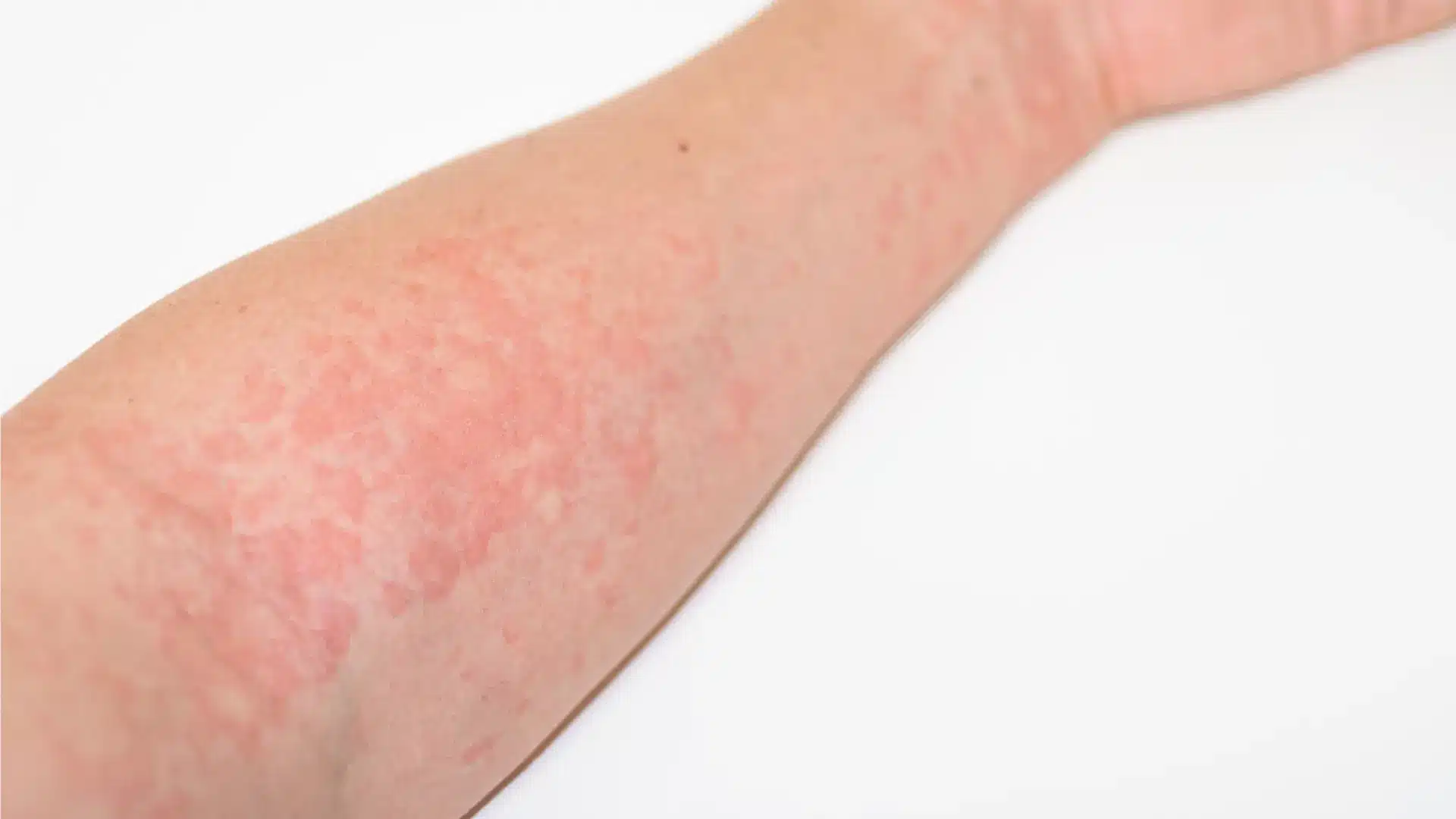
MCAS, or mast cell activation syndrome, is a condition in which mast cells release chemicals such as histamine too easily, causing repeated reactions in more than one body system.
Mast cells are immune cells found in the skin and other tissues that release histamine and other chemical signals when they detect a threat.
MCAS (mast cell activation syndrome) is a diagnosis for people whose mast cells release those signals in repeated, severe episodes that resemble anaphylaxis.
A 2024 review in the Journal of Allergy and Clinical Immunology lists three consensus criteria. They are symptoms in at least two organ systems, a rise in a mast cell chemical measured during symptoms, and a clear response to medicines that block those chemicals. The same review notes “many gaps in knowledge” about the condition. Our guide to what MCAS is covers the full picture.
Research shows Lyme bacteria (Borrelia burgdorferi) can activate mast cells in the lab, but every study we found used rodent cells or mice.
| Study | What was tested | What it found | Limit |
|---|---|---|---|
| Talkington and Nickell, 1999 | Rat and mouse mast cells in a dish with live Lyme bacteria | “Low but detectable” degranulation (release of stored chemicals) and an inflammatory signal called TNF-alpha | Cultured rodent cells |
| Bernard et al., 2017 | Mouse mast cells, and mice without mast cells | A Lyme surface protein (OspC) triggered degranulation, tick saliva dampened it, and the authors reported faster spread to the joints without mast cells | Mouse model; mast cells were not the only cells involved |
| Bencosme-Cuevas et al., 2023 | A tick saliva protein in mice and lab assays | The protein blocked chymase, an enzyme released by mast cells | Mouse and lab assays |
| Castells et al., 2024 | Review of MCAS research | Lyme and tick-borne infection do not appear in the review | Sets the MCAS criteria used on this page |
Taken together, these studies suggest mast cells meet Lyme bacteria in the skin at the tick bite. They also suggest mast cells are one player among several. In the 2017 mouse work, mast cells did not control how fast the bacteria multiplied in the skin.
The human data are missing. A PubMed search run on October 19, 2026 for MCAS together with Lyme, Borrelia, or tick-borne infection returned four papers. None measured how often MCAS occurs in people with Lyme, and none showed that Lyme causes it.
One tick-linked allergy is well documented. The CDC describes alpha-gal syndrome as an allergy that can develop after a tick bite, most often from the lone star tick, with a few cases after blacklegged tick bites. It is a separate condition from both Lyme and MCAS, and our page on red meat allergy after tick bites explains it.
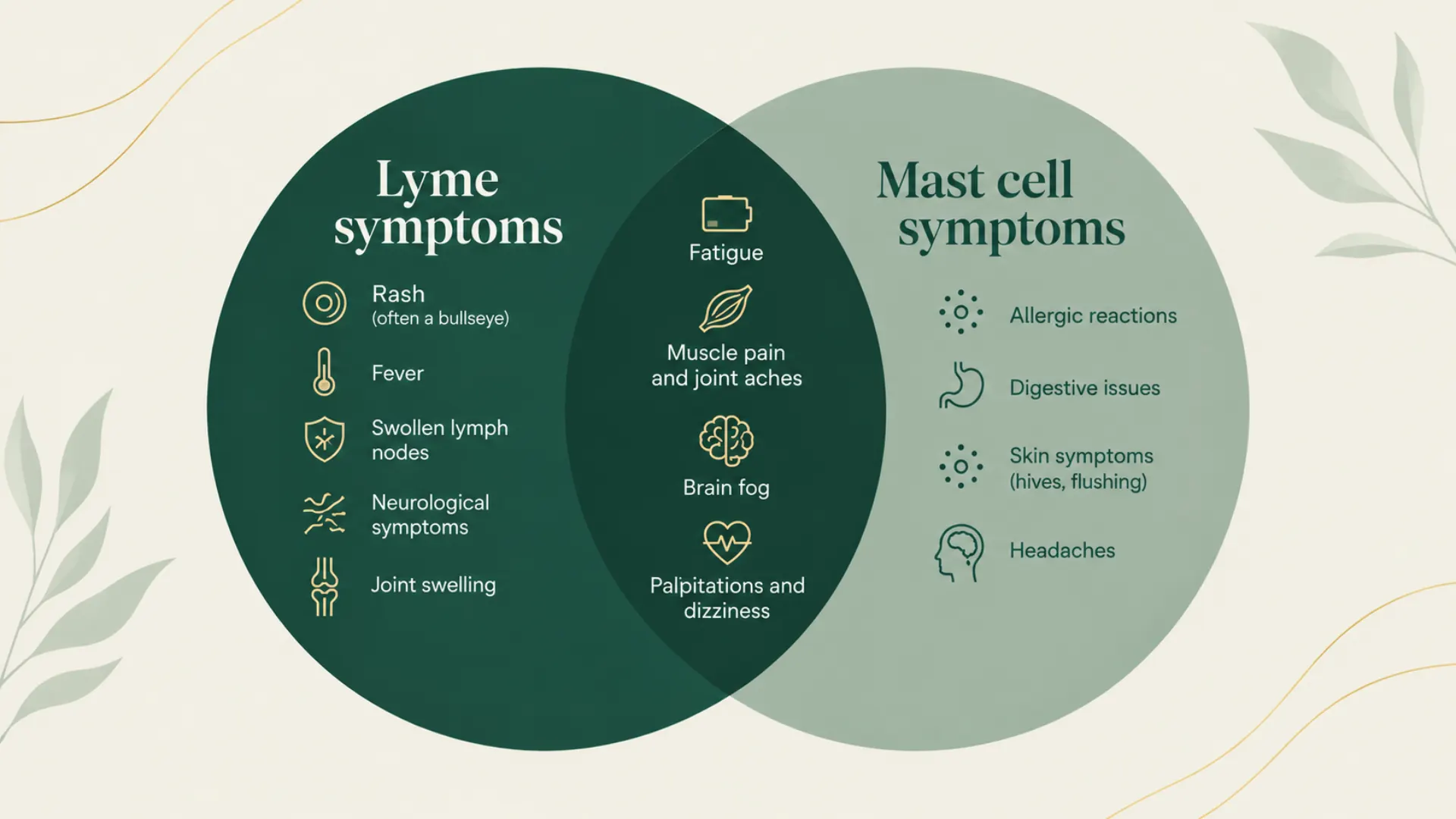
Lyme disease and MCAS share fatigue, aches, trouble thinking, and palpitations, which makes the two easy to confuse.
| Symptom | Lyme disease (CDC) | MCAS (2024 review) |
|---|---|---|
| Fatigue | Early symptom; prolonged in some people after treatment | Chronic fatigue commonly reported |
| Muscle and joint pain | Muscle and joint aches; intermittent pain in tendons, muscles, and joints | Pain commonly reported |
| Thinking and memory | “Difficulty thinking” among prolonged symptoms | Short memory span and trouble concentrating, called brain fog |
| Palpitations and dizziness | Heart palpitations, dizziness, shortness of breath | Palpitations, fast heartbeat, trouble tolerating standing |
| Hives, flushing, throat tightness, wheezing | Not on the CDC symptom page | Classic signs |
| Gut distress (nausea, cramping, diarrhea) | Not on the CDC symptom page | Classic signs |
The Lyme column draws on the CDC pages on Lyme symptoms and Lyme clinical care. The MCAS column draws on the 2024 review. The clue is the pattern. MCAS is defined by repeated reactions across body systems that resemble anaphylaxis, so hives, flushing, throat tightness, and gut upset arriving together lean toward mast cells. Fatigue and aches alone do not separate the two.
Two other look-alikes matter. The 2024 review notes that autonomic dysfunction can mimic MCAS symptoms such as flushing, palpitations, and orthostatic intolerance (trouble tolerating standing up). We cover that overlap in our guide to dysautonomia and POTS.
The CDC also says some people have prolonged symptoms after Lyme treatment and that the cause is currently unknown. We explain that pattern under post-treatment Lyme disease syndrome.
Mast cell reactivity may matter for Lyme treatment because a body that reacts to many things can react to a new treatment, but no trial has tested this.
The 2024 review states that no randomized trials have linked a mast cell phenotype or mediator level to a specific treatment response. What exists is clinical experience and personal accounts. One writer on LymeDisease.org described her daughter, who “developed allergies to soaps, perfumes, juices, fruits, vegetables, and lunch meats.”
A bad reaction after starting something new has more than one possible explanation. It could be a mast cell flare, a Herxheimer reaction, or an ordinary side effect. We found no home method that reliably tells these apart, so a clinician who knows your history should sort it out.
In our practice, Dr. Mueller’s 4-Phase Method builds the body first, supports the nervous system, and uses gentle detox before targeted microbe balancing. That order lets us move slowly when someone reacts to many things.
Safety note: Trouble breathing, throat swelling, or fainting after a medicine, food, or sting is an emergency. Call 911.
Lyme disease and MCAS are two separate testing questions, so each needs its own test.
The CDC says laboratory diagnosis of Lyme disease relies on a blood test that detects antibodies, using a two-step process. Our guide to interpreting Lyme test results explains how to read those numbers.
MCAS is tested differently. Doctors look for a rise in a mast cell chemical, such as tryptase, measured during symptoms. The 2024 review adds that MCAS can still be present when tryptase does not rise, so timing and the choice of marker both matter. Our MCAS symptoms guide lists the labs in detail.
A mast cell diagnosis needs confirming because the label is often applied more widely than the criteria allow. In a 2024 study of 703 referred patients, 31 had confirmed idiopathic MCAS, or 4.4%. Idiopathic means no IgE-mediated allergy or clonal mast cell disorder sits behind it. A Mayo Clinic allergy review in 2020 said the diagnosis has been attached to conditions not intended as part of it.
Your reactions are real, and the cause deserves a careful workup that can include Lyme and its co-infections. If MCAS is confirmed, our guide to MCAS treatment covers what comes next.
If you suspect both Lyme and MCAS, the next step is to separate the questions, gather timing data, and work with a clinician who sequences care.
My Lyme Doc sees patients by video visit in 11 states. You can book a consultation with Dr. Mueller to review your history, results, and reaction pattern together.