


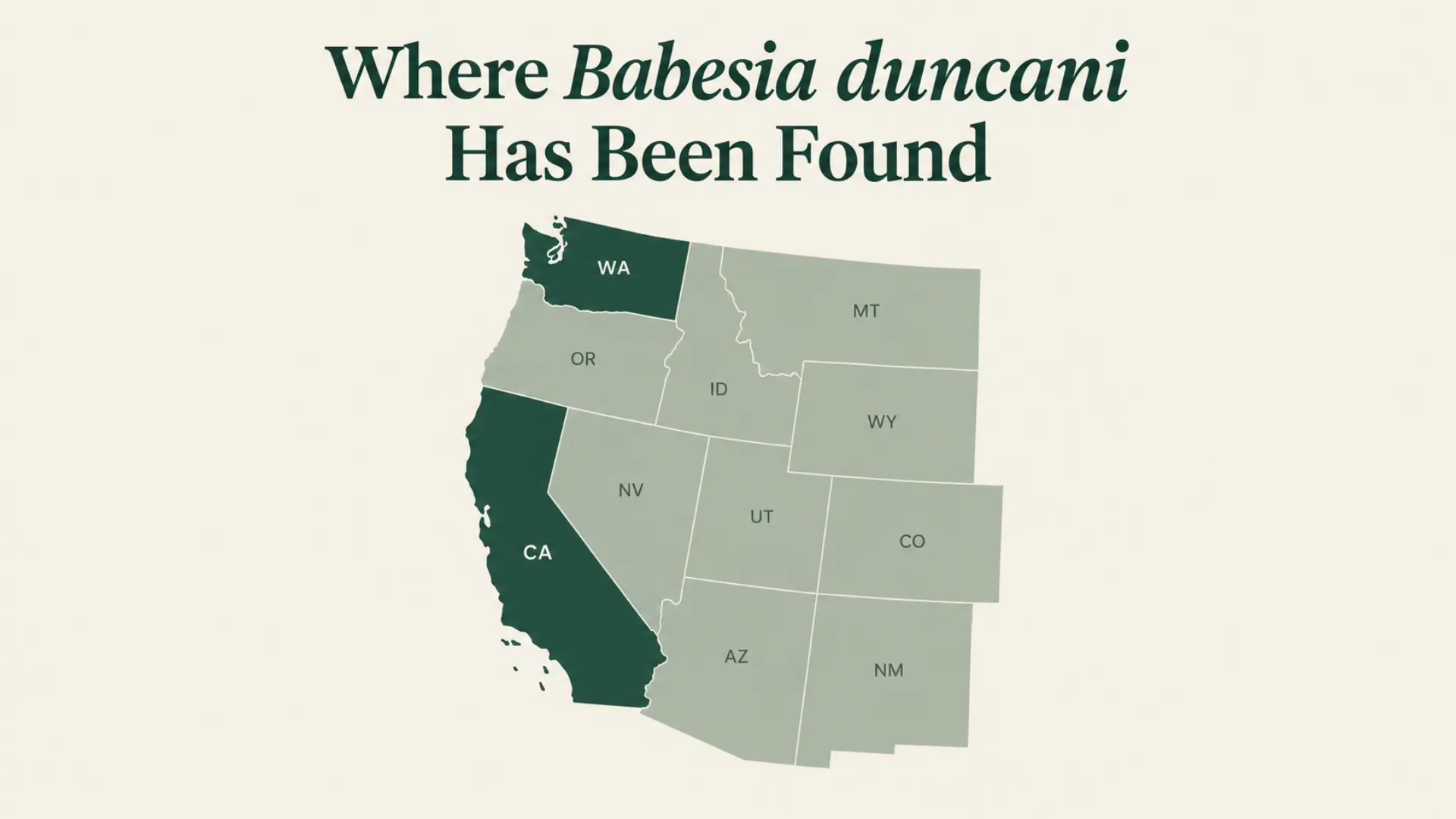
Babesia duncani is a tick-borne parasite that infects red blood cells, and the U.S. human cases reported so far have come from western states, mostly Washington and California. It looks identical to the better-known Babesia microti under a microscope, so a test built for B. microti can come back negative while B. duncani is the real cause. If you have lingering babesia-type symptoms and a negative result, the species question is worth raising.
If you have been told “your Babesia test is negative” while your symptoms keep pointing back to it, you are not imagining the gap. A smear cannot tell the two species apart, and a B. microti test can miss B. duncani. Our guide to Babesia testing covers the general tests.
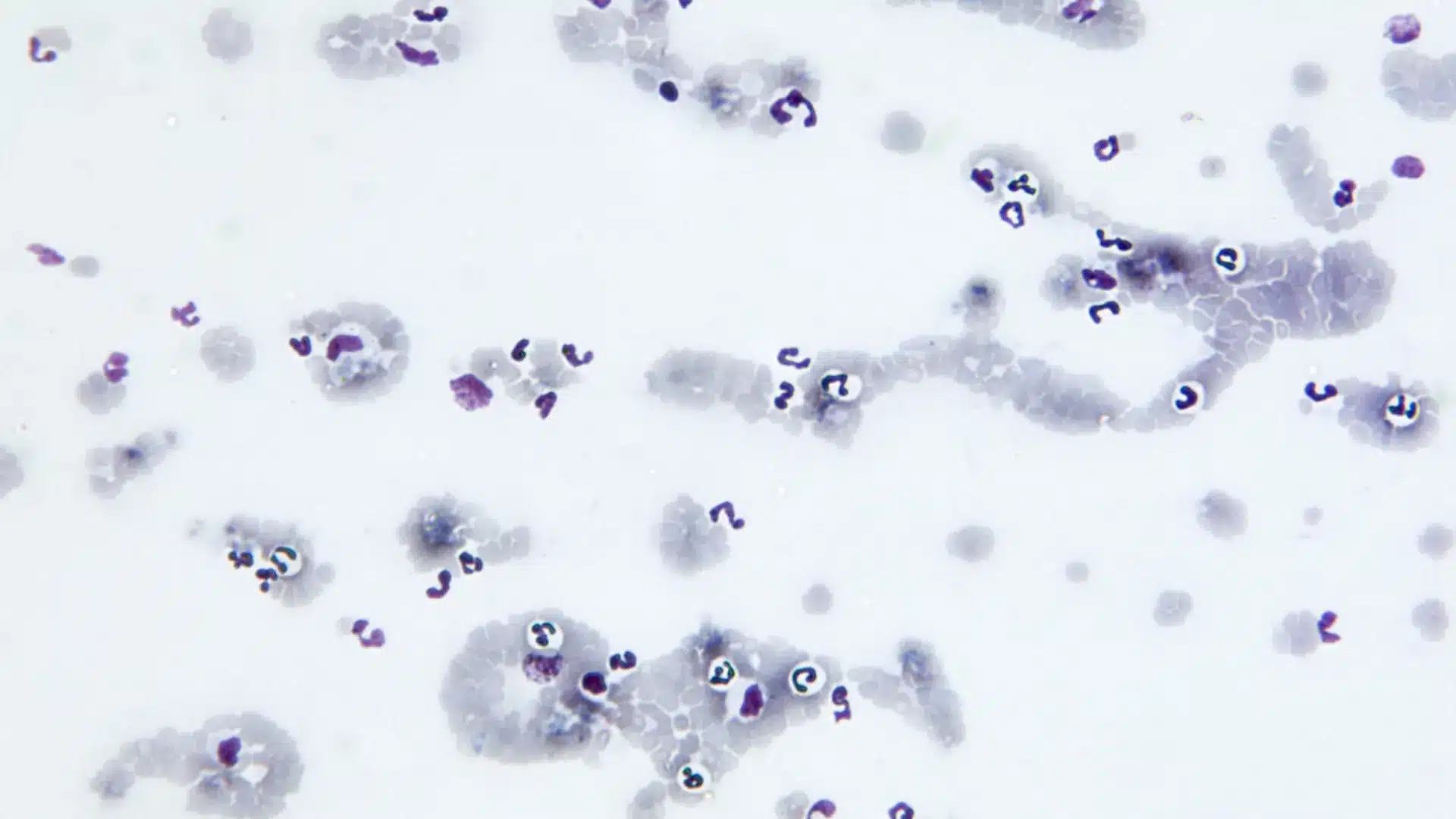
Babesia duncani is a single-celled parasite that lives inside human red blood cells and was first identified in a patient in Washington State in the early 1990s.
Babesia is a group of microscopic parasites spread mainly by ticks. They invade red blood cells, which is why the illness is called babesiosis.
WA1 is the original lab name for the parasite found in a Washington patient. Researchers later named it Babesia duncani.
A 1993 report in the Annals of Internal Medicine described that first Washington case, a 41-year-old man with a working spleen who developed a moderately severe illness. The authors found the parasite was “antigenically and genotypically distinct from B. microti.” In 2006, researchers formally named the species Babesia duncani after studying isolates from patients in Washington and California.
Babesia duncani and Babesia microti are separate species that cause a similar illness but differ in geography, suspected ticks, and testing.
| Babesia microti | Babesia duncani | |
|---|---|---|
| Where reported | Northeast and upper Midwest (CDC) | Western states, mainly Washington and California (Yang 2021) |
| Tick | Blacklegged tick, Ixodes scapularis (CDC) | Winter tick suspected (Swei 2019) |
| Under the microscope | Parasites visible inside red blood cells | Indistinguishable from B. microti (Conrad 2006) |
| Antibody test | B. microti test | Needs a B. duncani-specific test (Quick 1993) |
| Size of the evidence | The CDC calls it the most common U.S. species | 14 U.S. human cases in one 2021 review |
The CDC’s clinical overview says B. microti is the main species in people in the U.S. and that “occasional cases caused by other Babesia species have been detected.” B. duncani is one of those other species. If you want the broader picture of how babesia sits next to Lyme and Bartonella, see our guide to Babesia vs Bartonella vs Lyme.
Babesia duncani has been confirmed in people in Washington and California, and one case report describes a locally acquired infection in Canada.
A 2021 review in Microorganisms counted 14 human cases in the U.S., all in western states. The review places the parasite predominantly in Washington and California. A 2009 CDC journal report likewise described California and Washington cases caused by local Babesia-like isolates, including B. duncani. A 2017 case report described a locally acquired infection in Canada, though that report describes a single patient.
What about Colorado and Oregon? We did not find a published, confirmed human B. duncani case from either state. Oregon sits between Washington and California, and one 2010 reference-lab study found antibodies to the WA1 parasite in 2.0% of 900 blood donors from nine states. The authors argued exposure may reach beyond the Pacific coast. Antibody results alone cannot settle that, so this remains an open question.
Babesia duncani is thought to spread through tick bites, but the exact tick and animal host are still being worked out.
For decades nobody knew the vector. The team that described the first case trapped 83 small mammals and collected 235 ticks without finding it. A 2019 study then reported evidence that the winter tick, Dermacentor albipictus, is the vector, with the mule deer as the likely reservoir. The authors note that the two species overlap across much of far-western North America.
That is one study, and the word “likely” matters. A Canadian case report suggested instead that a blacklegged tick may carry B. duncani, based on a single patient. Both ideas remain provisional. Our guide to types of ticks shows how many different ticks are in play across the country.
Blood transfusion is a second route. A 2012 report in Transfusion described the third documented transfusion-transmitted B. duncani case. A California patient with sickle cell disease had no other risk factor than receiving red blood cell transfusions. The CDC also lists blood transfusion as a less common route for babesiosis in general.
Babesia duncani symptoms range from none at all to severe illness, and they overlap heavily with other babesia species.
The CDC says that many people with babesiosis do not feel sick, while others have fever, chills, sweats, headache, and fatigue. Its clinical page lists hemolytic anemia and flu-like symptoms, meaning red blood cells break down faster than the body replaces them. For the day-to-day pattern, including how this differs from Lyme, our guide to babesia symptoms vs Lyme symptoms goes deeper.
Severity is where B. duncani raises extra concern. A 2018 laboratory paper stated that clinical cases have been associated with high parasite burden, severe pathology, and death. A 2023 study reported that the parasite causes severe to lethal infection in humans and fulminant disease in infected mice. Yet the first Washington patient had only a moderately severe illness. With so few cases, we cannot say how often serious illness occurs.
If breathing becomes hard or you feel confused or very weak, seek urgent medical care first. Our page on air hunger and babesia covers shortness of breath with babesia.
A test aimed at Babesia microti can miss Babesia duncani, because the two parasites look the same under the microscope and differ in their antibodies and DNA.
A blood smear is a drop of blood stained and checked under a microscope for parasites inside red cells. It shows that a parasite is present, not which species.
The 2006 species description found B. duncani is morphologically indistinguishable from B. microti. The 2012 transfusion case shows how this plays out. The patient’s smear showed parasites, yet molecular and antibody tests aimed at B. microti were negative. The authors concluded that babesiosis can be caused by agents not detected by B. microti tests.
Species-specific testing exists but has its own limits. CDC scientists wrote in 2021 that the antibody test of choice, the IFA, needs parasite-infected cells grown in hamsters and is often difficult to interpret. The 2021 review adds that PCR and DNA sequencing are often needed to identify the species. A 2024 study notes that molecular blood assays exist, while a reliable marker of active infection remains elusive. New antigen tests from that team have been validated so far in lab models and stored samples.
In practice, ask whether your lab tested for B. duncani by name. Our guide to Babesia testing covers smears, PCR, and antibody tests in general.
Babesia duncani treatment is decided by a clinician case by case, and the evidence base for this species is thin.
The CDC notes that asymptomatic patients typically do not need treatment for babesiosis. For ill patients, standard care generally uses an antiparasitic combination. The CDC adds that treatment may also differ depending on the Babesia species.
Laboratory data raise a caution. In a 2018 culture study, B. duncani showed low susceptibility to the four drugs recommended for human babesiosis, and the authors suggested current practices may be of limited effect. This was a petri dish result, not a patient trial. We did not find published patient studies comparing regimens for B. duncani, so anyone with a confirmed or suspected infection needs individualized care. Our page on Babesia treatment explains the general approaches.
At My Lyme Doc, Dr. Diane Mueller, ND, LAc, DAOM, uses a 4-phase method. It builds the body first, supports the nervous system and lifestyle, uses gentle detox, and only then moves to targeted microbe balancing.
If you suspect Babesia duncani, match your symptoms, your tick or travel history, and your test results, then ask for species-specific testing.
My Lyme Doc sees patients by telehealth in 11 states, including Colorado and Oregon. You can book a consultation with Dr. Mueller to go through your results and history together.