


Written and medically reviewed by Dr. Diane Mueller, ND, LAc, DAOM, founder of MyLymeDoc. Last reviewed September 7, 2026.
Cat’s claw for Lyme disease has real laboratory evidence behind it and no human trials. In a 2020 Johns Hopkins study, cat’s claw extract was one of seven botanicals that showed strong activity against the stationary-phase, or persister, form of Borrelia burgdorferi, the form that standard antibiotics handle poorly. Every one of those results came from bacteria in a dish. Nobody has yet run a controlled trial of cat’s claw in people with Lyme disease. The gap between those two facts is the whole story of this page. The biology is promising, the clinical proof does not exist, and the herb carries one drug interaction that matters more than anything on a supplement label.
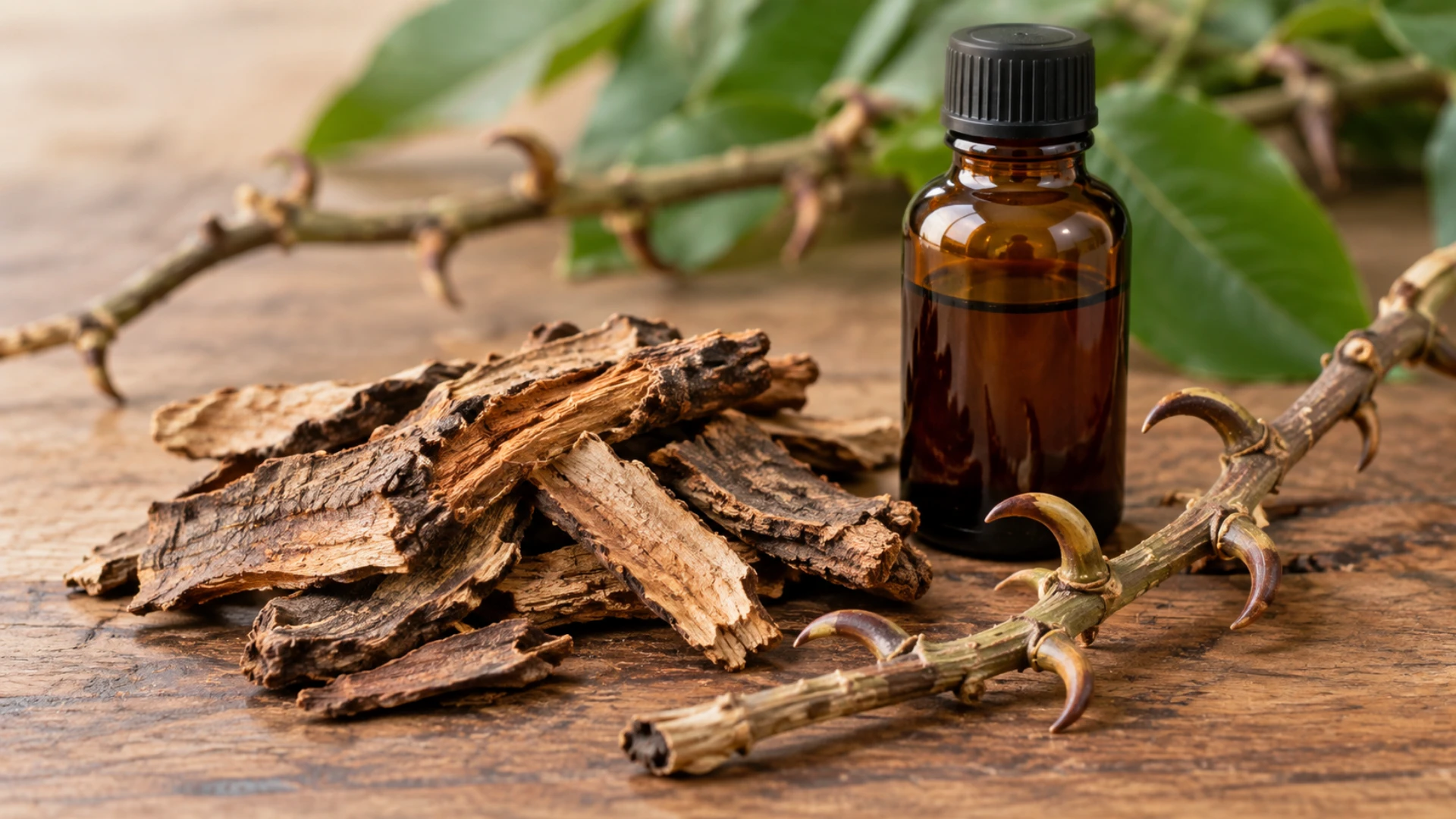
Cat’s claw is a woody vine from the Amazon basin, Uncaria tomentosa, named for the curved thorns along its stem. Its bark and root have been used in traditional Amazonian medicine for inflammation and immune support, and it is a core herb in the Buhner protocol for Lyme disease.
The plant contains two families of oxindole alkaloids. Pentacyclic oxindole alkaloids, or POAs, are generally credited with its immune effects. Tetracyclic oxindole alkaloids, or TOAs, are thought by some to blunt those effects, which is the basis of the “TOA-free” products on the market. Samento is a trade name for a TOA-free cat’s claw extract; the same evidence and cautions apply. The evidence that removing TOAs changes outcomes in Lyme patients is thin, and this page does not resolve that debate.
What is documented is that cat’s claw extracts stimulate immune signaling. A 1999 study found that Uncaria extracts “greatly stimulated” production of the cytokines IL-1 and IL-6 in macrophages, which the authors called a “strong immunostimulant action.” It is a finding about macrophage cytokines in a laboratory, not about the immune system of a person with Lyme disease.
Where it sits among the other herbs used for Lyme is covered on herbs for Lyme disease.
The most cited evidence is a 2020 study from Johns Hopkins Bloomberg School of Public Health, published in Frontiers in Medicine by Feng, Leone, Schweig and Zhang. The team tested 15 substances, 12 botanical medicines and 3 other natural antimicrobials, against Borrelia burgdorferi in culture.
Seven extracts stood out against the stationary-phase form: cryptolepis, black walnut, Japanese knotweed, sweet wormwood, cat’s claw, Cistus incanus, and Chinese skullcap. At a 1% concentration, cat’s claw showed what the authors describe as strong activity against stationary-phase Borrelia compared with the control antibiotics doxycycline and cefuroxime.
Two details from the same paper get left out of most summaries. First, against growing Borrelia, cat’s claw’s minimum inhibitory concentration was, in the authors’ words, quite high. It is a persister herb, not an all-purpose one. Second, the authors state plainly that an in vitro model “exists outside of the biological organism” and cannot capture how a botanical works through inflammation or immune regulation in a body.
A 2016 review in Therapeutic Advances in Infectious Disease by Goc and Rath summarized the phytochemicals and micronutrients tested against Borrelia to that point. Its section on cat’s claw reports effects on all morphological forms of Borrelia, strongest in combination with Otoba parvifolia, a separate Amazonian bark. On biofilm specifically, it reports that cat’s claw extract “showed significant reduction of biofilm size and its disruption but without the bactericidal effect.” In plain terms: it broke the structure up without killing what was inside.
Some articles describe cat’s claw as a weak biofilm disruptor. The source says the opposite.
There is no randomized controlled trial of cat’s claw in humans with Lyme disease. There is no established dose, duration, or protocol validated in a clinical study. Everything about how it is used in practice comes from clinical tradition, chiefly Stephen Buhner’s protocol, not from trial data. None of this is a reason to dismiss the herb. It is the reason this page does not tell you how much to take.
Borrelia burgdorferi does not exist in one form. The classic spirochete is what antibiotics target well, and what the ELISA and Western blot detect antibodies against.
Persister cells are slow-growing or dormant bacteria that survive antibiotics by going metabolically quiet rather than by being resistant, and can reactivate when treatment ends.
Under stress, the bacterium can shift into those persister states. These are not antibiotic-resistant in the classical sense, they are antibiotic-tolerant, which is why a course can end with the organism still present. In a 2012 primate study, Embers and colleagues recovered intact spirochetes from rhesus macaques after aggressive antibiotic treatment, and described the organism as becoming “tolerant post-dissemination.” Whether those survivors contribute to the symptoms that persist in some people after treatment is a question the authors themselves raise and leave open.
Biofilm is a protective matrix that bacteria build around themselves, shielding the cells inside from immune attack and from antimicrobials.
Borrelia also forms biofilm. Sapi and colleagues showed in 2012 that the bacterium builds protective aggregates with a matrix of alginate and extracellular DNA, which they concluded was “substantial evidence” of biofilm formation.
Cat’s claw earns its place in Lyme herbal protocols because its laboratory activity is strongest against exactly these forms. The same data explain why it is nearly always used in combination rather than alone, and why the Buhner protocol pairs it with Japanese knotweed and andrographis.
Cat’s claw inhibits cytochrome P450 3A4, the liver enzyme that clears a large share of prescription drugs, and in the one laboratory screen that compared them, it landed in the same top tier as St. John’s wort. Anyone on any prescription medication should read this section. In a 2000 laboratory screen of 21 commercial herbal extracts, goldenseal, St. John’s wort and cat’s claw had the lowest IC50 values, meaning they were the strongest inhibitors of the group, at less than 1% of full strength.
St. John’s wort is the herb most doctors already warn about for drug interactions. Cat’s claw sat in the same tier.
If CYP3A4 is inhibited, drugs that depend on it clear more slowly and blood levels rise. That list includes many statins, calcium channel blockers, some benzodiazepines, several antihistamines, some psychiatric medications, and immunosuppressants such as tacrolimus and cyclosporine. The practical rule is simple: bring your full medication list to whoever is advising you before adding cat’s claw, and do not add it on your own if you take anything on that list.
The NIH’s NCCIH also notes theoretical interactions with anticoagulant, antiplatelet and blood pressure drugs. Those are less well characterized than the CYP3A4 finding, which is why they are listed second.
The National Center for Complementary and Integrative Health, part of the NIH, lists four cautions:
In practical terms:

This page does not publish a dosing protocol, and that is deliberate. There is no trial-validated dose, the products on the market vary widely in alkaloid content, and the right amount depends on your medications, your liver function, and how reactive you are.
What can be said in principle:
If you want numbers, get them from the clinician who has your medication list in front of them.
In Dr. Mueller’s view, the usual reason herbal Lyme protocols disappoint is not the herb but timing: the antimicrobial phase started before the body could tolerate it.
Two overlaps are especially relevant. People with unaddressed mold exposure, or chronic inflammatory response syndrome from a water-damaged building, share a great deal of symptom territory with chronic Lyme. The ongoing inflammatory load also makes die-off reactions worse and detoxification slower. Whether that applies to you is worth checking against mold illness symptoms before any antimicrobial phase begins.
The second is mast cell activation. People who react to nearly every supplement, medication and sometimes food are often dealing with mast cell activation, and an immunostimulant herb is a poor starting point in that state. The pattern is described on MCAS symptoms.
Dr. Mueller’s approach puts antimicrobial herbs, cat’s claw included, in the last phase rather than the first: build the foundations, settle the nervous system, support detoxification, and only then go after the organism. The full sequence is on Lyme disease treatment.
In laboratory culture, yes. A 2020 Johns Hopkins study found cat’s claw extract had strong activity against stationary-phase Borrelia burgdorferi, comparable to the control antibiotics against that form. No human trial has confirmed the effect in patients.
There is no trial-validated dose, and this page does not publish one. The principle is to start low, increase slowly, and do it with a clinician who knows your medications. The CYP3A4 interaction makes self-dosing on top of prescriptions a real risk.
The evidence that removing TOAs changes outcomes in Lyme patients is thin. Some highly reactive people report tolerating TOA-free products better. Product quality and standardization matter more than the label.
No direct interaction with doxycycline is documented in the interaction studies cited here. Combining any antimicrobial herb with an antibiotic increases the total die-off load, and the CYP3A4 effect can still alter other medications you take. Decide it with your prescriber, not a label.
Its laboratory evidence is specific to Borrelia. Other herbs are more commonly used for those co-infections. Cat’s claw’s role in a co-infection protocol is immune support, not direct activity against those organisms.
The 2016 review reports that cat’s claw extract reduced and disrupted Borrelia biofilm in the laboratory without killing the bacteria inside it. Pairing it with other agents follows from that finding.
What to look for in a clinician who can run that check is on Lyme disease specialist.
If you have been treating with herbs on your own and are not where you hoped to be, the useful next step is usually a look at what else is in the picture, co-infections, mold, mast cell activation, before changing the herb. You can book an initial visit.
If you are working with another clinician, bring this page and your medication list to them. Cat’s claw becomes safe in that conversation, not on a label. What to look for in that clinician is on Lyme disease specialist.
Every source below was checked against the specific claim it supports.
Written and medically reviewed by Dr. Diane Mueller, ND, LAc, DAOM. Dr. Mueller is a naturopathic doctor and licensed acupuncturist who has worked with more than 1,000 patients across the seven states where MyLymeDoc is licensed. Read more about the team.
Last reviewed: September 7, 2026
This page is for general educational purposes and is not medical advice. It does not create a doctor and patient relationship, and it is not a substitute for diagnosis or treatment from your own clinician. Do not start or stop any supplement or medication based on this page. If you are experiencing a medical emergency, call 911 or go to the nearest emergency room.
We have helped thousands of people in Colorado, Oregon, Wyoming, New Jersey, Pennsylvania, Texas, and Wisconsin restore their health and quality of life by diagnosing and treating their Lyme Disease.
We have helped thousands of
people restore their health
and quality of life by diagnosing
and treating their Lyme Disease.
“Dr. Mueller’s approach to medicine is refreshing! There is only so much you can do with western medicine and in my life I was needing a new approach. By addressing the whole body, nutritional diet factors, environmental factors, blood work, and incorporating ideas I had not previously known, I was able to break through with my conditions. I am not only experiencing less pain in my life, but through the process of healing guided by Dr. Diane Mueller, I am now happy to say I have more consciousness surrounding how I eat, what to eat and when things are appropriate. Living by example Dr. Mueller has a vibrancy that makes you want to learn and know more about your body and overall health. I highly recommend her to anyone looking for new answers, a new approach to health, or in need of freedom from pain and limitations.”
-Storie S.
Kihei, HI