


Written and medically reviewed by Dr. Diane Mueller, ND, DAOM, LAc, founder of MyLymeDoc. Last reviewed August 28, 2026.
How fast does Lyme disease progress? It moves through three recognized stages, and the timeline is faster than most people expect at the start and slower than they expect later. Early localized disease usually appears within 1 to 28 days of the tick bite, most often in the first one to two weeks. The CDC describes the same early window as 3 to 30 days, so treat the range rather than any single figure as the guide. Early disseminated disease typically develops 3 to 12 weeks after infection, when the bacteria have spread beyond the bite site. Late disease may appear months after the initial infection. Those windows come from the clinical literature, and knowing them changes what you do with a symptom that arrives three weeks after a camping trip.
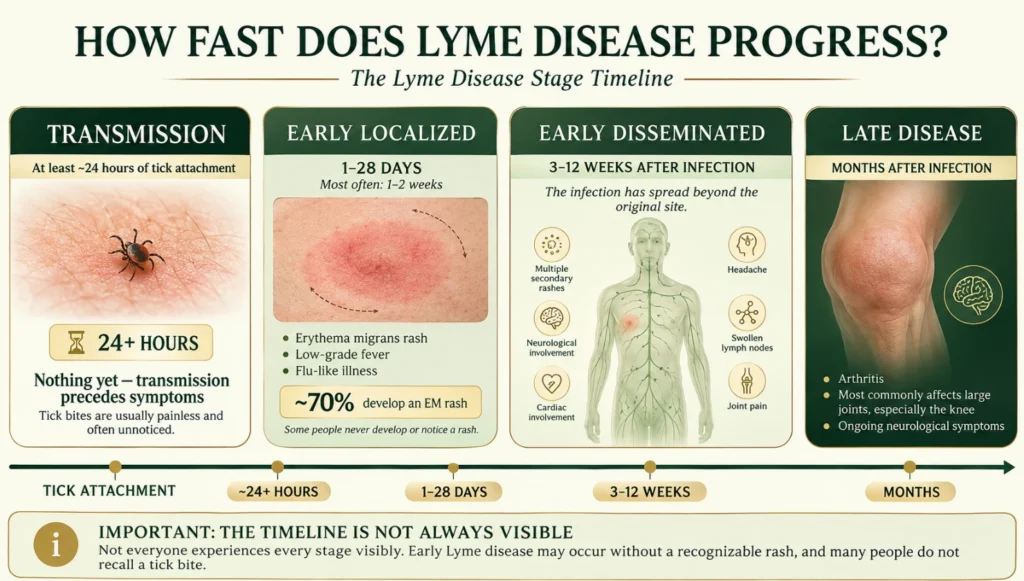
| Stage | When it appears | What typically shows up |
|---|---|---|
| Transmission | Laboratory studies suggest at least 24 hours of attachment | Nothing yet. Bites are usually painless and often unnoticed. |
| Early localized | 1 to 28 days, most often 1 to 2 weeks | Erythema migrans rash in about 70% of patients, low-grade fever, flu-like illness |
| Early disseminated | 3 to 12 weeks after infection | Multiple secondary rashes, neurological and cardiac involvement, joint pain, headache, swollen glands |
| Late disease | Months after infection | Arthritis, most commonly in large joints such as the knee, and ongoing neurological symptoms |
Erythema migrans is the expanding rash that can appear at the site of a tick bite. Untreated, it “persists for 2 to 3 weeks and may expand to 20 cm in diameter.”
The clean structure of that table hides something important, which is that a large number of people do not move through it visibly. More on that below.
The timeline does not begin at the bite. It begins at transmission, and those are not the same moment, which is why the stages of Lyme disease start later than people assume.
Oregon Health Authority guidance notes that “attachment for at least 24 hours is required for spirochete transmission to occur,” which is why prompt tick removal genuinely matters. A tick found and removed quickly is a much lower risk event than one that fed for two days.
The complication is that you often do not get to make that decision, because “Ixodid tick bites are generally painless, and many LD patients have no recollection of a tick bite.”
Most infections are acquired between May and August, when the nymphs, which are roughly poppy-seed sized, are most active. Small, painless, and easy to miss.
This is the window where treatment is most straightforward and where the diagnosis is most often available.
The rash is the classic sign, seen in about 70% of patients, typically developing 7 to 14 days after the bite. It expands over days rather than appearing at full size, which is one way it differs from an ordinary insect bite reaction.
Alongside it, people commonly report low-grade fever and a flu-like illness that does not fit the season.
That 70% figure carries a lot of weight. Roughly three in ten people never get the rash, or never see it, and those people frequently go undiagnosed at exactly the point when diagnosis would have been simplest. If you want the detail on what the rash does and does not look like, that is on the Lyme disease bullseye rash.
The wider early picture, including what shows up when the rash never does, is on early Lyme disease symptoms.
Dissemination means the bacteria have spread beyond the original site.
This stage usually develops 3 to 12 weeks after the initial infection, and it is associated with neurological and cardiac manifestations. People may develop multiple secondary rashes, along with fever, joint pain, headache and swollen lymph nodes.
The three-to-twelve-week window is where a great deal of diagnostic confusion happens. The bite, if it was noticed at all, is now a month or more in the past. Symptoms look like many other things. Nobody connects a facial droop or a run of palpitations in August to a walk taken in June.
Late disease may occur months after the initial infection. Arthritis is the characteristic feature, most often affecting large joints and most commonly the knee.
By this point the causal chain is very hard to see from the inside. Someone presenting with a swollen knee and a year of fatigue is not usually asked about a summer two years ago.
This is where most people who reach this practice actually are, and the timeline explains why. The diagnosis was available and simple at week two, harder at week eight, and by the time symptoms became undeniable it looked like several unrelated problems. The broader picture is on chronic Lyme disease symptoms.

The staging above is real and clinically useful. It is also cleaner than most people’s experience.
So the practical question is not only how fast it progresses, but how much time has already passed and what is still worth investigating. That is what Lyme disease diagnosis covers.
Seek emergency care, do not wait for an appointment, if you develop: chest pain, heart palpitations, fainting or near-fainting, shortness of breath, a facial droop, severe headache with a stiff neck, or new confusion. Lyme can affect the heart and nervous system, and cardiac involvement is the presentation that can become life threatening.
Early localized disease usually appears within 1 to 28 days, most often at 1 to 2 weeks. The erythema migrans rash typically develops 7 to 14 days after the bite.
Generally at least 24 hours, which is why prompt removal matters.
Early disseminated disease usually develops 3 to 12 weeks after infection, and late disease may appear months afterward.
Yes. The rash is seen in about 70% of patients, so roughly 30% never develop or never notice one, and progression can occur regardless.
No. Late presentations are common and still worth investigating. The diagnosis becomes harder, not impossible.
Early appropriate treatment resolves the infection for many people. Some remain symptomatic afterward, which is a different clinical problem and one worth evaluating properly rather than dismissing.
Every source below was checked against the specific claim it supports.
Written and medically reviewed by Dr. Diane Mueller, ND, DAOM, LAc. Dr. Mueller is a naturopathic doctor and licensed acupuncturist who has worked with more than 1,000 patients across the seven states where MyLymeDoc is licensed. Read more about the team.
Last reviewed: August 28, 2026
If your timeline started a long time ago and nobody has taken it seriously, you can book an initial visit.
This page is for general educational purposes and is not medical advice. It does not create a doctor and patient relationship, and it is not a substitute for diagnosis or treatment from your own clinician. If you suspect a recent tick bite and develop symptoms, contact a clinician promptly. If you are experiencing a medical emergency, call 911 or go to the nearest emergency room.
We have helped thousands of people in Colorado, Oregon, Wyoming, New Jersey, Pennsylvania, Texas, and Wisconsin restore their health and quality of life by diagnosing and treating their Lyme Disease.
We have helped thousands of
people restore their health
and quality of life by diagnosing
and treating their Lyme Disease.
“Dr. Mueller’s approach to medicine is refreshing! There is only so much you can do with western medicine and in my life I was needing a new approach. By addressing the whole body, nutritional diet factors, environmental factors, blood work, and incorporating ideas I had not previously known, I was able to break through with my conditions. I am not only experiencing less pain in my life, but through the process of healing guided by Dr. Diane Mueller, I am now happy to say I have more consciousness surrounding how I eat, what to eat and when things are appropriate. Living by example Dr. Mueller has a vibrancy that makes you want to learn and know more about your body and overall health. I highly recommend her to anyone looking for new answers, a new approach to health, or in need of freedom from pain and limitations.”
-Storie S.
Kihei, HI