

A VCS test for mold, short for visual contrast sensitivity, measures how well your eyes pick out faint gray patterns. Dr. Ritchie Shoemaker’s research on chronic inflammatory response syndrome (CIRS), a persistent inflammatory illness, treats a low score as one marker of biotoxin illness after water-damaged building exposure. A low score is a screening signal, not a diagnosis, because eye disease, lighting, and screen settings can also lower it. In a 2006 case series by Shoemaker and House, VCS was abnormally low in all participants (28 enrolled, 26 completed). A 2026 comparison of 28 exposed adults and 30 controls found the Shoemaker handheld chart did not separate the two groups, while digital tests did. A normal score does not rule out mold illness, and a low score points toward a fuller workup.
If you have ever said, “My labs all come back normal but I feel terrible,” a free vision screen can feel like the first test that finally measures something. This guide explains what the screen can and cannot show, and how it fits with the rest of a workup for mold brain fog and related symptoms.
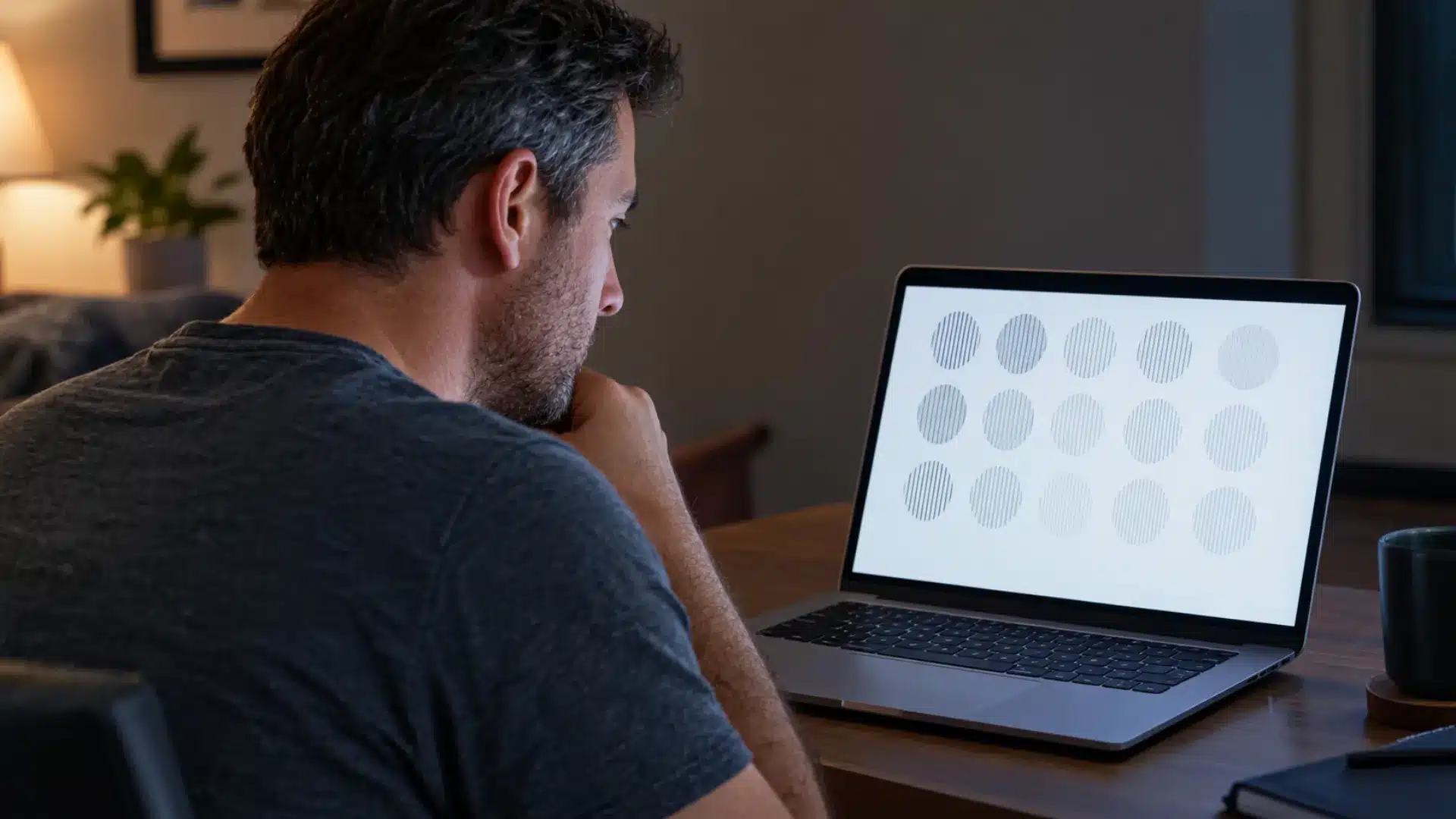
The visual contrast sensitivity test measures the faintest pattern your eyes can detect at several levels of detail, which is a different skill from reading letters on an eye chart.
Visual contrast sensitivity (VCS) is the ability to detect a pattern that differs only slightly in shade from its background. EPA researcher Ken Hudnell describes it as an indicator of neurologic function in the visual system.
Chronic inflammatory response syndrome (CIRS) is a persistent, multi-system inflammatory illness that Shoemaker’s research links to biotoxin exposure, most often from a water-damaged building. Its diagnosis remains controversial.
On the test, you look at rows of gray bars that grow fainter, and you report which way each set tilts. The faintest set you can judge, at each level of detail, becomes your score. Our guide to what CIRS is covers the illness itself.
Contrast sensitivity and sharpness are separate measures. In the 2006 Shoemaker and House series of 28 enrolled patients, visual acuity on a standard chart did not vary significantly while VCS scores changed. That gap shows the two measures are separate: in these patients VCS changed while acuity stayed about the same.
Ken Hudnell, a researcher at the U.S. Environmental Protection Agency, developed the VCS test, and Dr. Ritchie Shoemaker adopted it as a screening and monitoring tool in his work on illness after toxin exposure.
The first published use in this line of work was a 2001 case series of five patients exposed to estuary water where a toxin-forming organism was suspected, not to indoor mold. The authors reported that VCS was sharply reduced in affected people and recovered during treatment with cholestyramine, a prescription bile acid binder. Shoemaker later reported VCS findings in patients from water-damaged buildings, and a 2025 review calls VCS the first objective marker in the CIRS diagnostic framework. Our cholestyramine and mold guide covers that drug and its evidence.
The Shoemaker protocol is Dr. Shoemaker’s published treatment approach for CIRS.
The VCS screen and the Shoemaker protocol belong to Dr. Shoemaker’s research tradition. They are not part of the 4-phase method that Dr. Diane Mueller, ND, LAc, DAOM, uses with patients.
Published evidence on the visual contrast sensitivity test is small and comes mostly from one research tradition, so its accuracy is still being worked out. This table lists each source we could open, with its size and its main limit.
Sensitivity is the share of affected people a test flags. Specificity is the share of unaffected people it correctly clears.
| Study | Design and size | What it found | Main limit |
|---|---|---|---|
| Shoemaker and Hudnell, 2001 | Case series, 5 patients | VCS sharply reduced in affected people; recovered during cholestyramine | Estuary exposure, not mold; no control group |
| Shoemaker and House, 2006 | Case series, 28 enrolled and 26 completed; 13-person placebo-controlled trial (7 drug, 6 placebo) | VCS abnormally low in all participants at baseline; mid-frequency VCS improved 65% after 2 weeks of cholestyramine and fell 42% after 3 days back in the building | Patients from one practice; one research group; very small trial |
| Jimenez-Barbosa et al., 2026 | 28 exposed adults vs 30 controls, four VCS tests | Digital tests showed lower scores in exposed adults. An experimental test reached 85% to 100% sensitivity and 60% to 80% specificity. Two commercial digital tests reached 80% to 95% sensitivity but 20% to 40% specificity. The Shoemaker handheld chart did not distinguish the groups | Small study; highest-scoring test was research software, not a consumer product; exposed group diagnosed by one kind of practitioner |
The 2026 sensitivity and specificity figures are ranges across cut-off levels. The 20% to 40% specificity of the commercial digital tests means many people without the illness also score low.
Results also vary between practices. In a Kresser Institute practitioner Q&A, a clinician said that, according to Shoemaker’s data, 92 percent of people with biotoxin illness had a positive VCS. In his own practice, about 60 to 70 percent of CIRS patients did. That is a practitioner’s account, not a peer-reviewed study.
None of these studies is a large, independent test against an agreed outside standard. The 2026 authors call the diagnosis itself controversial, in part because symptoms overlap with other disorders such as allergies.
A low VCS score has several possible causes besides mold, and the test itself has limits, so the number alone cannot name the cause.
You take a VCS test for mold illness online by viewing gray bar patterns on a screen and choosing which way each one tilts. Several online versions exist, and some give limited results free while asking a contribution for a detailed report, so read the terms before you start. We do not endorse a specific vendor.
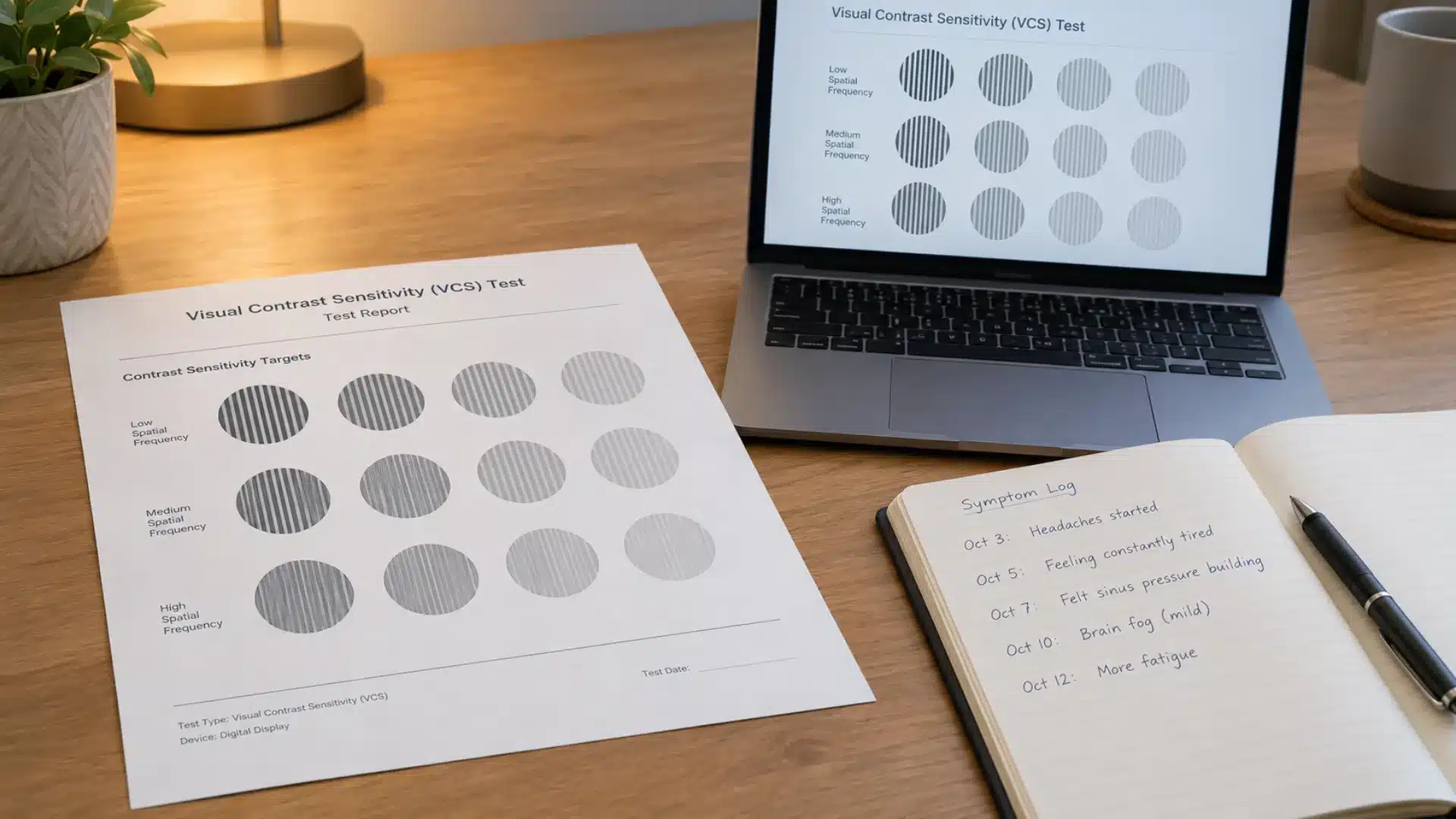
People often call a VCS result pass or fail, but it is a screening score, and a score is not a diagnosis. The pattern of your symptoms matters as much as the number, as our guide to mold illness symptoms explains.
| Your situation | What it may suggest | What it does not tell you |
|---|---|---|
| Low score, plus symptoms and time in a water-damaged building | A pattern consistent with biotoxin illness, worth a fuller workup | That CIRS is confirmed, or that mold is the cause |
| Low score, no exposure history | Another cause to rule out first, such as an eye condition or test setup | Anything about mold |
| Normal score, plus symptoms and exposure | The screen did not flag you, and labs and history still matter | That mold illness is ruled out |
| Scores that change over time | In the 2006 series, mid-frequency VCS moved with treatment and with re-exposure | Whether a given treatment is working for you |
Researchers place the VCS test for mold within a wider process. A 2025 review describes CIRS diagnosis as a combination of symptom clusters, exposure history, VCS testing, HLA haplotypes, and a panel of laboratory biomarkers. VCS is one piece of that picture.
After a VCS test for mold illness, your next step is a fuller workup that combines your exposure history, your symptoms, and lab testing.
If you have asked, “Why am I still sick even though I moved out of the moldy house?”, a VCS screen can be the first clue, and it works best as one clue among several. Any clinician who uses a VCS result should read it next to your exposure history, symptoms, and labs.
Where a workup points to CIRS, Dr. Mueller’s 4-phase method builds the body first. The next phases are lifestyle and nervous system support, gentle detox, and targeted microbe balancing. The Shoemaker protocol stays Dr. Shoemaker’s own work.
My Lyme Doc offers video visits for patients in 11 states: CO, OR, WY, NJ, PA, TX, WI, NH, AL, SD, and VT. You can book a consultation with Dr. Mueller to go through your results together.