


A PCR test for Lyme disease looks for the DNA of Borrelia burgdorferi, the bacteria that causes Lyme, in joint fluid, skin, spinal fluid, or blood. A positive result is highly specific, though lab contamination can cause false positives. A negative result says much less, because Borrelia DNA is often absent from the small sample tested. Joint fluid and skin biopsies perform well, while blood and spinal fluid miss most cases. The CDC’s recommended workup is two-step antibody testing, and PCR sits outside it. If your PCR came back negative and your symptoms still match, that result alone does not rule Lyme out.
If you have ever thought, “I tested negative but my symptoms match exactly,” you are far from alone. Our guide to interpreting Lyme test results covers the antibody side.
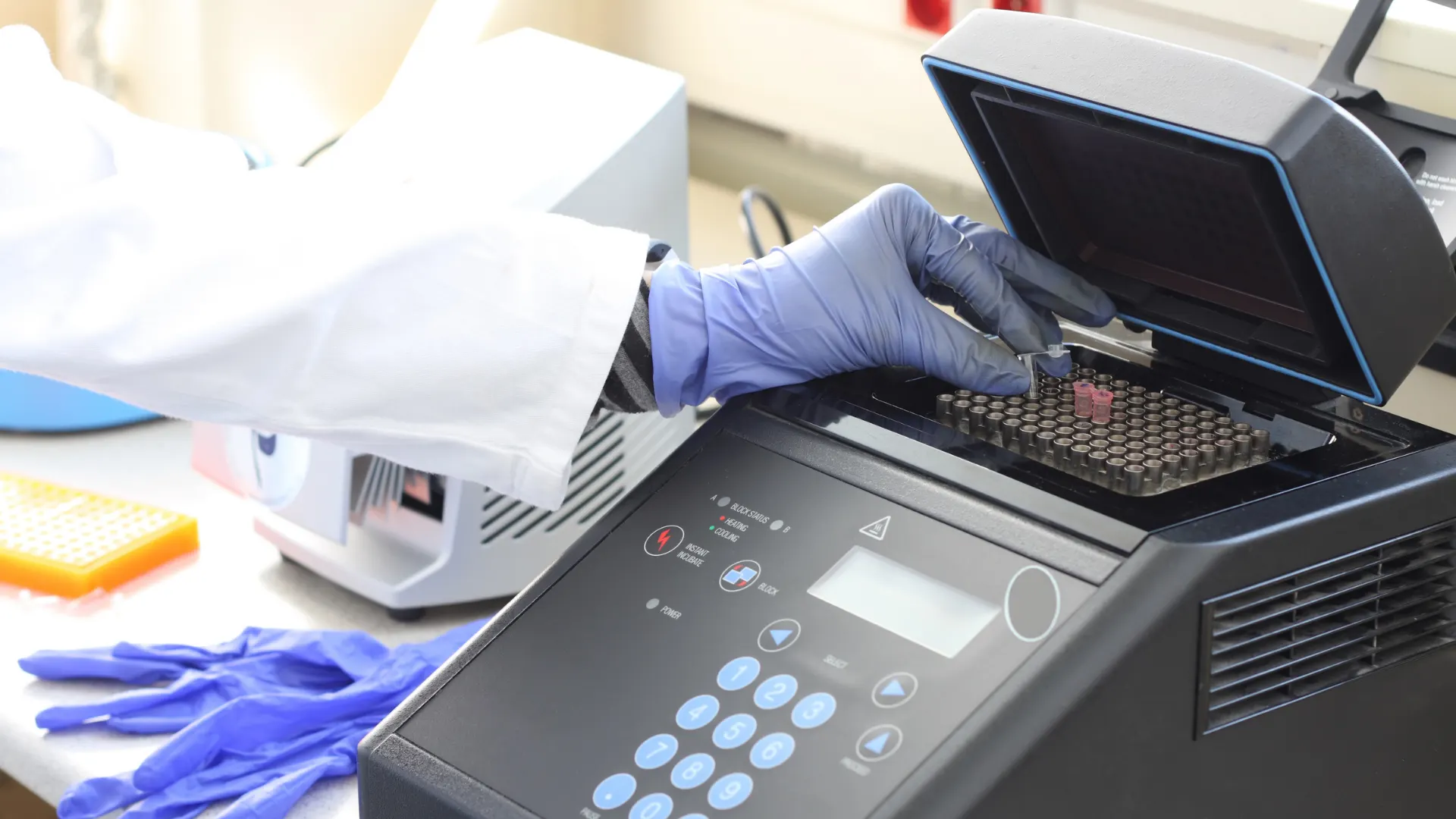
The PCR test for Lyme disease is a DNA test that searches a sample for Borrelia burgdorferi and copies any genetic fragment it finds until the lab can detect it.
Borrelia burgdorferi is the spiral-shaped bacteria that causes most Lyme disease in the United States, carried by blacklegged ticks.
PCR (polymerase chain reaction) is a lab method that makes millions of copies of a specific stretch of DNA, so a trace of genetic material becomes measurable.
Standard Lyme tests are indirect, because they measure the antibodies your immune system makes. A 2016 CDC review describes PCR as able to “provide highly specific evidence of B. burgdorferi nucleic acid.” The same review adds that its usefulness “is limited by low sensitivity (particularly for blood and CSF samples).” Specific means a positive is rarely wrong. Low sensitivity means many true infections test negative.
Four sample types can go to the lab for Lyme PCR, and each matches a different stage of illness.
Erythema migrans is the expanding red rash at the site of an infected tick bite. The CDC says it appears 3 to 30 days after the bite, about 7 days on average.
Some labs also offer urine PCR. A 2001 meta-analysis found urine assays varied widely between studies, and Borrelia DNA can persist in urine after treatment.
Lyme disease PCR accuracy runs from about 73% to 85% in joint fluid down to 18% to 38% in spinal fluid, depending on the study. This Lyme PCR test accuracy table lists each figure with its source.
Sensitivity is the share of truly infected people a test correctly flags as positive. Specificity is the share of uninfected people a test correctly reads as negative.
| Sample | Reported sensitivity | Source | What it means for you |
|---|---|---|---|
| Joint fluid, Lyme arthritis | Above 75% | CDC, Emerg Infect Dis 2016 | The best use of PCR |
| Joint fluid, pooled | 73% | Dumler meta-analysis, 2001 | Pooled across studies |
| Joint fluid, all patients | 85% (75 of 88) | Nocton et al., NEJM 1994 | Zero positives in 64 controls |
| Joint fluid, untreated or short oral antibiotics | 96% (70 of 73) | Nocton et al., NEJM 1994 | Strongest before long antibiotic courses |
| Skin biopsy | 68% (pooled) | Dumler meta-analysis, 2001 | Useful, but the rash is usually diagnosed by sight |
| CSF, early nerve Lyme | 38% (one US study) | CDC, Emerg Infect Dis 2016 | Misses most cases |
| CSF, pooled | 18% | Dumler meta-analysis, 2001 | Cannot rule Lyme in or out |
| Plasma (blood) | 29% | Dumler meta-analysis, 2001 | Misses roughly 7 in 10 cases |
| Mixed samples, children | 41.8%, specificity 100% | Nigrovic et al., 2020 | Added no new diagnoses |
The pediatric study followed 124 children at six centers and defined Lyme cases by positive two-tier antibody results. Its authors concluded that PCR did not improve diagnosis. The spinal fluid numbers matter most if you have neurological Lyme symptoms, because a negative CSF PCR is the expected result in most true cases.
The CDC’s standard Lyme workup relies on FDA-cleared, two-step antibody tests, and Lyme PCR has no single validated standard.
The CDC “recommends using antibody tests that have been cleared by the U.S. Food and Drug Administration (FDA) and follow a two-step process.” In the standard version, an enzyme immunoassay (EIA) comes first and a Western blot for Lyme disease confirms it. In the modified two-tier approach, both steps are EIAs.
An EIA (ELISA) is a blood test that screens for antibodies to Lyme bacteria. A Western blot is a follow-up test that sorts those antibodies into bands by protein.
Two-tier testing is the CDC’s two-step antibody approach: a screening test first, then a second test on any positive or unclear result.
The 2016 CDC review states that Lyme PCR “has not been universally standardized.” Dumler’s meta-analysis found published assays differ in methods and gene targets, so one lab’s result may not match another’s.
Joint fluid from someone with positive antibody tests is where a PCR test for Lyme disease earns its place.
Lyme arthritis is joint swelling, most often in a knee, caused by Lyme bacteria that have spread beyond the skin.
The 2020 guideline from the Infectious Diseases Society of America, the American Academy of Neurology, and the American College of Rheumatology sets out its advice by sample.
Blood PCR also has a narrow role, since the CDC review notes it has helped detect Borrelia mayonii and Borrelia miyamotoi. PCR works differently for Bartonella and Babesia, covered in our guide to co-infection testing.
A negative PCR test for Lyme disease tells you only that no Borrelia DNA turned up in that sample, on that day.
What a negative PCR means: no Borrelia DNA was found in the sample tested. It does not show that the infection is absent from your body.
Treatment history matters too. In a 1994 NEJM study, joint fluid PCR was positive in 96% of patients who were untreated or had only short oral courses. It was positive in only 37% of those given IV or month-long oral antibiotics. Our guide to a false negative Lyme test explains other reasons results miss.
Positive results need the same care. A review in Clinical Microbiology Reviews says PCR should not be the only lab evidence for Lyme beyond the skin. It adds that a positive PCR with negative antibody tests in late Lyme most likely reflects a false positive.
Western blot testing and PCR answer different questions: PCR asks whether bacterial DNA is present, and the Western blot asks whether your immune system has responded.
| PCR | Two-tier antibody testing | |
|---|---|---|
| What it detects | Borrelia DNA | Your antibodies to Borrelia |
| Sample | Joint fluid, skin, CSF, or blood | Blood |
| First weeks of infection | Skin biopsy can detect it | 30% to 40% sensitivity |
| Later, spread infection | Strong in joint fluid only | 70% to 100% sensitivity |
| CDC first-line test | No | Yes, FDA-cleared tests |
| Main weakness | Misses most cases outside joint fluid | Antibodies take weeks to form |
The antibody figures come from the 2016 CDC review of Lyme lab testing. Antibody timing explains why an early ELISA test for Lyme disease can come back negative.
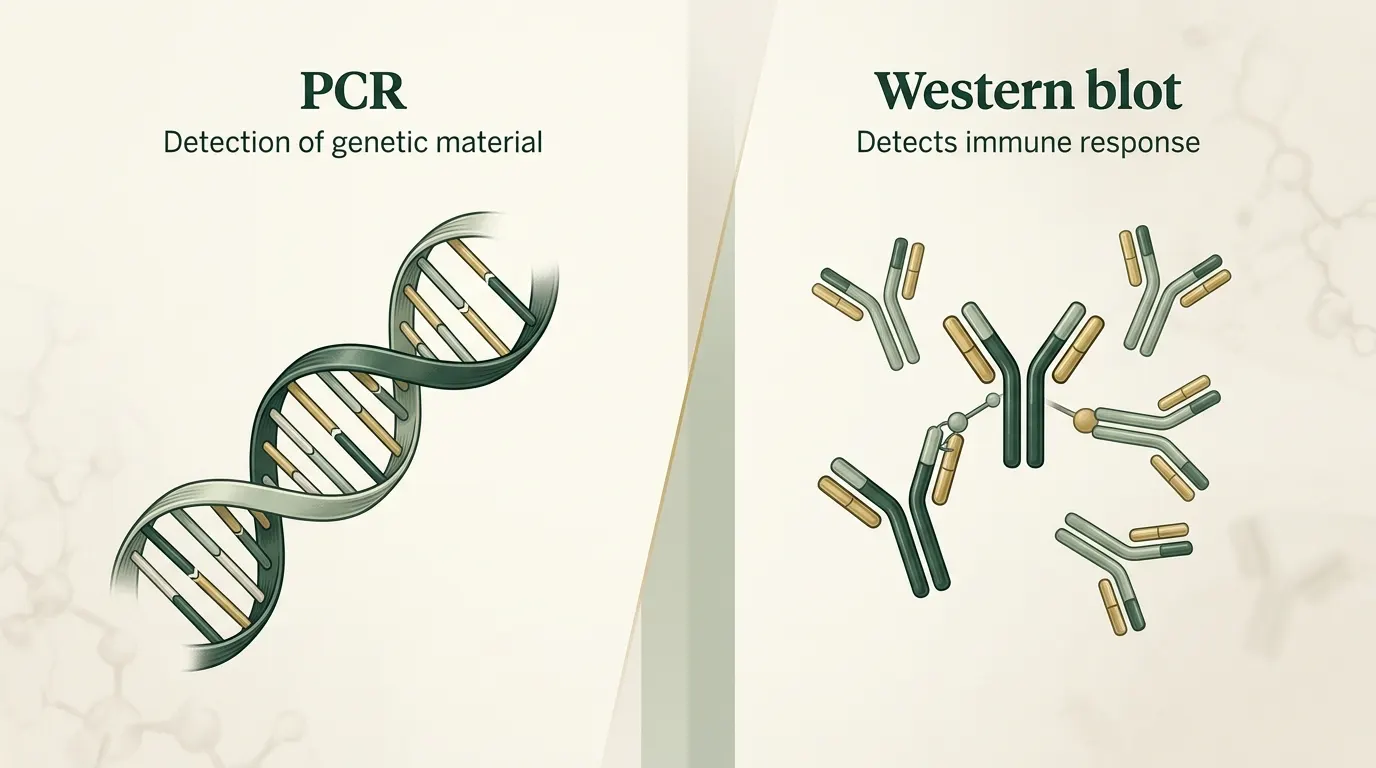
Your next step after a negative Lyme PCR is to read that single result alongside your antibody tests, exposure history, and symptoms.
A negative result is one data point, and a clinician can read it next to your antibody tests, timeline, and exposure history. My Lyme Doc sees patients by telehealth in 11 states, with an office in Centennial, Colorado. You can book a consultation with Dr. Mueller to review your results together.