

Lyme disease relapse is the return of symptoms after treatment that seemed to work, and it is one of seven possible explanations, not a verdict. In a 2012 New England Journal of Medicine study, none of 22 repeat rashes in treated patients came from the original strain, so those rashes were new infections.
A flare, a Herxheimer reaction, post-treatment Lyme disease syndrome, an untreated co-infection, or an exposure like mold can each look like relapse. You did the treatment, you felt like yourself again, and now the fatigue, pain or brain fog is back. That fear makes sense and deserves a real workup. Doctors disagree about how often true relapse happens, and this page shows where.
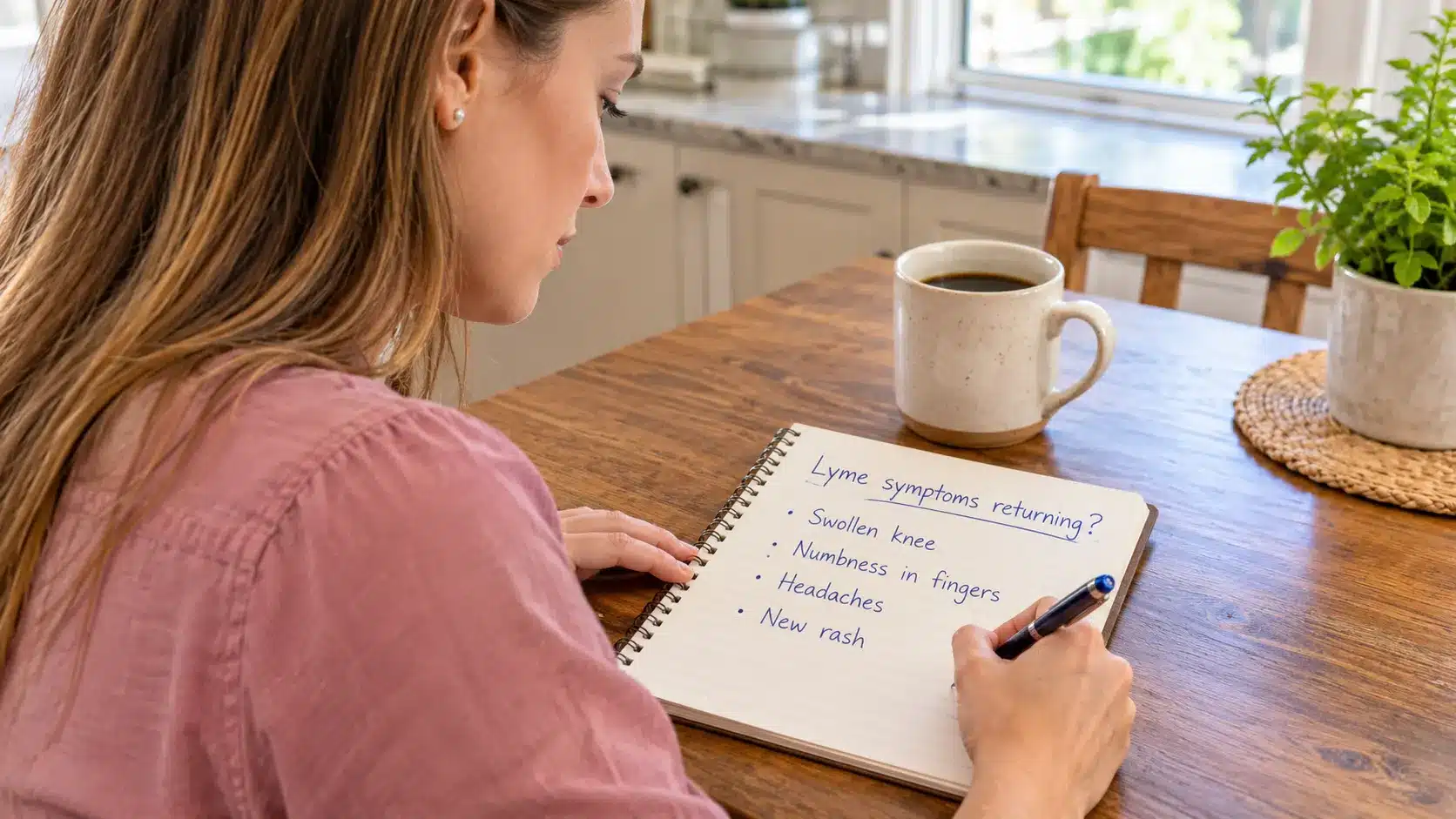
Seven different explanations can make Lyme symptoms return after treatment, and each one carries a different clue and a different level of evidence. If you are still early in care, our Lyme disease recovery timeline shows what a normal course looks like.
Relapse is the return of illness from the original infection after treatment seemed to work.
Reinfection is a new infection from a new tick bite, even if the first infection was treated.
Post-treatment Lyme disease syndrome (PTLDS) is the CDC’s name for prolonged symptoms such as fatigue, body aches or trouble thinking after Lyme treatment, with a cause that is currently unknown.
A Jarisch-Herxheimer (herx) reaction is a short worsening of symptoms in the first day after antibiotics start, likely an inflammatory response to bacterial material released by the first doses.
A flare is the everyday word for a temporary surge in symptoms you already had.
| Reason | What it means | Clue worth noting | Evidence status |
|---|---|---|---|
| Relapse | The original infection was not cleared and returns | Objective signs such as arthritis, meningitis or neuropathy (IDSA) | Debated. Animal studies show persistence, human evidence is thin |
| Reinfection | A new infection from a new tick bite | A new bite, or a new rash | Strong for rashes: 22 of 22 paired episodes were new strains |
| Flare | A temporary surge of symptoms you already had | No agreed clue. Raise it with your clinician and rule out the other six first | No research definition found, so it is a patient and clinician term |
| Herx reaction | A reaction to antibiotics, early in treatment | Starts within about 24 hours of an antibiotic and fades within hours | Described in the IDSA guideline and a 2017 review |
| PTLDS | Lingering symptoms after completed treatment | Fatigue, aches or thinking problems after treatment ended | Recognized by the CDC. Cause unknown |
| Untreated co-infection | A second tick-borne infection no one treated | More sweats, chills and headache than Lyme alone tends to bring | Documented in one New England series |
| Mold and other exposures | An exposure that produces similar symptoms | Symptoms that track with a building are worth raising. No study tests this for Lyme | Respiratory associations are established. Wider effects are contested |
These explanations can overlap, so you can have PTLDS and an untreated co-infection at once. Treat the table as a sorting tool and not a diagnosis.
True relapse means the original Borrelia infection returns after treatment, and it is the most debated explanation because animal and human evidence point in different directions.
In animals, bacteria can survive treatment. In a 2012 rhesus macaque study, animals received aggressive antibiotics four to six months after infection. Researchers still found Borrelia antigen, DNA and RNA in their tissues, and recovered small numbers of intact spirochetes by xenodiagnosis, which feeds clean ticks on the animal.
Human data are thinner. In a 2014 first-in-human study of 36 people, xenodiagnosis was negative in 16 people with PTLDS or high antibody levels and in 5 people treated for an early rash. It was positive for Borrelia DNA in one person early in treatment for a rash and in one person with PTLDS. The authors wrote that this was insufficient to conclude viable spirochetes were present. Their background statement, written in 2014, was that no convincing evidence existed for viable spirochetes after recommended antibiotic courses in humans.
One trial shows a pattern worth knowing. In a 2008 randomized trial of 37 patients with treated Lyme and memory impairment, 10 weeks of IV ceftriaxone improved cognition at week 12. The authors reported that the cognitive gain was not sustained at week 24, and described a relapse in cognition after the antibiotic stopped. Patients with more severe pain and physical impairment who received antibiotics kept their gains in those areas at week 24.
These findings show a real scientific disagreement, and they cannot tell you whether your symptoms come from active infection. For the full range of symptoms Lyme can cause over time, see our guide to chronic Lyme disease symptoms.
Reinfection, a new infection from a new tick bite, explains repeat erythema migrans rashes in treated patients, according to a molecular study of culture-confirmed rashes.
In the 2012 NEJM study, researchers typed the Borrelia strain from 22 paired rash episodes in 17 patients, all given standard antibiotics. None of the 22 pairs matched. The authors concluded that repeat rashes in appropriately treated patients were due to reinfection and not relapse.
That finding has limits. It covers culture-confirmed rashes, so it cannot tell you what is behind returning fatigue or pain with no rash. It does mean a new rash after treatment points to a new bite, and a bullseye rash deserves a call to a clinician the same week.
A Herxheimer reaction belongs to the first day of antibiotic treatment, and a flare is a surge of symptoms that arrives at some other time.
The IDSA guideline says a minority of patients treated for early Lyme have a transient intensification of symptoms during the first 24 hours of antibiotics. It calls this reaction usually mild and self-limited, and says it does not recur later in therapy. It adds that symptoms arising later in the course of treatment should not be classified as Jarisch-Herxheimer-like reactions. A 2017 review of spirochetal infections describes the same window, with symptoms resolving a few hours later.
By that definition, a surge that starts weeks or months after your last dose falls outside the herx window. It may be a flare, which has no formal research definition, or one of the other reasons in the table above. For symptoms and management of herx reactions during treatment, see our guide to the Herxheimer reaction.
PTLDS is the formal label for fatigue, aches and thinking problems that persist after Lyme treatment, and the CDC says its cause is currently unknown.
The CDC states that some people have prolonged symptoms of fatigue, body aches or difficulty thinking after treatment, and that more antibiotics are unlikely to help. A 2022 prospective cohort found 13.7% of 234 people with prior Lyme met criteria for post-treatment Lyme disease, compared with 4.1% of 49 people without it. Those with prior Lyme were about 5.3 times as likely to meet the criteria.
Two large trials tested more antibiotics. In Klempner and colleagues’ 2001 trials, 129 patients received 30 days of IV ceftriaxone plus 60 days of doxycycline, or placebo, and outcomes at day 180 did not differ. In the 2016 PLEASE trial of 280 patients, longer antibiotic courses added no benefit at week 14, though everyone improved from baseline.
For the full criteria, read our PTLDS guide.
IDSA and ILADS give opposite answers on antibiotic retreatment for persistent symptoms, though both put a check ahead of any retreatment.
| Question | IDSA, AAN and ACR (2020) | ILADS (2014) |
|---|---|---|
| More antibiotics for persistent or recurring symptoms? | Recommends against when there is no objective evidence of reinfection or treatment failure | Clinicians should discuss retreatment with all patients who have persistent manifestations |
| Strength of recommendation | Strong, moderate-quality evidence | Strong, very low-quality evidence |
| What counts as treatment failure? | Objective signs, such as arthritis, meningitis or neuropathy | Ongoing assessment for persistence, progression or relapse, since no test confirms that treatment worked |
| Before any retreatment | Look for objective evidence of reinfection or failure | Reassess the original diagnosis and investigate other tick-borne illnesses |
The two panels read the same literature differently. IDSA concludes that prolonged antibiotics have not been helpful and may cause harm. ILADS argues that selective entry criteria may limit how far the four retreatment trials generalize to patients seen in practice. It rates the overall evidence very low and judges that retreatment will prove appropriate for the majority of patients who remain ill. Each panel puts a check first, and the next two sections cover the two most common ones.

An untreated co-infection, such as babesiosis, can produce symptoms that look like Lyme returning, and it can make illness last longer.
A 1996 JAMA study in Rhode Island and Connecticut found 26 of 240 Lyme patients (11%) were also infected with babesia. Coinfected patients reported fatigue, headache, sweats and chills more often. Thirteen of 26 coinfected patients (50%) were symptomatic for 3 months or longer, compared with 7 of 184 (4%) with Lyme alone. This was one region from 1990 to 1994 and covered babesia only.
The IDSA guideline advises assessing for Anaplasma and Babesia in patients with high-grade fever or characteristic lab abnormalities in endemic regions. ILADS tells clinicians to investigate other tick-borne illness before retreating. Our co-infection symptom comparison chart lays out how these infections overlap.
Mold exposure can cause respiratory symptoms, and whether it explains Lyme-like fatigue, pain and brain fog is contested.
A 2004 Institute of Medicine report found sufficient evidence linking mold and damp conditions to asthma symptoms in people with asthma, and to cough, wheeze and upper respiratory symptoms in otherwise healthy people. For fatigue and neuropsychiatric complaints it found very few studies and did not find support for an association, but it could not rule one out because of the dearth of well-conducted studies.
Chronic inflammatory response syndrome (CIRS) is a framework developed by Dr. Ritchie Shoemaker for illness after exposure to water-damaged buildings. A 2024 review found 13 articles on CIRS treatment, with two randomized trials and ten papers from Shoemaker’s group. The authors said it was not a systematic review, and two of them disclosed expert witness work in CIRS cases, for both plaintiffs and defense.
We found no study that tests mold as a reason Lyme symptoms return. Fatigue is part of both the CDC description of PTLDS and the complaints the report reviewed, so the two can be hard to separate. Dr. Mueller treats both Lyme disease and mold illness. If your symptoms track with a building, our guide to mold illness symptoms is a place to start.
The first move when symptoms return is to document what changed and when, then get a clinician to reassess the whole picture.
If you have been told it is stress, or that your labs look normal, read what to do when your doctor does not believe you.
For lifestyle steps after treatment, see life after Lyme treatment.
Returning symptoms deserve a second look when a flare does not pass, when new signs appear, or when you were told nothing more can be done.
Patients have seen 20 or more specialists on average before finding Dr. Mueller. My Lyme Doc sees patients by telehealth in 11 states. Dr. Mueller, ND, LAc, DAOM, treats Lyme disease and mold illness with a four-phase method: build the body first, then lifestyle and the nervous system, then gentle detox, then targeted microbe balancing.
If your first round of treatment did not really work, read why Lyme treatment fails.
When you are ready, you can book a call with Dr. Mueller to go through your timeline and results.