


Long COVID vs Lyme disease comes down to your history. A COVID infection points toward Long COVID, while a tick exposure, an expanding rash, or a swollen knee points toward Lyme. Both can cause lingering fatigue, brain fog, and pain, and each can bring palpitations or dizziness, so symptoms alone rarely settle it. The CDC says there is no laboratory test for Long COVID. Lyme antibody tests can read negative in the first 4 to 6 weeks. A normal result does not close the case, and some people may have both.
If you have thought, “I tested negative but my symptoms match exactly,” you deserve a straight answer. Our guide to Do I Have Lyme Disease? covers the symptom quiz, and this page covers how Long COVID and Lyme compare, side by side.
Long COVID and Lyme disease share fatigue, headaches, joint and muscle pain, and heart palpitations on the CDC’s symptom lists, and post-treatment Lyme adds the thinking problems that also mark Long COVID.
Long COVID is a condition that follows a SARS-CoV-2 infection and lasts at least three months, whether symptoms stay constant, come and go, or progress.
Lyme disease is an infection caused by the bacteria Borrelia burgdorferi, passed to people by the bite of an infected blacklegged tick.
Post-treatment Lyme disease syndrome is fatigue, widespread pain, or thinking problems that begin within 6 months of treated Lyme disease, last at least 6 months, and impair daily function, with a cause that remains unknown, per a 2020 review of post-treatment Lyme disease.
The CDC’s Long COVID symptom list runs past 200 symptoms and includes tiredness that interferes with daily life, symptoms that worsen after physical or mental effort, brain fog, and a fast, pounding heart. The CDC’s Lyme symptom page lists fatigue, muscle and joint aches, and headache early, then palpitations, dizziness, and numbness later. Dr. John Aucott of Johns Hopkins told STAT that Long COVID, post-treatment Lyme, and other post-infectious conditions “all look remarkably similar”.
Long COVID and Lyme disease differ most in trigger, timing, and a few signature symptoms. An expanding rash, large-joint swelling, and facial droop point toward Lyme, while cough and changes in smell or taste appear on the CDC’s Long COVID list but not its Lyme list.
| Long COVID | Lyme disease | |
|---|---|---|
| Trigger | SARS-CoV-2 infection of any severity, including cases that went unrecognized | Bite from an infected blacklegged tick, sometimes not remembered |
| Timing | Symptoms present for at least 3 months | Rash 3 to 30 days after the bite (average about 1 week), other symptoms days to months later |
| Rash | Rash is on the CDC list | Erythema migrans in roughly 70% to 80% of cases, expanding up to 12 inches, can look different from a bullseye |
| Joints | Joint or muscle pain | Arthritis with severe pain and swelling, particularly the knees and other large joints |
| Breathing and chest | Shortness of breath, cough, chest pain | Episodes of dizziness or shortness of breath, palpitations in Lyme carditis, cough not on the CDC list |
| Smell and taste | Change in smell or taste is listed | Not listed |
| Nerves and face | Pins-and-needles feelings | Facial palsy, shooting pains, numbness in the hands or feet |
| Lymph nodes | Not on the CDC list | Swollen lymph nodes in early illness |
| Lab test | None, per the CDC | Two-step antibody testing, which can read negative in the first 4 to 6 weeks |
The table draws on the CDC’s pages for Long COVID, Lyme disease, and the National Academies definition of Long COVID. A rash that spreads over several days is described in our guide to the bullseye rash of Lyme disease.
A swollen, painful knee fits the Lyme column better than widespread aches after a respiratory infection, and our page on Lyme disease joint pain explains the large-joint pattern.
Erythema migrans is the expanding skin rash of early Lyme disease, which the CDC says can appear 3 to 30 days after a tick bite.
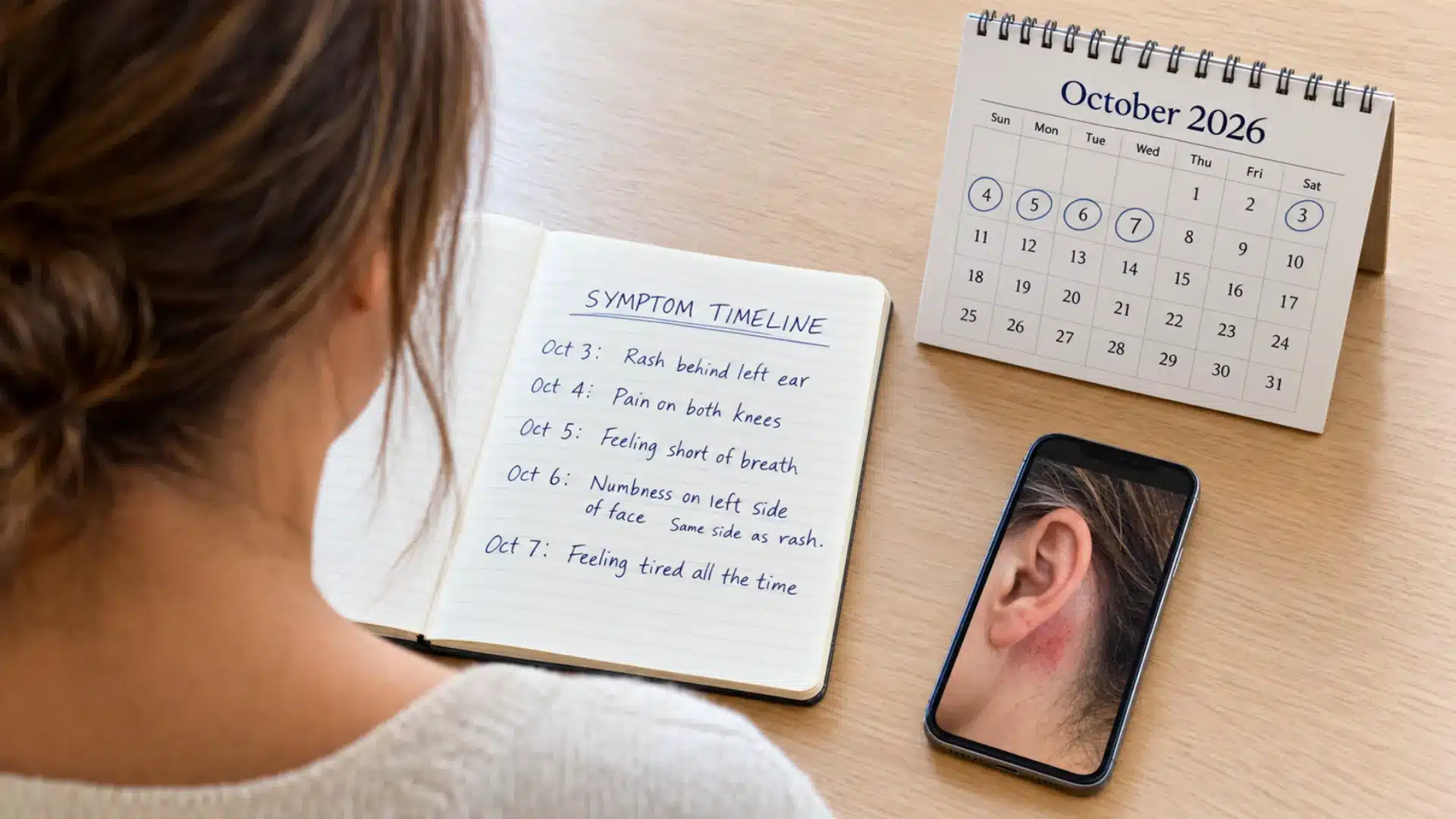
Five history questions help separate Long COVID from Lyme disease, because Aucott says sorting them out takes careful history-taking and no shortcuts, as STAT reported on diagnosing both.
For a typical rash after tick exposure in an endemic area, the 2020 IDSA, AAN, and ACR guideline recommends diagnosis by exam rather than lab testing.
POTS-like symptoms, a fast heart rate and dizziness when you stand, are well described after COVID-19, and autonomic symptoms are common in post-treatment Lyme disease, where a standing test can measure them.
POTS (postural orthostatic tachycardia syndrome) is a form of dysautonomia in which heart rate rises by at least 30 beats per minute within 10 minutes of standing, without a significant drop in blood pressure.
A 2022 review of POTS after COVID-19 describes head-up tilt table and active standing tests as the main evaluations and states that the cause remains unknown. A 2025 study of people with post-treatment Lyme found that autonomic symptoms were common, yet only 9 of 210 people (4.29%) showed orthostatic tachycardia on a 10-minute active stand test. Autonomic symptoms and a measured fast heart rate on standing are different findings, and a stand test shows who meets the POTS definition. Our dysautonomia and POTS page covers the condition itself.
Long COVID has no confirming lab test, and Lyme disease has antibody testing that shows exposure but cannot show whether Lyme is behind your symptoms today.
For Long COVID, the CDC states that there is no laboratory test for it, and the National Academies report says that no biomarker currently available demonstrates conclusively the presence of Long COVID. Diagnosis is clinical. Researchers are studying blood-marker panels, and one 2024 Scientific Reports paper opens by noting that no Long COVID diagnostic exists, then proposes an experimental machine-learning model built on cytokine markers.
For Lyme disease, the CDC recommends two-step antibody testing, and both steps are required. Antibody tests may read falsely negative in the first 4 to 6 weeks. Once antibody levels rise they can stay elevated for months to years, so the CDC says they cannot be used to show whether treatment worked. Aucott told STAT that the Western blot can confirm past exposure but cannot tell whether someone has Long COVID or chronic Lyme. Our guide to interpreting Lyme disease test results covers each result.
A negative result with a tick history and matching symptoms is one data point, and our page on the false-negative Lyme test explains why timing matters.
A person can have Long COVID and Lyme disease at the same time, because they come from separate exposures, and a positive Lyme antibody result in someone with Long COVID needs a history to interpret.
STAT reports that Aucott says multiple of his patients developed Long COVID after being diagnosed with post-treatment Lyme. A Lyme antibody result shows exposure at some point, so your history decides what it means for your symptoms today. We did not find a study that counts how often the two occur together, so no percentage appears here.
Tick co-infections are tied to longer Lyme illness, a reactivated Epstein-Barr virus is associated with fatigue in Long COVID, and the CDC links damp-building exposure to cough and wheeze, and each rests on a different level of evidence.
Ticks often carry multiple pathogens that can infect people at the same time, according to a 2023 editorial on tick-borne coinfections. In a 1996 JAMA study in southern New England, 26 of 240 people with Lyme disease (11%) also had babesiosis. 50% of the coinfected group stayed symptomatic for 3 months or longer, compared with 4% of those with Lyme alone, the study found. Our page on co-infections testing covers how Babesia, Bartonella, and others are checked.
EBV reactivation, in these studies, means blood antibody markers suggesting that Epstein-Barr virus has become active again.
In a 2021 study, 20 of 30 people with Long COVID (66.7%) had EBV reactivation markers, versus 2 of 20 controls (10%). A 2023 study of 280 adults associated fatigue and thinking problems with recent reactivation markers, but not with ongoing EBV in the blood. Both are association studies, and neither shows that EBV causes Long COVID.
Mold belongs in the history because the CDC says damp and moldy environments may cause health effects that differ by person, or none at all, including cough and wheeze. The CDC does not recommend mold testing, so a water-damaged home is a question for your timeline. Our page on mold illness symptoms covers how we approach it.
A root-cause workup at My Lyme Doc starts with a dated timeline of infections, exposures, and symptoms, then matches testing and treatment order to that timeline instead of to a single label.
Dr. Diane Mueller, ND, LAc, DAOM, builds care around a four-phase method:
Ninety-nine percent of our patients come in with missing root causes others have missed. Rose M. of Austin, TX, wrote that she “had gone to 20 top specialists over 3 years and was not able to get a correct diagnosis.” Every visit is a video visit, and My Lyme Doc sees patients in 11 states: CO, OR, WY, NJ, PA, TX, WI, NH, AL, SD, and VT. You can book a consultation with Dr. Mueller to walk through your timeline.
Our guide to peptides for chronic illness covers that topic separately, including the evidence and the sourcing risks.

To sort Long COVID from Lyme disease this week, write a one-page timeline and bring it to a clinician who evaluates both together.
If you have been dismissed, the timeline gives the next doctor something concrete, and you can start with a video visit from home.