


By Dr. Diane Mueller, ND, LAc, DAOM | Last reviewed: August 3, 2026

Peptides for inflammation work primarily as signaling molecules that calm an overactive immune response, support tissue repair, or restore mitochondrial energy production. Physicians currently use at least nine distinct peptides across chronic illnesses including fibromyalgia, long COVID, mast cell activation syndrome (MCAS), and mold illness (CIRS). Peptides are not drugs in the conventional sense: a peptide does not force a biological process, it signals a cell or system to start, adjust, or stop one it already knows how to run.
If you have chased a diagnosis through specialist after specialist and walked out with a shrug or a normal lab panel, you already know the exhaustion. Peptides get talked about online with the same overconfidence as everything else in this space, noise that makes a straight answer harder to find. Here is the direct version, for people managing fibromyalgia, long COVID, MCAS, mold illness, or an infection like Lyme disease that has not yet been named.
A peptide is a short chain of amino acids that acts as a signaling molecule, instructing a cell or system to start, slow, or change a biological process. A growth hormone peptide does not put growth hormone into your bloodstream directly, it asks the pituitary to make more. That supplies only the signal in a chain of signal, response, and adaptation.
This distinction determines almost everything else about how peptides for inflammation fit into chronic illness care, since a peptide that calms an overactive immune system and one that stimulates immune activity are solving opposite problems. That is exactly why peptide therapy treats each compound on its own terms. It never promises one peptide will fix every chronic condition.
Fibromyalgia, long COVID, MCAS, and mold illness look unrelated from the outside, but inflammation and immune dysregulation run underneath all four, which is why peptides for inflammation show up across every one of these labels.
The RECoVERED cohort study found that long COVID patients with ongoing symptoms at 24 weeks carried measurably raised CRP.[2] A separate subgroup, those with abnormal lung diffusion capacity, also carried raised IL-6, IL-10, IL-17, and TNF-alpha at the same time point. Fibromyalgia and MCAS follow a similar pattern: normal-looking labs alongside a nervous and immune system both running hot. Mold illness, or CIRS, adds mycotoxin exposure that keeps the inflammatory cascade active long after leaving the moldy building.
Peptides get used across this whole group because several address the shared mechanism, immune dysregulation and inflammatory signaling, rather than a single disease label. Semax and Selank support the nervous system side (cognitive fog, anxiety); thymosin alpha-1 and LL-37 support the immune side; SS-31 supports mitochondrial fatigue; larazotide supports the gut lining frequently compromised across these conditions. None of these peptides resolves any condition on its own, each addresses one piece of a shared pattern.
We have helped thousands of people in Colorado, Oregon, Wyoming, New Jersey, Pennsylvania, Texas, Wisconsin, New Hampshire, Alabama, South Dakota, and Vermont restore their health and quality of life by diagnosing and treating their Lyme Disease.
Peptides for inflammation work through several distinct mechanisms, and knowing which one applies matters more than knowing peptides exist.
Some calm inflammatory signaling directly. Others repair structures inflammation damages, such as the gut lining or the blood-brain barrier. Still others support the mitochondria, the cellular structures responsible for energy production, which chronic inflammation reliably suppresses over time. A patient with long COVID fatigue and a patient with post-Lyme fatigue can both be dealing with mitochondrial suppression from different triggers. This is why SS-31, a mitochondrial-support peptide, gets used across multiple chronic illness labels rather than one.
Mitochondrial-targeted peptides as a class have real regulatory precedent, not just wellness-market buzz. In September 2025, the FDA granted accelerated approval to elamipretide (Forzinity), the first treatment for Barth syndrome, a drug that binds directly to the mitochondria to improve their structure and function.[1] That approval covers a rare pediatric disease only, not chronic fatigue or general use. SS-31 itself remains research-use here, not an FDA-approved drug. The mechanism class has proof of concept; the application to chronic fatigue is still investigational.
I tell every patient the same thing before starting a peptide protocol: sourcing is not a technicality, it is the safety plan.
There are two paths to getting a peptide. One is a licensed compounding pharmacy on prescription, with real quality-control standards. The other is an online research-chemical vendor, no prescription, no physician reviewing your history. The label can say the same peptide name on both. What actually arrives in the vial can be very different, and that difference is where the real risk lives.
Lipopolysaccharide, or LPS, is a bacterial endotoxin that should never appear in a peptide vial, a risk rarely mentioned in peptide-safety content. Research-only manufacturing that skips pharmaceutical-grade purification can leave LPS behind. A 2021 Frontiers in Cellular and Infection Microbiology review found LPS damages the blood-brain barrier directly, contributing to neuroinflammation.[3] For a chronic illness patient already managing leaky gut or brain fog, a contaminated peptide adds fuel to the fire you are trying to put out. This is why I only prescribe peptides through compounding pharmacies with a genuine standard of care, never a research-chemical website.
The regulatory picture is still moving. As of the FDA's July 2026 Pharmacy Compounding Advisory Committee meeting, several popular research peptides are under review for legal compounding status. These include BPC-157, Semax, KPV, TB-500, MOTS-C, Epitalon, and Emideltide.[4] None is FDA-approved. That gap does not mean unsafe, but it means outcome data has to be managed with real supervision, not assumptions.
Growth hormone peptides like tesamorelin, CJC-1295, and ipamorelin signal the pituitary to release more of the body's own growth hormone rather than introducing it directly.
In my clinical experience with chronic infection and chronic illness patients, two benefits come up far more often than the visceral-fat effects usually marketed for these peptides: real pain reduction and noticeably deeper sleep. Growth hormone releases in its largest pulses during deep sleep, and chronic illness patients are disproportionately affected by insomnia. Tesamorelin itself is FDA-approved under the brand name Egrifta for exactly one use, reducing excess abdominal fat in HIV-associated lipodystrophy. Every other application, including the pain and sleep benefits discussed here, is off-label.
Here is the rule I do not bend: growth hormone peptides are never used with active or recent cancer. Not used cautiously. Not used at all. Elevated IGF-1, the growth factor these peptides raise, can theoretically support the growth of existing cancer cells, so in a system with active cancer that risk outweighs any potential benefit. If you have a personal or recent cancer history, this needs to be part of the conversation before a growth hormone peptide protocol is even discussed.
We have helped thousands of people in Colorado, Oregon, Wyoming, New Jersey, Pennsylvania, Texas, Wisconsin, New Hampshire, Alabama, South Dakota, and Vermont restore their health and quality of life by diagnosing and treating their Lyme Disease.
Peptides that stimulate immune activity carry a different risk than peptides that calm inflammation, one that chronic illness patients are more likely to encounter.
Thymosin alpha-1, used for immune and antiviral support including EBV and CMV reactivation, and LL-37, an antimicrobial peptide often used for chronic infections, both turn immune activity up. That is what makes them useful against a persistent infection or reactivated virus. It is also why they can trigger a Herxheimer reaction, a temporary worsening of symptoms when the body clears dying pathogens and inflammatory byproducts faster than it can process them. If you have been through Lyme disease treatment before, this pattern may already be familiar.
A second caution sits on top of the first: if you have an autoimmune condition, your immune system is frequently already overactivated. Adding a peptide that stimulates immune function further needs a provider watching for that interaction, not guessing after symptoms flare.
Peptides are not interchangeable. The right question is never "should I try peptides," it is which peptide, for which piece of your inflammatory picture, with which caution attached.
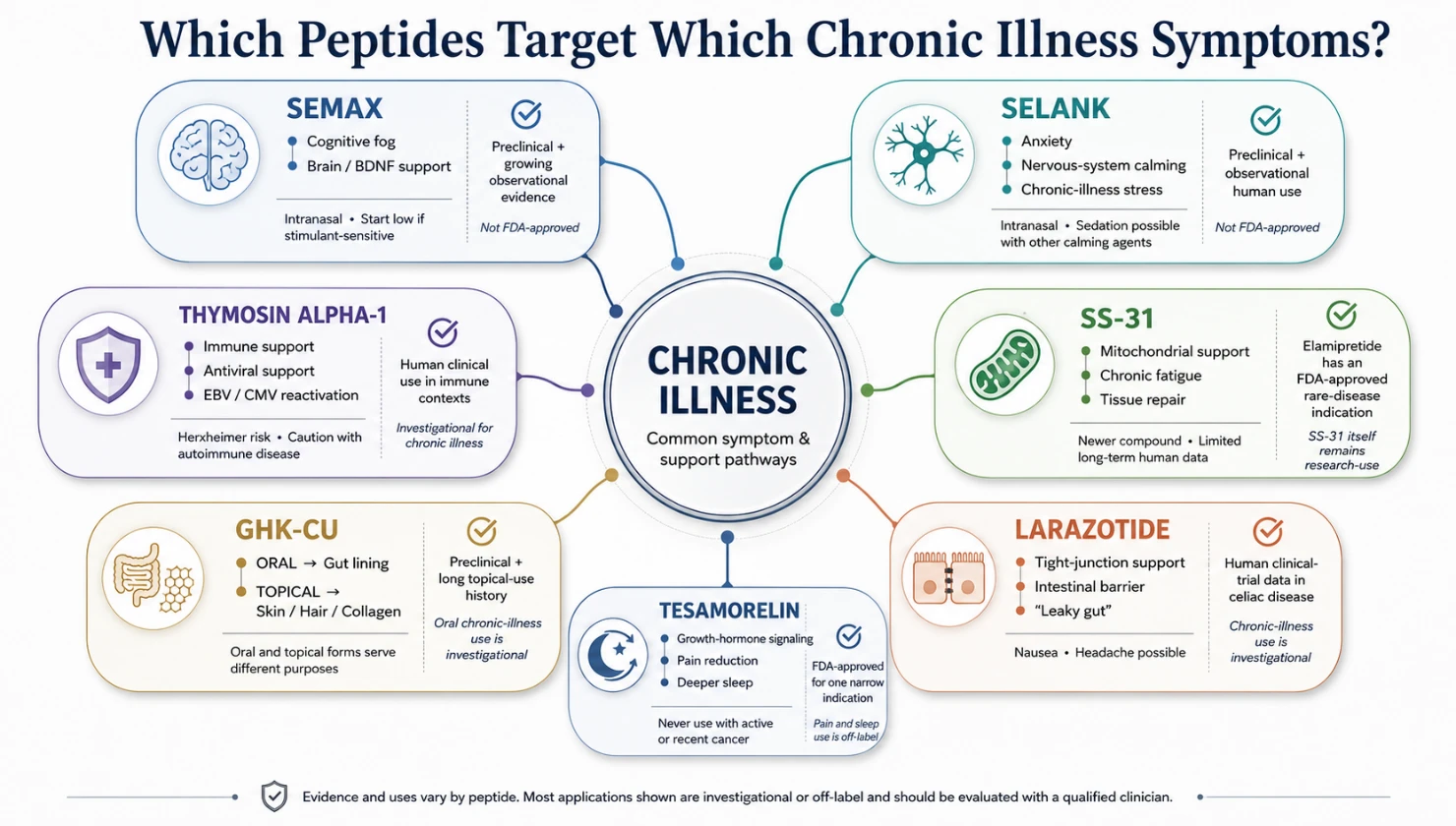
| Peptide | What it supports | Key caution | Evidence strength |
|---|---|---|---|
| Semax | Cognitive fog, BDNF-driven brain repair | Intranasal only; start low if stimulant-sensitive | Preclinical plus growing human observational use; not FDA-approved |
| Selank | Anxiety and nervous-system calming tied to chronic illness stress | Intranasal only; sedation possible with other calming agents | Preclinical plus human observational use; not FDA-approved |
| Thymosin Alpha-1 | Immune and antiviral support, EBV and CMV reactivation | Herxheimer risk; caution in autoimmune disease | Human clinical use in immune contexts; investigational for chronic illness |
| SS-31 | Mitochondrial support, chronic fatigue, tissue repair | Newer compound; limited long-term human data | Mechanism class FDA-approved for one rare disease (elamipretide); SS-31 itself is research-use |
| GHK-Cu | Gut lining repair (oral); skin, hair, collagen (topical) | Oral and topical forms serve different purposes | Preclinical plus long topical-use history; oral chronic-illness use is investigational |
| Larazotide | Tight-junction repair, leaky gut common across chronic illness | Nausea and headache possible | Human clinical trial data in celiac disease; chronic-illness use is investigational |
| Tesamorelin | Growth hormone signaling, pain reduction, deeper sleep | Never use with active or recent cancer | FDA-approved for one narrow indication (Egrifta); pain and sleep use is off-label |
For a look at how these same peptides apply specifically to diagnosed Lyme disease and tick-borne co-infection, see the peptide therapy hub. For the full sourcing and contamination picture behind every row in this table, see are peptides safe.
When a patient asks whether peptides will fix their chronic illness, my answer starts with sequencing, not the peptide.
Our practice follows a 4-phase method. Peptides for targeted repair sit in Phase 04, after the body is rebuilt in Phases 01 through 03. Those phases cover foundational nutrient, adrenal, thyroid, and blood-sugar work, then nervous system regulation, then gentle strategic detoxification timed to minimize a Herxheimer-style crash. Only in Phase 04 do we introduce targeted tools like peptides, once the body has the foundation to use them.
Most clinics skip straight to peptides before that foundation is built, a common reason patients feel worse instead of better on a protocol that looked reasonable on paper. A peptide asked to repair a body not ready for it underperforms, or triggers a reaction blamed on the peptide when the real issue was sequencing.
We have helped thousands of people in Colorado, Oregon, Wyoming, New Jersey, Pennsylvania, Texas, Wisconsin, New Hampshire, Alabama, South Dakota, and Vermont restore their health and quality of life by diagnosing and treating their Lyme Disease.
Evidence strength varies enormously across this list, and an honest page says so plainly instead of treating every peptide as equally proven.
A small number of peptides in this class, including semaglutide-type GLP-1 medications and insulin, carry decades of randomized controlled trial data. None discussed on this page belong to that category. Tesamorelin is FDA-approved for one indication and used off-label elsewhere. Larazotide has real trial data in a related condition, celiac disease, but investigational status here. Semax, Selank, and SS-31 rest mainly on preclinical research and clinical observation rather than large trials. Long COVID research has not yet produced large peptide-focused trials.[2] The mechanistic rationale is real, but funded trial programs have so far prioritized other drug classes. None of this means these tools are ineffective, the confidence level should match the evidence, not the most optimistic claim online.
Peptide therapy fits some situations better than others, and a few call for real caution.
If any of these apply to you, that is not a reason to rule out peptide therapy. It is a reason to have this conversation with a physician who reviews your full history before writing a prescription. A checkout page never will. If you are ready, schedule an initial visit and we will walk through where your picture stands before recommending anything.
Some patients report meaningful improvement, particularly with mitochondrial-support peptides like SS-31 and growth hormone peptides used for sleep and pain. Large controlled trials specific to chronic fatigue syndrome do not yet exist for most of these compounds. Evidence is strongest for the underlying mechanisms and still developing for chronic fatigue as a specific diagnosis.
Some are, with real caution attached to others. Immune-stimulating peptides like LL-37 and thymosin alpha-1 need careful monitoring in autoimmune disease, since they can add to an already overactive immune response. Peptides that calm inflammation or support repair, such as larazotide or SS-31, carry a different risk profile, but every case needs individualized review.
Peptides that reduce inflammation and support mitochondrial function address mechanisms known to be disrupted in long COVID, based on inflammatory biomarker research.[2] Large-scale trials of peptides specifically for long COVID are still limited, so this remains an investigational, mechanism-guided application, not a proven, FDA-approved treatment.
Peptides instruct the body to do more of a process it already performs, such as releasing its own growth hormone or repairing a damaged gut lining. A hormone like synthetic growth hormone introduces the substance directly instead of asking the body to produce it. That distinction changes both mechanism and safety profile.
Start with the comparison table above and match it to the symptom driving the most disruption: fatigue, cognitive fog, gut symptoms, or immune flares. From there, a physician review of your full history, including any cancer or autoimmune history, determines which peptides are appropriate and in what sequence.
We have helped thousands of
people restore their health
and quality of life by diagnosing
and treating their Lyme Disease.
“Dr. Mueller’s approach to medicine is refreshing! There is only so much you can do with western medicine and in my life I was needing a new approach. By addressing the whole body, nutritional diet factors, environmental factors, blood work, and incorporating ideas I had not previously known, I was able to break through with my conditions. I am not only experiencing less pain in my life, but through the process of healing guided by Dr. Diane Mueller, I am now happy to say I have more consciousness surrounding how I eat, what to eat and when things are appropriate. Living by example Dr. Mueller has a vibrancy that makes you want to learn and know more about your body and overall health. I highly recommend her to anyone looking for new answers, a new approach to health, or in need of freedom from pain and limitations.”
-Storie S.
Kihei, HI