

A mold exposure test checks your body, not your home, and no single test proves that mold made you sick. Allergy skin tests and IgE blood tests are the established options. Urine mycotoxin panels and CIRS blood markers are used by some clinicians, even though the CDC does not recommend biologic testing for mold exposure. Which test fits you depends on the question you are asking: allergy, lung effects, or a broader inflammatory pattern. If your labs came back normal and you still feel terrible, that question is the place to start.
If you have ever searched “how do I know if I have mold illness,” you are asking the right question, and the answer is not one lab. Our guide to mold illness symptoms lists what patients describe, and this page covers the testing side.

Five kinds of test are used when someone asks about mold and the body, and each one answers a different question.
Mold exposure test is a lab or screening test of your body, such as skin, blood, urine, or vision testing, that looks for a reaction to mold or its by-products. A mold test of your home is a separate question.
CIRS (chronic inflammatory response syndrome) is the term some clinicians use for an ongoing inflammatory illness that follows exposure to a water-damaged building, following the work of Dr. Ritchie Shoemaker.
Mycotoxin is a metabolite made by some fungi that can cause illness in humans and animals, mainly after eating contaminated food.
| Test | Question it answers | What a result cannot tell you | Public-health stance |
|---|---|---|---|
| Skin prick or IgE blood test | Is your immune system sensitized to mold? | Whether mold caused your other symptoms | Established allergy tests (WAO, AAAAI) |
| Urine mycotoxin panel | Are mycotoxins in your urine? | Whether they came from mold, food, or a building | No FDA-approved test, CDC does not recommend |
| CIRS blood markers | Does your inflammatory pattern fit CIRS? | What caused that pattern | Used by some clinicians, CDC does not recommend biologic testing |
| VCS vision screen | Is your contrast vision reduced? | Why it is reduced | NIOSH does not recommend it for diagnosis |
| Lung function tests | Is asthma or lung disease present? | Whether mold is the trigger | Standard asthma work-up (CDC) |
The CDC says exposure to damp and moldy environments can cause health effects in some people and none in others. The WHO’s 2009 guideline on dampness and mold names respiratory symptoms, allergies, and asthma as the most important effects of dampness and mold.
For a wider overview of your options, see our mold toxicity test guide.
Skin prick and IgE blood tests are the established mold exposure tests, because they show whether your immune system has become sensitized to mold. A World Allergy Organization position paper calls IgE sensitization testing “the cornerstone of diagnostic evaluation in suspected allergic conditions.”
The two versions work differently, according to the AAAAI’s allergy testing guide. A skin prick test places a tiny amount of allergen into the skin through a small prick. A blood test draws blood, so results come back more slowly than skin testing.
Both tests measure sensitization, and the same WAO paper separates sensitization from allergy. Allergy also requires symptoms triggered by that allergen. A positive result says your immune system recognizes mold, and it does not say mold is behind your fatigue or brain fog.
Allergy-pattern symptoms are where these tests fit best. The CDC lists a stuffy nose, sore throat, coughing or wheezing, burning eyes, and skin rash as effects mold can have for some people. An allergist usually reads and acts on these results.
A urine mycotoxin test measures mold by-products in your urine, and a CDC and NIOSH report states that there is no FDA-approved test for mycotoxins in human urine. The same MMWR report adds that low levels of mycotoxins are found in many foods, so they turn up in the urine of healthy people. It also says mycotoxin levels that predict disease have not been established.
The report describes a real case. An employee’s urine test came back “positive” for two mycotoxins, and consultants then removed drywall, carpet, and ceiling tiles from her workspace. They found no evidence of water damage or significant fungal growth, and the building manager’s cost exceeded $25,000. She had also been prescribed an antifungal, which treats fungal infections and not illness from toxins.
What this means for you: a urine result is one clue to weigh next to your symptoms and exposure history. Our urine mycotoxin test guide compares panels in detail.
Ask before you buy: What would this result change about my care? If the answer is nothing, the test may not be worth your money.
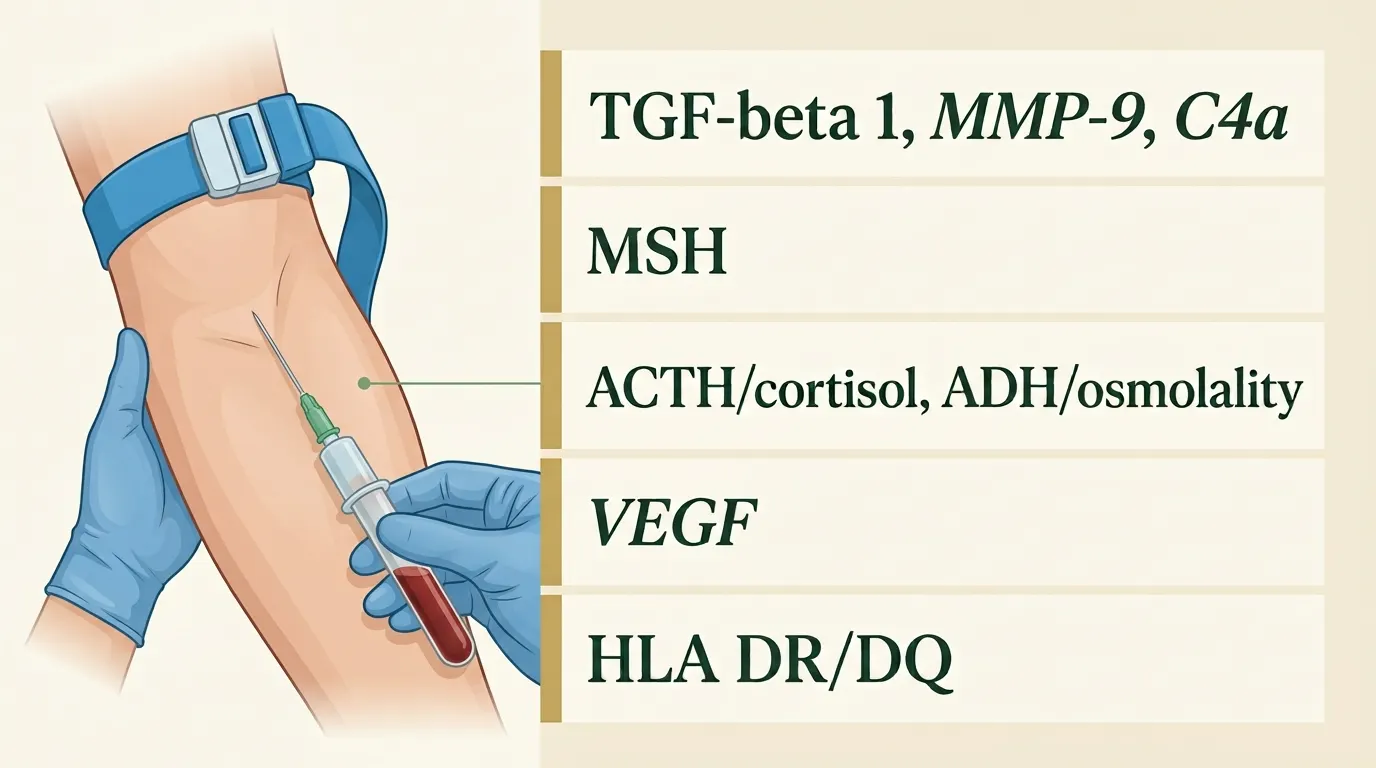
A CIRS blood panel is a group of markers that clinicians who use the chronic inflammatory response syndrome framework read together as their mold exposure test, instead of relying on one result. A 2025 review of the CIRS biomarker literature lists the panel below. The review’s author discloses providing expert witness testimony in CIRS cases for both plaintiffs and defense.
The review describes an older case definition that required exposure, symptoms in four or more of eight body systems, and abnormalities in at least three of six core markers.
The CDC does not recommend biologic testing of people in water-damaged buildings. A 2007 pediatric review found that reviews of building-associated mycotoxic illness generally reached a consensus that credible evidence for non-food-borne mycotoxin-induced disease was lacking. A clinician reads any single result alongside your symptoms, timeline, and exposure history. Our blood test for mold illness guide goes marker by marker.
If CIRS is a new term, what is CIRS explains the illness model in plain language.
Key point: Treat a CIRS panel as one input to discuss with a clinician, because the CDC does not recommend biologic testing of people in water-damaged buildings.
The visual contrast sensitivity (VCS) screen is a short vision test, and a 2025 review of CIRS biomarkers calls it the first objective marker in the CIRS diagnostic framework.
Visual contrast sensitivity (VCS) is how well you can see faint differences in shade at several levels of detail, measured in cycles per degree. It can be tested without any blood or urine sample.
NIOSH put VCS to the test in a water-damaged school. In the NIOSH evaluation, researchers compared employees at an extensively water-damaged school (95 participants) with employees at a comparison school (110 participants), using a symptom questionnaire and VCS testing. The exposed group had more rashes and nasal, lower respiratory, and constitutional symptoms, and their VCS values were lower at every spatial frequency.
The authors still wrote that they do not recommend VCS in a clinical setting to diagnose illness in occupants of water-damaged buildings, because the result is nonspecific. A low score can be a reason to look further, and the screen works best as a pointer that tells a clinician where to look next.
Urgent care and your primary care doctor can take a history and examine you, and an allergist handles mold allergy testing. Ask any center which tests it runs before you go. The CDC does not recommend biologic testing of people who work or live in water-damaged buildings.
Here is what ordinary medicine does offer:
Centers differ, so call ahead and ask which tests they run. Asking “which test, for which question” gets a better answer than asking whether they can test you for mold. If you want CIRS markers, a urine result, or a VCS score reviewed, a doctor who works with mold illness can do that by video visit. Our guide to doctors who treat mold illness explains what to look for.
A child’s mold exposure test starts with a pediatrician and, for allergy symptoms, skin or blood testing for sensitization. A pediatric review of mold and children describes that workup as a careful history, a physical exam for asthma, rhinitis, and eczema, and skin or laboratory testing for sensitization. The same review names four ways mold can affect health: immune reactions, toxicity, infection, and irritation.
Urine mycotoxin testing is a weak fit for children. In a UK study of children’s urine, the mycotoxin DON appeared above the detection limit in 95.61% of children’s urine samples, and cereal food intake was strongly associated with the levels. Children’s urine can show mycotoxins from cereal-based foods such as bread and breakfast cereal, so a positive urine result does not point to a house.
For parents: If your child has wheezing or trouble breathing, get medical care right away instead of waiting on a mold test.
The VCS screen has been studied in children as well. In a 2017 study of 127 children at wellness checks, the pediatric scores matched the manufacturer’s adult norms. That suggests children can be tested. VCS stays a screen for a child too, for the same reasons NIOSH gave for adults.
Your next step after a mold exposure test is to read that single result next to your symptoms, your timeline, and the rest of your labs.
Test results are one input. Dr. Diane Mueller’s 4-Phase Method builds the body first, then moves through lifestyle and nervous system support, gentle detox, and targeted microbe balancing. My Lyme Doc sees patients by video visit in 11 states, and you can book a consultation with Dr. Mueller to review your results and history together.