

Fibromyalgia and Mold: Is Your Building Part of the Pain?

Fibromyalgia and mold exposure can overlap in the same person, but no controlled study has shown that mold causes fibromyalgia. If your pain and fatigue began or worsen around a water-damaged home or workplace, it is reasonable to test whether mold is a driver before assuming fibromyalgia explains everything.

You were told to manage it. You pace yourself, protect your sleep, and take what you were prescribed, and the pain and exhaustion are still there. If your home or workplace has had a leak or a musty smell, asking whether mold is part of this is a fair question. Our guide to fibromyalgia symptoms in women covers the symptom list, so this page stays on the mold question.

Key Takeaways

  • The cause of fibromyalgia is not known, and no controlled study has shown that mold causes it.
  • Mold illness and fibromyalgia share widespread pain, fatigue, poor sleep, and brain fog, so the two are easy to confuse.
  • Fibromyalgia is diagnosed from symptoms alone, and referral studies show the label is sometimes wrong.
  • The American College of Rheumatology states that a fibromyalgia diagnosis does not exclude other clinically important illnesses.
  • Clues that a building matters include symptoms that ease when you are away from it and a history of water damage.
  • Dr. Mueller treats Lyme disease and mold illness by video visit, and a visit looks at whether either one could be part of your symptoms.

Woman resting at a kitchen table beside a window with a water stain on the ceiling

What the research says about mold and fibromyalgia

The direct research on mold and fibromyalgia is thin, and it does not show that mold causes the condition.

Fibromyalgia is a chronic condition marked by widespread pain, fatigue, sleep problems, and trouble thinking clearly, and it is diagnosed from symptoms because no lab or imaging test confirms it.

The National Institute of Arthritis and Musculoskeletal and Skin Diseases states that the cause of fibromyalgia is not known. It points to altered signaling in the nervous pathways that carry pain. Public health summaries of damp buildings point to other body systems. The 2009 WHO review of dampness and mould found the main effects were respiratory symptoms, allergies, asthma, and immune disruption. The CDC list of mold effects names stuffy nose, sore throat, cough, wheezing, burning eyes, and skin rash. Neither summary lists fibromyalgia.

The closest study looked at chronic fatigue syndrome, not fibromyalgia. In a 2013 study of 112 people with chronic fatigue syndrome, 104 (93%) had at least one mycotoxin in their urine, and over 90% reported exposure to a water-damaged building. The comparison group was 55 healthy people with no exposure history, tested earlier by the same lab. That design shows the toxins were present. It cannot show that mold caused the illness.

CIRS (chronic inflammatory response syndrome) is the term Dr. Ritchie Shoemaker uses for a multi-system illness that he links to living or working in a water-damaged building.

Shoemaker’s 2005 study of 21 volunteers reported symptoms in at least four organ systems. The authors listed their own limits: exposure to specific agents was not demonstrated, participants were not randomly selected, and the study was not double-blinded. You can read more in our explainer on what CIRS is.

A single-author 2017 clinical review in Frontiers in Immunology says some people in damp buildings “may develop rheumatic symptoms resembling fibromyalgia.” It rests on the author’s clinical experience. It also states that there are no accepted diagnostic criteria for the syndrome it describes.

Here is where that leaves you. A link between mold and fibromyalgia-like pain is plausible in some people, it is unproven as a cause, and it can be tested one person at a time.

Why mold illness and fibromyalgia can look the same

Mold-related illness and fibromyalgia overlap on the four symptoms that bother patients most: pain, fatigue, broken sleep, and brain fog.

 Fibromyalgia (NIAMS)Mold-related illness (2017 clinical review)
PainChronic, widespread painMuscle and joint pain resembling fibromyalgia
FatigueOverwhelming tirednessUnexplained fatigue, in a minority chronic fatigue syndrome
Thinking“Fibro fog”“Brain fog” with memory and focus problems
Early signsNot listed on the pageIrritated eyes, nose, and respiratory tract
Location patternNot describedSymptoms ease away from the building
Lab testNone confirms itNo unanimously accepted test yet

The table comes from the NIAMS fibromyalgia page and the 2017 review above.
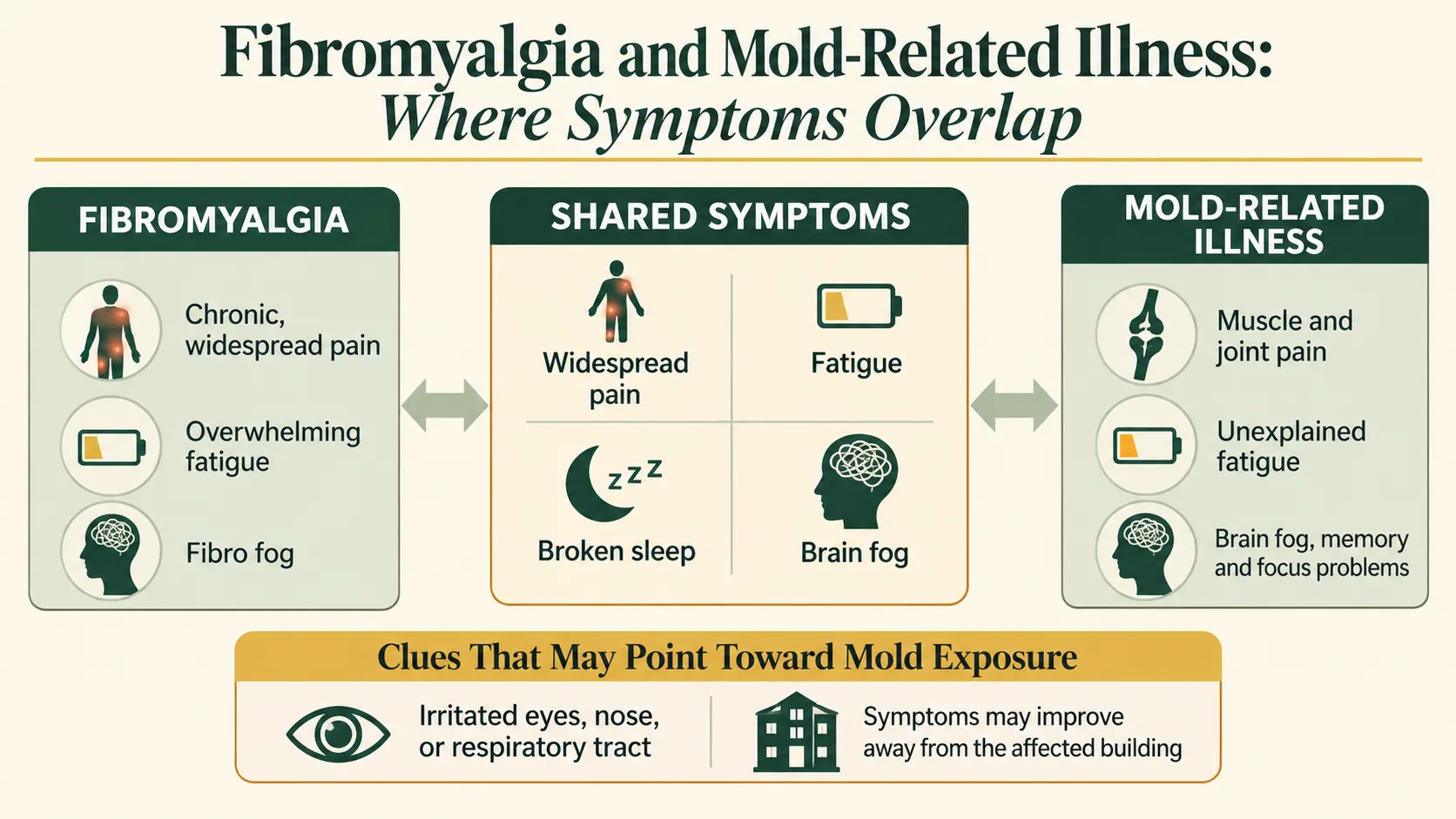
chart comparing overlapping fibromyalgia and mold illness symptoms

Our mold illness symptoms guide lists the full range across body systems.

Overlap in symptoms is not evidence of a shared cause. It is the reason a clinician has to ask about your building. The same overlap is why CIRS symptoms are often mistaken for something else.

If exhaustion is your main complaint, our page on mold and fatigue goes deeper.

What a fibromyalgia diagnosis can miss

A fibromyalgia diagnosis rests on symptoms alone, so another cause can sit underneath it.

NIAMS notes that there are no specific laboratory or imaging tests for fibromyalgia. The 2016 criteria use a widespread pain score and a symptom severity score, with a threshold of 7 and 5, or 4 to 6 and 9. Two referral studies show how often the label shifts once a rheumatologist looks. A 2003 study of 76 rheumatology referrals found the initial fibromyalgia diagnosis was correct in 34%. The authors described “a disturbing inaccuracy, mostly observed to be overdiagnosis.” A 2009 study from Israel found that rheumatologists confirmed 71% of 196 patients referred with fibromyalgia.

These studies are about rheumatology referrals, not mold, and they do not tell you your own diagnosis is wrong. They do show why the label deserves a second look when pain and fatigue do not respond to treatment.

The American College of Rheumatology adds a point that matters here. Its criteria state that a fibromyalgia diagnosis does not exclude other clinically important illnesses. You can have fibromyalgia and a mold problem at the same time. Lyme disease belongs on that list too, and our page on Lyme disease and fibromyalgia covers how the two are told apart.

Is a damp building behind your fibromyalgia?

On a video visit, Dr. Mueller reviews your timeline, your home or workplace, and your symptoms to work out whether mold, Lyme, both, or neither is part of your picture.

Signs your pain may be tied to a building

Certain patterns point toward a building as a possible driver, and none of them is a diagnosis on its own.

  • Your pain, fatigue, or brain fog is worse in one home or workplace and eases after a day or two away.
  • The symptoms began after a leak, a flood, a roof problem, or a move.
  • You can see mold or water stains, or you smell a musty odor.
  • Your eyes, nose, or throat feel irritated, or you get repeated sinus and chest infections.

These clues come from the clinical description in the 2017 review, which is one clinician’s proposal and not an accepted standard. If you want to look at your space, read our guide to hidden mold in walls.

Fibromyalgia and mold: how to find out whether your building is involved

Finding out whether mold is a driver starts with your history and your building, because no single lab test settles the question.

The 2017 review states that available laboratory methods do not fully support clinical practice for mold-related illness. So the work is a pattern, built from several pieces.

  1. Write a timeline. Mark when symptoms began, when any water damage happened, and where you lived and worked.
  2. Track where you feel worse. Note your symptoms on days at home, at work, and away from both.
  3. Look at the building. Check for leaks, stains, humidity, and odor, and consider a professional inspection if you see signs.
  4. Read labs in context. Mold-related testing is interpreted alongside your history, and our guide to mold exposure testing explains the options.
  5. Rule out other causes with your own doctor. Other rheumatologic conditions, thyroid problems, and sleep disorders can overlap with fibromyalgia and need their own workup.

How My Lyme Doc approaches mold and fibromyalgia-like pain

Dr. Diane Mueller, ND, LAc, DAOM, treats Lyme disease and mold illness by video visit, and her method works in four phases.

  1. Build the body first. The body is built up before the pathogen is targeted.
  2. Lifestyle and nervous system. This phase works on daily habits and nervous system regulation.
  3. Gentle, strategic detox. Detox is gentle and planned.
  4. Targeted microbe balancing. Treatment then targets the microbes and repairs what they affected.

A visit looks at whether mold, Lyme, both, or something else could be part of your pain and fatigue. The CIRS framework described above is Dr. Shoemaker’s work, and the four phases are Dr. Mueller’s own method. Results vary from person to person, and no plan fits everyone.

What to do this week

Your next steps are to keep your current care, gather your pattern, and bring both to a clinician who treats Lyme and mold.

  1. Keep your fibromyalgia care in place. Do not stop medication on your own, and see our page on natural fibromyalgia treatment for what the evidence supports.
  2. Start the timeline and the symptom log from the steps above.
  3. Photograph any water damage and note when it happened.
  4. Gather your labs and diagnosis records, including how and when you were diagnosed with fibromyalgia.
  5. Ask for an evaluation that includes mold and Lyme.

My Lyme Doc sees patients by telehealth in 11 states. When you are ready, you can book a call with Dr. Mueller and bring your timeline, your building history, and your records.

Common Questions

No controlled study has shown that. The cause of fibromyalgia is not known, and the research on mold covers respiratory, allergic, and immune effects more than pain syndromes.

Research on that question is lacking. Some clinicians report symptoms tracking a building, but those reports are not trials, and they are best tested one person at a time.

It can be either, both, or neither. Fibromyalgia is diagnosed from symptoms, and the ACR notes that the diagnosis does not exclude other illnesses, so history and evaluation are what separate them.

Widespread muscle and joint pain, fatigue, poor sleep, and brain fog overlap. One clinical review also lists irritated eyes, nose, and airways as early signs of mold-related illness.

In that clinical review, early symptoms may ease when a person stays away from the building. It describes patients, not a fibromyalgia trial, and some people do not recover fully on that step alone.

Written and medically reviewed by Dr. Diane Mueller, ND, LAc, DAOM | Last reviewed: November 1, 2026

This article is for educational purposes and is not medical advice. It does not replace evaluation by a qualified clinician who knows your history. Work with your doctor before ordering tests or making any change to your care.

Have Lyme Disease or suspect you do?

We have helped thousands of people in Colorado, Oregon, Wyoming, New Jersey, Pennsylvania, Texas, Wisconsin, New Hampshire, Alabama, South Dakota, and Vermont restore their health and  quality of life by diagnosing and treating their Lyme Disease.

Free Lyme/Mold Webinar: "Why Am I Still Sick?"

Have Lyme Disease or suspect that you do?

We have helped thousands of
people restore their health
and quality of life by diagnosing
and treating their Lyme Disease.

“Dr. Mueller’s approach to medicine is refreshing! There is only so much you can do with western medicine and in my life I was needing a new approach.  By addressing the whole body, nutritional diet factors, environmental factors, blood work, and incorporating ideas I had not previously known, I was able to break through with my conditions.  I am not only experiencing less pain in my life, but through the process of healing guided by Dr. Diane Mueller, I am now happy to say I have more consciousness surrounding how I eat, what to eat and when things are appropriate.  Living by example Dr. Mueller has a vibrancy that makes you want to learn and know more about your body and overall health.  I highly recommend her to anyone looking for new answers, a new approach to health, or in need of freedom from pain and limitations.”

-Storie S.

Kihei, HI

Lyme Disease is Often Misdiagnosed as Fibromyalgia, Chronic Fatigue, Depression,
or Other Illnesses

End Chronic Fatigue, Pain, Brain Fog &
More Taught By Expert Dr. Diane Mueller