


By Dr. Diane Mueller, ND, LAc, DAOM | Medically reviewed by Dr. Diane Mueller, ND, LAc, DAOM
The Asian longhorned tick (Haemaphysalis longicornis) is an invasive, non-native tick that arrived in the United States from East Asia and was confirmed here for the first time in 2017. In its home range it is a serious agricultural and public health pest, and it has spread through the U.S. faster than almost any tick on record. As of April 2026, it had been reported in at least 24 states [10], and the count keeps climbing: Kansas was confirmed in late 2025 [9] and Alabama in April 2026 [10].
The Asian longhorned tick (Haemaphysalis longicornis) is a small, invasive tick native to East Asia that reached the United States and can build enormous local populations on a single host.
What sets this tick apart is a biological trait almost unheard of among the ticks native to North America: the females can reproduce without mating. Through a process called parthenogenesis, a single female can lay thousands of viable eggs on her own, no male required.
Parthenogenesis is reproduction from unfertilized eggs, meaning a lone female can produce viable offspring with no male present. That is the main reason a population can explode from a single introduced tick, and why one animal can end up carrying hundreds or thousands of ticks at once.
For patients in the eastern and central U.S., that combination, an invasive species spreading quickly, capable of extreme local density, and still being characterized for the diseases it may carry here, is exactly why it deserves attention. What follows is a plain-language account of what this tick is, where it has been found, what it can and cannot yet transmit, and what to do if you encounter one.
The Asian longhorned tick is an invasive species first detected in the U.S. in 2017, now reported in at least 24 states across the eastern and central U.S. as of April 2026
Females can reproduce parthenogenetically (without mating), which drives rapid spread and extreme local density, hundreds to thousands of ticks on a single host
In its native range (Asia, Australia, New Zealand), it transmits severe fever with thrombocytopenia syndrome (SFTS), a serious viral illness with significant mortality
In the U.S., SFTS has not yet been confirmed in this tick, though active CDC, USDA, and state-level surveillance is ongoing
It can transmit Theileria orientalis Ikeda strain, a blood parasite that has sickened and killed cattle in the U.S., and heavy infestations can cause severe blood loss (anemia) in livestock and pets
All three life stages (larvae, nymphs, adults) can bite humans painlessly, and standard tick prevention (repellent, permethrin-treated clothing, prompt tick checks) is effective against this species
We have helped thousands of people in Colorado, Oregon, Wyoming, New Jersey, Pennsylvania, Texas, and Wisconsin restore their health and quality of life by diagnosing and treating their Lyme Disease.
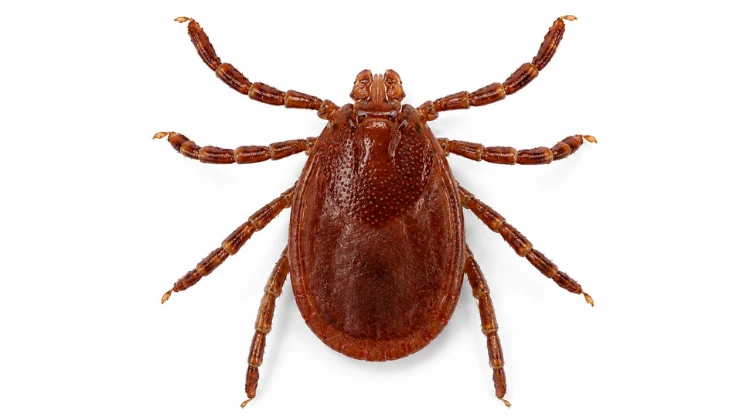
Honestly, the hardest thing about the Asian longhorned tick is that it looks unremarkable. It has none of the field marks people are taught to look for, which is precisely why it went undetected for as long as it did.
Small size, unfed adult females are roughly 2 to 3 mm, about the size of a sesame seed, and larvae and nymphs are smaller still
Uniformly reddish-brown to dark brown, with no ornate patterns
No white dot on the back (unlike the female lone star tick) and no silvery or mottled shield on the scutum (unlike the American dog tick)
Shorter mouthparts relative to some other tick species, though this is not something you can reliably judge without magnification
A fully engorged tick swells and can look pale gray or greenish, further muddying identification
Because it carries none of the distinctive markings of the more familiar U.S. ticks, it is genuinely easy to mistake for a young deer tick, a rabbit tick, or any other small brown tick. Reliable identification usually requires a laboratory, a state health department, or a university entomologist, not the naked eye. If you remove a tick you cannot confidently identify, the right move is not to guess but to save it (see the guidance below) for expert confirmation.
The one feature that gives it away is behavioral, not visual: sheer numbers. Because a single unmated female can found an entire population, Asian longhorned ticks form infestations on a scale rarely seen with native species. Livestock, deer, and even pets have been found carrying hundreds to thousands of ticks at the same time. If you see an animal blanketed in small brown ticks, that density is itself a red flag for this species. On animals, that level of blood feeding is not just unsettling to look at, it can drain enough blood to cause life-threatening anemia, and in heavily infested cattle it has been linked to reduced weight gain, lower milk production, and death.
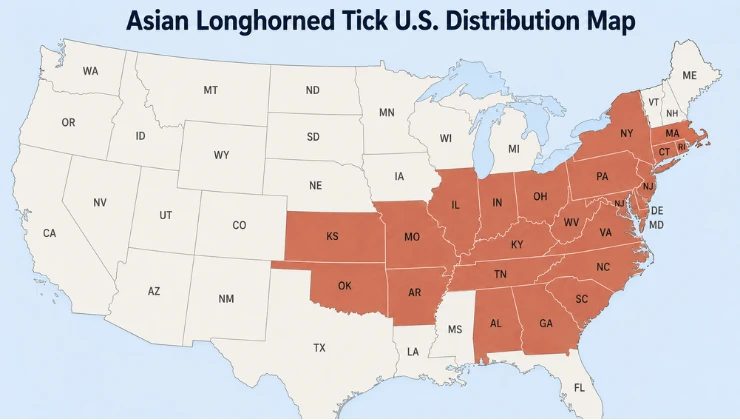
The first U.S. detection was on a sheep in New Jersey in 2017, though later analysis showed the tick had actually been present since at least 2010. [1][2] From that beachhead it has moved outward year after year. Illinois was announced as the 20th state to confirm the tick in May 2024 [7], Kansas followed in late 2025 [9], and Alabama was added in April 2026 [10], bringing the reported total to at least 24 states. The states with established or well-documented populations include the following (a representative list, not exhaustive):
Mid-Atlantic: New Jersey, New York, Pennsylvania, Delaware, Maryland, Virginia, West Virginia
Northeast: Connecticut, Rhode Island, Massachusetts
Southeast: North Carolina, South Carolina, Georgia, Tennessee, Kentucky, Arkansas, Alabama
Midwest: Ohio, Indiana, Illinois, Missouri
South Central: Oklahoma, Kansas
Each state above appears in only one region; the tick’s true range does not respect these tidy buckets, and detections in new counties are reported regularly. The practical takeaway is that this is no longer a New Jersey curiosity: it is a realistic exposure risk across a broad swath of the eastern and central United States, and the western edge of its range keeps moving.
Part of why it spreads so effectively is its enormous host range. It has been recovered from white-tailed deer, cattle, sheep, goats, horses, dogs, cats, raccoons, opossums, groundhogs, wild birds, and humans. Deer and migratory birds are thought to be significant drivers of long-distance spread, ferrying ticks well beyond where they could crawl on their own. That generalist appetite, combined with parthenogenesis, is a hard combination to contain.
This is the most clinically important area, and the most unsettled.
Severe fever with thrombocytopenia syndrome (SFTS) is a serious viral illness, spread by tick bite, that causes high fever and a dangerous drop in blood platelets.
In Asia (primarily Japan, China, South Korea), the Asian longhorned tick is a confirmed vector for:
Severe fever with thrombocytopenia syndrome (SFTS), a viral illness caused by SFTS phlebovirus (a bandavirus). Case fatality rates in China have ranged from 12-30%. Symptoms include fever, low platelet count, gastrointestinal symptoms, and in severe cases, multiorgan failure. [3]
Theileria species affecting cattle
Rickettsia, Anaplasma, Ehrlichia, and Borrelia species in some regions
As of the most recent CDC guidance, SFTS virus has not been confirmed in U.S. Asian longhorned ticks. This is being actively monitored. [4]
Theileria orientalis Ikeda is a blood parasite of cattle that destroys red blood cells and has sickened and killed U.S. livestock; it is not a confirmed human pathogen.
What has been confirmed in U.S. H. longicornis ticks:
Theileria orientalis Ikeda, a blood parasite that has caused illness and death in U.S. cattle. Not currently a confirmed human pathogen in the U.S., but under investigation. [6]
Spotted fever group Rickettsia has been detected in some U.S. specimens, significance for human disease is being evaluated
Some specimens have tested positive for Anaplasma species
The honest summary: this tick’s disease potential in the U.S. is still being characterized. The absence of confirmed SFTS transmission to date should be understood as “not yet confirmed,” not “confirmed safe.” Surveillance is active.
We have helped thousands of people in Colorado, Oregon, Wyoming, New Jersey, Pennsylvania, Texas, and Wisconsin restore their health and quality of life by diagnosing and treating their Lyme Disease.
The tick-borne illness world in the United States is not static. The emergence of the Asian longhorned tick represents an ongoing change to that world. What this means practically:
If you live in the eastern U.S. and find a tick that doesn’t match the classic description of a deer tick, lone star tick, or dog tick, brown, no markings, small, it may be an Asian longhorned tick. Submission to your state health department or local university extension service for identification is worth doing.
If you develop unexplained fever after a tick bite in an area where this tick has been confirmed, mention it to your provider. The differential diagnosis for tick-borne illness in the U.S. is expanding.
If you have livestock or pets in the affected states, talk to your veterinarian about surveillance and prevention. Theileria in cattle is a significant economic and animal health concern.
Part of responsible tick-borne medicine is being honest about the state of the evidence. What remains uncertain about H. longicornis in the U.S.:
Whether SFTS virus will establish in this tick as its U.S. range expands
The full range of pathogens U.S. ticks may acquire as they feed on an expanding host range
Whether human illness from this tick has occurred but gone undetected due to unfamiliarity with the species
This uncertainty doesn’t require alarm. It requires awareness. If you’ve been bitten and develop unusual or unexplained illness, particularly fever with low platelet counts, this tick is now part of the differential in states where it’s been detected.
In my practice I treat a lot of patients who were bitten, tested, told they were fine, and yet never got back to feeling like themselves. A single confirmed infection does not always explain the whole clinical picture, and an emerging tick like H. longicornis, whose full U.S. pathogen profile is still being written, is a reminder of why. In functional medicine we work the pathogen and the terrain at the same time: what got in, and how well the body is equipped to clear it and recover. When someone comes to me after a significant tick exposure, especially with lingering, unexplained symptoms, a thorough evaluation usually looks at several systems rather than a single test.
HPA-axis and stress-response function. Chronic infection and the physical stress of a prolonged illness lean heavily on the hypothalamic-pituitary-adrenal (HPA) axis. Assessing cortisol rhythm and the broader stress response helps explain the profound fatigue, poor stress tolerance, and disrupted sleep that so many tick-exposed patients describe, and it points to where support is needed for recovery.
Immune function. Rather than stopping at a single antibody test, a fuller immune workup can include markers of immune activation and inflammation (such as high-sensitivity CRP), white blood cell differential, and, when the history warrants it, immunoglobulin levels and markers of immune dysregulation. Because SFTS and several tick-borne infections drive down platelet counts, a complete blood count with platelets is a sensible baseline in anyone with fever after a bite in an area where this tick is established.
Nutrient and mitochondrial status. The immune system runs on raw materials. Vitamin D, zinc, magnesium, B vitamins, and iron all shape how well the body mounts and resolves an immune response, and deficiencies are common and correctable. Iron status deserves particular attention here: the heavy blood loss this tick causes is dramatic in animals, and while human infestations are far smaller, nutrient depletion is part of how the body pays for fighting any chronic infection.
The whole picture. Gut health, detoxification capacity, and existing inflammatory load all influence how a person weathers an infection. None of this replaces standard diagnosis and treatment of a specific tick-borne disease, and it should never delay urgent care for a fever with low platelets. It complements that care by asking why this patient, with this terrain, is or is not recovering, and by supporting the systems that do the actual work of healing.
This is not about fear, and it is not about ordering every test that exists. It is about matching the workup to the exposure and the symptoms, so that patients who were told “everything looks normal” but still feel unwell finally get a fuller answer. If you have had a significant tick exposure or lingering symptoms you cannot explain, a functional medicine evaluation can help you understand where you actually stand.
For a full overview of tick species active in the United States, see our complete tick identification guide.
We have helped thousands of people in Colorado, Oregon, Wyoming, New Jersey, Pennsylvania, Texas, and Wisconsin restore their health and quality of life by diagnosing and treating their Lyme Disease.
As of 2026, SFTS, the most dangerous disease this tick carries in Asia, has not been confirmed in U.S. ticks. But, it has been found to carry other pathogens including Theileria orientalis Ikeda (affecting cattle) and some spotted fever group Rickettsia. Surveillance is ongoing. Its disease potential in the U.S. is considered an active area of concern, not a confirmed emergency.
As of April 2026 it had been reported in at least 24 states, from New Jersey and New York down through the Southeast and west into the Midwest and South Central states. Illinois was the 20th state in 2024, Kansas followed in late 2025, and Alabama was confirmed in April 2026. The range continues to expand and should be considered across much of the eastern and central United States.
Typically no. Like most tick bites, the bite of the Asian longhorned tick is painless. Ticks inject compounds that prevent awareness of the bite. This is part of why tick checks after outdoor exposure are important.
Yes. All three life stages, larvae, nymphs, and adults, can bite humans. Human bites are most often from nymphs and adults.
Female Asian longhorned ticks can reproduce parthenogenetically, without mating. A single female can produce hundreds of viable offspring. This is rare among tick species in North America and is a key reason for the tick’s rapid establishment and spread.
Deer Tick (Black-Legged Tick): established Lyme disease vector in overlapping northeastern range
Lone Star Tick: another invasive-range tick with expanding northeastern territory
American Dog Tick: the most commonly encountered tick in the Mid-Atlantic and eastern states
Brown Dog Tick: another tick species that can infest domestic environments
Types of Ticks: full guide to tick identification across all U.S. species
Standard prevention applies regardless of tick species:
Apply EPA-registered repellent to exposed skin: DEET (20-30%) or picaridin (20%) are the most studied options for tick prevention
Treat clothing and gear with permethrin (0.5% concentration). Let it dry completely before wearing. Treated clothing repels ticks on contact and remains effective through multiple washes.
Cover up in high-risk areas: long sleeves, long pants tucked into socks, and closed-toe shoes reduce skin exposure in wooded or grassy terrain
Perform a tick check within 2 hours of outdoor activity, focusing on warm and hidden areas: scalp, behind the ears, underarms, groin, and behind the knees
Shower promptly after time outdoors: this rinses off any unattached ticks and gives you a full-body tick check opportunity
Check pets before they come indoors; dogs can carry ticks into the home
If you find a tick attached to your skin, use fine-tipped tweezers to grasp it as close to the skin surface as possible and pull upward with slow, even pressure. Do not twist or jerk. Clean the bite area with rubbing alcohol or soap and water after removal.
The Asian longhorned tick is a new presence in the United States, and its disease potential here is still being characterized. What we know: it can bite humans, it is spreading rapidly, and it carries serious pathogens in its native range. Staying informed and practicing standard tick prevention are the right response to an evolving situation.
Author: Dr. Diane Mueller, ND, LAc, DAOM
Medical Reviewer: Dr. Diane Mueller, ND, LAc, DAOM
Medical Disclaimer: This content is for educational purposes only and is not a substitute for professional medical advice, diagnosis, or treatment. Always consult a qualified healthcare provider with questions about your specific situation.
We have helped thousands of
people restore their health
and quality of life by diagnosing
and treating their Lyme Disease.
“Dr. Mueller’s approach to medicine is refreshing! There is only so much you can do with western medicine and in my life I was needing a new approach. By addressing the whole body, nutritional diet factors, environmental factors, blood work, and incorporating ideas I had not previously known, I was able to break through with my conditions. I am not only experiencing less pain in my life, but through the process of healing guided by Dr. Diane Mueller, I am now happy to say I have more consciousness surrounding how I eat, what to eat and when things are appropriate. Living by example Dr. Mueller has a vibrancy that makes you want to learn and know more about your body and overall health. I highly recommend her to anyone looking for new answers, a new approach to health, or in need of freedom from pain and limitations.”
-Storie S.
Kihei, HI