


By Dr. Diane Mueller, ND, LAc, DAOM | Medically reviewed by Dr. Diane Mueller, ND, LAc, DAOM
The deer tick, or blacklegged tick (Ixodes scapularis), is a small, hard-bodied tick that is the primary vector of Lyme disease in the eastern and upper-midwestern United States. Adults have dark, nearly black legs and a reddish-brown body; the immature nymph is about the size of a poppy seed. Beyond Lyme, this one tick can transmit anaplasmosis, babesiosis, Powassan virus, and Borrelia miyamotoi.
Lyme disease is a bacterial infection caused by Borrelia burgdorferi and spread through the bite of an infected deer tick. It is the most common vector-borne illness in the United States.
If you’ve been diagnosed with Lyme disease, or if you’re trying to figure out whether that’s what’s wrong, the deer tick is the tick you need to understand.
This is the tick that changes lives. Not because every bite leads to illness, but because the bite often goes unnoticed, the disease is frequently missed in standard testing, and the window for straightforward treatment is real.
Here is what the research shows about this tick, and what it means for you.
Dr. Diane Mueller treats tick-borne illness by telehealth in the states where the deer tick is most active.
Full list of states: where we practice.
We have helped thousands of people in Colorado, Oregon, Wyoming, New Jersey, Pennsylvania, Texas, and Wisconsin restore their health and quality of life by diagnosing and treating their Lyme Disease.
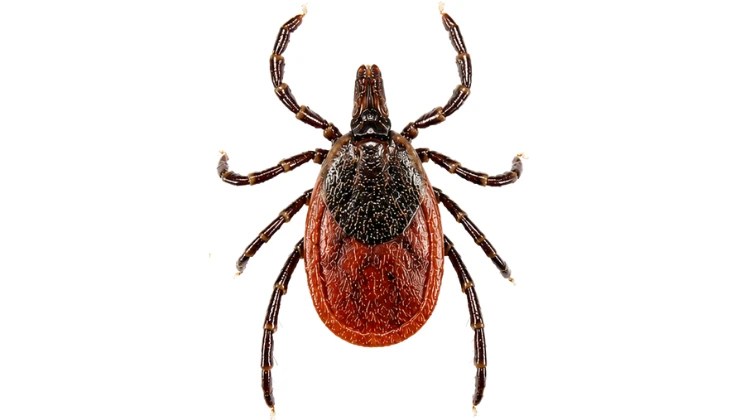
The deer tick (Ixodes scapularis) is a small, hard-bodied tick. Adult females are typically described as reddish-brown with a dark scutum (back shield), the dark plate at the scutum is one of the key visual identifiers. After a blood meal, the reddish-brown abdomen expands considerably.
Males are smaller and darker overall, with a uniform dark body.
The species is commonly called the blacklegged tick because of the dark, nearly black legs that contrast against the reddish-brown body in adults. This is the most useful identification clue in the field.
Size comparison by life stage
This is where the deer tick becomes dangerous: nymphs, the immature feeding stage responsible for most human Lyme transmission, are approximately the size of a poppy seed (1-2 mm). They are extraordinarily difficult to see on skin, in hair, or on clothing. Adults are larger (approximately 3-5 mm unfed) and easier to spot.
If you found a tiny dark speck and you’re not sure what it is, assume it may be a tick nymph and treat it accordingly.
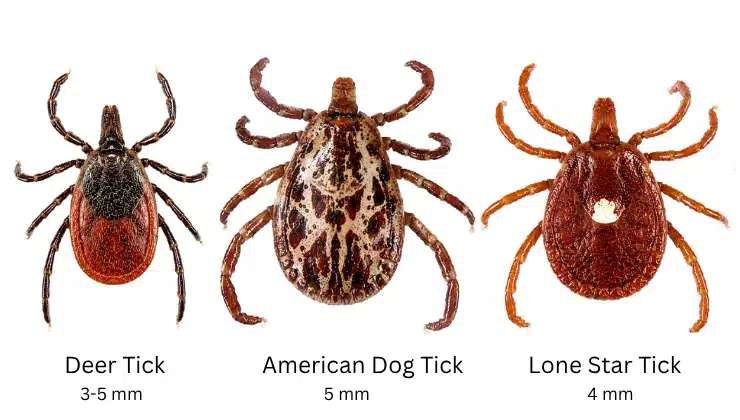
The fastest way to tell the deer tick apart from the two other ticks people most often confuse it with is size and the pattern on the scutum (the hard shield on the back). The deer tick is the smallest of the three, has no white or silvery markings, and is the only one of the three that transmits Lyme disease.
Identifying marks – Deer Tick (Ixodes scapularis): Dark, nearly black legs; solid dark scutum; reddish-brown body (female), uniformly dark (male); no white markings; American Dog Tick (Dermacentor variabilis): Ornate silvery-white marbled pattern on the scutum; brown body; Lone Star Tick (Amblyomma americanum): Female has a single bright white dot in the center of the back; reddish-brown, rounded body
Adult size (unfed) – Deer Tick (Ixodes scapularis): Smallest of the three, about 3 to 5 mm; American Dog Tick (Dermacentor variabilis): Largest, about 5 mm; Lone Star Tick (Amblyomma americanum): Between the two, slightly smaller than the dog tick
U.S. range – Deer Tick (Ixodes scapularis): Eastern and upper-midwestern U.S.; American Dog Tick (Dermacentor variabilis): Widespread east of the Rockies, plus parts of the Pacific Coast; Lone Star Tick (Amblyomma americanum): Southeastern and eastern U.S., expanding northward
Diseases transmitted – Deer Tick (Ixodes scapularis): Lyme disease, anaplasmosis, babesiosis, Powassan virus, Borrelia miyamotoi; American Dog Tick (Dermacentor variabilis): Rocky Mountain spotted fever, tularemia; Lone Star Tick (Amblyomma americanum): Ehrlichiosis, tularemia, STARI, Heartland virus, alpha-gal syndrome (red-meat allergy)
Which stages bite humans – Deer Tick (Ixodes scapularis): Larva, nymph, and adult; nymphs cause most Lyme cases; American Dog Tick (Dermacentor variabilis): Nymphs and adults; adults most often bite humans; Lone Star Tick (Amblyomma americanum): Larva, nymph, and adult; all stages bite aggressively
The lone star tick does not spread Lyme disease. If a bite came from a tick with a white dot or silvery markings, Lyme is not the primary concern, but other tick-borne illnesses still are.
Ixodes scapularis is found across much of the eastern half of North America, with established populations in:
The Northeast: Maine south through Virginia, with particularly high densities in Connecticut, Rhode Island, Massachusetts, New York, New Jersey, and Pennsylvania
The Upper Midwest: Wisconsin, Minnesota, Michigan, and surrounding states
Mid-Atlantic states with expanding range
Parts of the southern Appalachian/Blue Ridge corridor
The tick’s range is not static. Recent research documents continued range expansion and higher densities in previously low-risk areas, including parts of the Canadian border and areas of the central United States.
Deer ticks thrive in wooded areas and forest edges with leaf litter and dense shrubs, the classic habitat of white-tailed deer, which serve as the primary host for adult feeding and reproduction. But exposure happens close to home: a study of tick bite locations found that a significant proportion occur in patients’ own yards, in areas with overgrown vegetation, woodpiles, or adjacency to wooded borders.
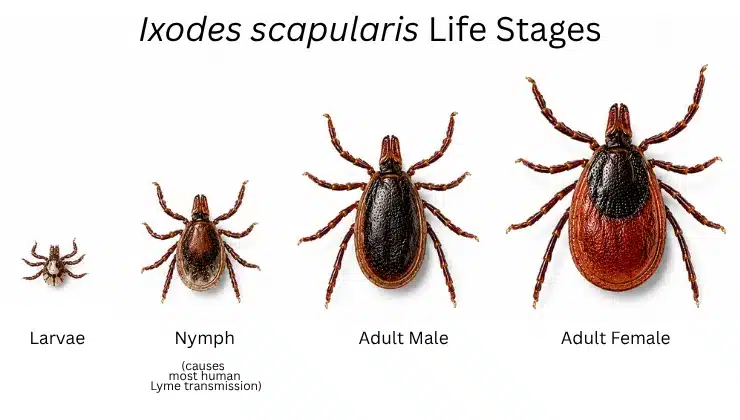
The deer tick completes its life cycle over roughly two years and feeds once at each of three stages: larva, nymph, and adult. Understanding this cycle explains why one stage, the nymph, drives most human Lyme disease.
The tick is not born infected. A larva picks up Borrelia burgdorferi when it takes its first blood meal from an infected reservoir host, most often a white-footed mouse or other small mammal. It then molts into a nymph carrying the bacteria. When that infected nymph feeds the following spring and summer, it can pass Lyme disease to whatever it bites, including a human. This is why the nymph is the dangerous stage: it is both infected and small enough to go completely unnoticed.
All three feeding stages can bite humans.
Because transmission risk rises with how long a tick stays attached, the near-invisibility of the nymph matters as much as its biology: a tick you never notice is a tick you never remove.
We have helped thousands of people in Colorado, Oregon, Wyoming, New Jersey, Pennsylvania, Texas, and Wisconsin restore their health and quality of life by diagnosing and treating their Lyme Disease.
Lyme disease, caused by Borrelia burgdorferi (and related Borrelia species), is the most common tick-borne illness in the United States [1]. The CDC reports approximately 476,000 cases diagnosed annually, though the true number is likely higher due to underdiagnosis [5].
The deer tick is the primary vector in the eastern U.S. The western blacklegged tick (Ixodes pacificus) carries Lyme in the western U.S.
Early symptoms after a bite may include:
The characteristic expanding bull’s-eye rash (erythema migrans), present in roughly 70-80% of early cases [2]
Fatigue, fever, headache, muscle and joint aches
Flu-like illness without respiratory symptoms
If untreated or inadequately treated, Lyme disease can disseminate to the nervous system (Lyme neuroborreliosis), joints (Lyme arthritis), and heart (Lyme carditis). Late-stage and persistent symptoms, including cognitive difficulties, chronic pain, and fatigue, represent one of the most contested and undertreated areas of tick-borne medicine.
If your symptoms sound familiar and you’ve had inconclusive testing, the tick-borne co-infections comparison resource can help you understand what may be overlapping.
Babesiosis is a malaria-like illness caused by Babesia microti (and other Babesia species). It infects and destroys red blood cells. Symptoms range from mild flu-like illness to severe hemolytic anemia requiring hospitalization, particularly dangerous in elderly patients, immunocompromised individuals, or those without a spleen [4].
Babesiosis is a malaria-like infection caused by Babesia parasites that invade and destroy red blood cells. It is transmitted by deer ticks and can range from mild flu-like illness to severe anemia.
Babesiosis co-infection with Lyme disease is increasingly recognized and significantly worsens outcomes. Standard Lyme treatment does not address Babesia.
Caused by Anaplasma phagocytophilum, anaplasmosis presents as a febrile illness with headache, muscle aches, and low white blood cell counts. Like ehrlichiosis (carried by the lone star tick), it responds to doxycycline, but only when diagnosed [6].
Anaplasmosis is a bacterial infection caused by Anaplasma phagocytophilum and transmitted by deer ticks. It typically causes fever, headache, and muscle aches, and responds to doxycycline when diagnosed early.
Powassan is a rare but serious neurological infection with no specific treatment. Unlike Lyme disease, Powassan can be transmitted in as little as 15 minutes of tick attachment [8], making prompt removal less reliable as a protective measure. Encephalitis and lasting neurological damage are possible. Cases have increased as deer tick populations have expanded.
Powassan virus is a rare but serious tick-borne infection that attacks the nervous system and has no specific treatment. Unlike Lyme, it can transmit within 15 minutes of a deer tick bite.
A relapsing-fever Borrelia species transmitted by deer ticks, B. miyamotoi does not reliably show up on standard Lyme tests. It causes a relapsing febrile illness and is increasingly recognized in tick-borne illness patients.
This is something I explain to patients regularly, and it is one of the most important things to understand about deer tick-related illness.
The standard two-tier testing protocol (ELISA followed by Western blot) was designed to detect antibodies produced during Lyme infection. Several documented limitations exist:
Early disease: In the first few weeks after a bite, the immune response may not yet be detectable. A negative test in week 1-2 does not rule out infection.
Seronegative Lyme: Some patients produce an atypical or delayed antibody response and never test positive on standard panels.
Other Borrelia species: Standard tests are designed around B. burgdorferi and may not detect B. miyamotoi or other Borrelia species transmitted by the same tick.
Co-infections: A positive Lyme test does not rule out concurrent babesiosis, anaplasmosis, or other co-infections. Each requires specific testing.
In functional medicine, we order tick-borne panels, not just the standard Lyme ELISA. If your standard test was negative but your symptoms suggest tick-borne illness, that result alone does not close the case.
For more on how these diseases overlap and present differently, see our co-infections resource.
The widely cited figure is 36-48 hours of attachment before Borrelia burgdorferi transmission occurs [3]. This is based on the understanding that the spirochetes migrate from the tick’s midgut to salivary glands during feeding, a process that takes time to complete.
Transmission risk climbs with attachment duration rather than switching on at a single moment. Reviews of the experimental data find little to no transmission when an infected nymph is removed at 24 hours, a probability that rises to roughly 10% by 48 hours and about 70% by 72 hours of feeding [7]. In practical terms, the first day is relatively protective and the risk accelerates sharply after that, which is why same-day tick checks matter so much.
This window is real and meaningful, it is why checking for ticks within 24 hours of outdoor exposure and removing them promptly can prevent transmission.
But, the window does not apply equally to all pathogens carried by this tick. Powassan virus can transmit in as little as 15 minutes. Borrelia miyamotoi transmission timing has not been as thoroughly studied. The 36-48 hour rule is a useful guideline for Lyme specifically, not for tick-borne illness in general.
We have helped thousands of people in Colorado, Oregon, Wyoming, New Jersey, Pennsylvania, Texas, and Wisconsin restore their health and quality of life by diagnosing and treating their Lyme Disease.
In our practice, patients who come in after a deer tick bite, or who are months or years into unresolved symptoms, receive a thorough evaluation that goes beyond what standard infectious disease workups typically cover.
Build Body First: Lyme disease and its co-infections deplete mitochondrial energy production, strain the adrenal system, and create pervasive inflammation. Addressing these foundations isn’t separate from treating Lyme, it’s what makes treatment effective.
Nervous System Support: The neurological impact of tick-borne illness, brain fog, cognitive difficulties, mood instability, neuropathy, is real and documented. We address the terrain, not just the pathogen.
Detox Pathways: The Herxheimer reaction (a temporary worsening as bacteria die off) is easier to tolerate and less damaging when detox pathways are well-supported.
Microbe Balancing: Targeted antimicrobial support, whether botanical, pharmaceutical, or combined, is individualized to what the evaluation reveals, not a standard protocol applied to everyone.
Contact a healthcare provider if you develop any of these within 30 days of a tick bite:
A bull’s-eye rash or expanding redness at the bite site (even without a bull’s-eye pattern)
Fever, chills, fatigue, or flu-like symptoms without a respiratory component
Headache, neck stiffness, or facial drooping
Joint pain, especially if asymmetric
Heart palpitations or irregular heartbeat
Any neurological symptoms, numbness, tingling, word-finding difficulties
Do not wait for symptoms to progress. Lyme disease is significantly easier to treat early.
For general tick safety information, prevention, proper removal technique, and what to do after a bite, see our tick prevention guide.
The deer tick (Ixodes scapularis) is smaller, with dark legs and a reddish-brown body (females) or uniformly dark body (males). The American dog tick (Dermacentor variabilis) is larger with distinctive silvery-white markings on the scutum. They carry different diseases: the deer tick transmits Lyme, babesiosis, and anaplasmosis; the dog tick transmits Rocky Mountain spotted fever and tularemia.
Yes. Transmission requires the tick to be attached and feeding for a sufficient period (typically 36-48 hours for B. burgdorferi). Not every deer tick is infected, infection rates vary by region and life stage but average 20-30% for nymphs in high-risk areas, higher in some endemic regions.
Removing a tick within 24 hours substantially reduces Lyme transmission risk. The 36-48 hour attachment window means prompt removal is protective for Lyme specifically. But, it does not eliminate all risk, particularly for other pathogens with shorter transmission windows.
A deer tick nymph is approximately 1-2 mm, roughly the size of a poppy seed, with a translucent brownish body. Without magnification, it can look like a small fleck of dirt or pepper on the skin. They do not jump; they crawl.
Deer ticks tend to migrate to warm, moist, concealed areas: the scalp, behind the ears, the neck, armpits, groin, and the back of the knees. A thorough tick check after outdoor exposure should prioritize these areas.
Lone Star Tick: causes alpha-gal syndrome, ehrlichiosis, and STARI; easy to confuse with deer tick nymphs
American Dog Tick: also transmits Rocky Mountain spotted fever; larger than the deer tick
Asian Longhorned Tick: an invasive species now confirmed in more than 19 eastern states
Rocky Mountain Wood Tick: the primary RMSF vector in the western United States
Types of Ticks: full guide to tick identification across all U.S. species
The deer tick is the tick that drives Lyme disease in the eastern United States, along with several other serious conditions that are often missed when providers focus only on Lyme. Understanding this tick, its biology, and the full range of pathogens it carries is the first step toward an accurate diagnosis.
If you’ve been bitten, developed unexplained symptoms, or received inconclusive test results, you deserve a thorough evaluation. Not just a Lyme ELISA, a look at what may actually be going on.
Author: Dr. Diane Mueller, ND, LAc, DAOM
Medical Reviewer: Dr. Diane Mueller, ND, LAc, DAOM
Medical Disclaimer: This content is for educational purposes only and is not a substitute for professional medical advice, diagnosis, or treatment. Always consult a qualified healthcare provider with questions about your specific situation.
We have helped thousands of
people restore their health
and quality of life by diagnosing
and treating their Lyme Disease.
“Dr. Mueller’s approach to medicine is refreshing! There is only so much you can do with western medicine and in my life I was needing a new approach. By addressing the whole body, nutritional diet factors, environmental factors, blood work, and incorporating ideas I had not previously known, I was able to break through with my conditions. I am not only experiencing less pain in my life, but through the process of healing guided by Dr. Diane Mueller, I am now happy to say I have more consciousness surrounding how I eat, what to eat and when things are appropriate. Living by example Dr. Mueller has a vibrancy that makes you want to learn and know more about your body and overall health. I highly recommend her to anyone looking for new answers, a new approach to health, or in need of freedom from pain and limitations.”
-Storie S.
Kihei, HI