


You pulled off a tick. It had a single white dot on its back. And now you’re searching to find out whether you should be worried.
The lone star tick (Amblyomma americanum) is an aggressive, human-biting tick named for the single white spot on the back of the adult female. It ranges across the eastern and south-central United States and is the primary cause of alpha-gal syndrome, a tick-triggered red meat allergy that can last for years. That white spot is its signature, and yes, you should know what this tick can do, because it carries risks that most people have never heard of, including one that can change what you eat for the rest of your life.
Alpha-gal syndrome is a tick-triggered allergy to red meat and other mammalian products. A lone star tick bite sensitizes your immune system to a sugar molecule called alpha-gal, so that later eating beef, pork, or lamb can trigger a delayed allergic reaction.
Here is what the research shows, and what it means for your health.
The lone star tick (Amblyomma americanum) is identified by a single white spot on the back of the adult female
It is the primary driver of alpha-gal syndrome, a tick-triggered red meat allergy now affecting an estimated 450,000 Americans
Lone star ticks transmit several infections including ehrlichiosis, tularemia, STARI (Southern tick-associated rash illness), and the emerging Heartland and Bourbon viruses
The CDC does not consider it a Lyme disease vector, though it can cause a Lyme-like rash
Its range has expanded well north and east, including New Jersey, Long Island, and coastal New England
All three life stages (larva, nymph, adult) bite humans
Dr. Diane Mueller treats tick-borne illness by telehealth in the states where the lone star tick is most active.
Full list of states: where we practice.
We have helped thousands of people in Colorado, Oregon, Wyoming, New Jersey, Pennsylvania, Texas, and Wisconsin restore their health and quality of life by diagnosing and treating their Lyme Disease.
The adult female lone star tick has one distinctive marking that makes identification straightforward: a single white dot, or “lone star,” centered on her dark brown back shield (scutum). This is where the species gets its name.
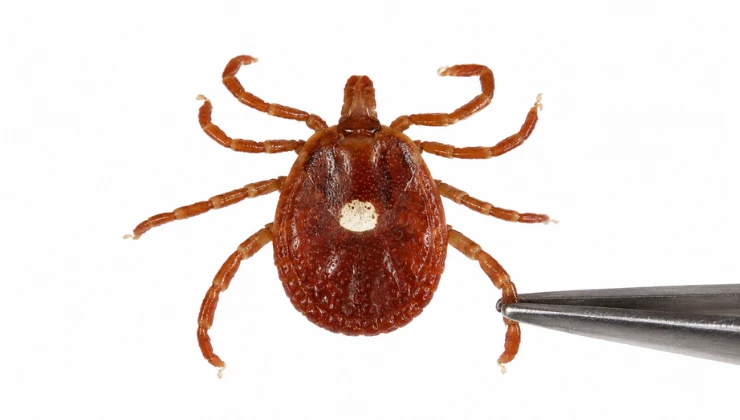
Males are also brown but display scattered white markings along the rear edge of their body rather than the single central spot. Unfed adults are roughly 3/16 of an inch long, about the size of a sesame seed. After a blood meal, they can swell to the size of a small raisin.

One practical note: the white spot is only visible on adult females. Nymphs and larvae lack it. If you found a very small tick, pinhead-sized or smaller, it may be a lone star tick larva or nymph without any distinctive markings.
The three ticks people most often confuse, look different and carry different diseases. Here is how they compare at a glance:

This species has historically been associated with the southeastern United States. That picture is no longer accurate.
Lone star ticks are now well-established across much of the eastern and south-central United States, with confirmed populations in:
The Mid-Atlantic and Northeast, including New Jersey, Long Island, and parts of Connecticut
Cape Cod and coastal Massachusetts, where the species was first documented in 2015
Much of the Southeast, from Florida to Texas
The Midwest in expanding pockets
If you live east of the Mississippi River, this tick is a realistic concern, not just a southern problem.
Lone star ticks prefer areas with dense brush, wooded edges, and areas where deer and other wildlife are common. They are particularly active along trails, forest edges, and suburban greenbelts, wherever people and deer share habitat.
We have helped thousands of people in Colorado, Oregon, Wyoming, New Jersey, Pennsylvania, Texas, and Wisconsin restore their health and quality of life by diagnosing and treating their Lyme Disease.
This is the lone star tick’s most surprising health impact.
Alpha-gal syndrome (AGS) is a tick-triggered allergy to red meat and other mammalian food products. When a lone star tick bites you, it injects a carbohydrate molecule called alpha-gal (galactose-alpha-1,3-galactose) into your bloodstream. Your immune system responds by producing antibodies against it. The problem: alpha-gal is present in the meat of most mammals, beef, pork, lamb, venison, bison. [2]
After sensitization, eating red meat triggers an allergic reaction. Symptoms typically appear 3-6 hours after eating, which makes the connection maddeningly difficult to recognize: [1]
The delayed timing means most people don’t connect their reactions to food. They arrive in emergency rooms, get workups for cardiac or gastrointestinal conditions, and get sent home without answers. Some patients spend years in diagnostic limbo before anyone runs an alpha-gal IgE antibody test.
This is not a nuisance allergy. In 2025, researchers at the University of Virginia reported what is believed to be the first documented death from alpha-gal syndrome: a previously healthy 47-year-old New Jersey man who collapsed a few hours after eating a hamburger and died of anaphylaxis. [9] He had not been diagnosed during his life. The case is a reminder that in rare instances the reaction can be fatal, which is why recognizing the pattern early matters.
If you’ve had unexplained allergic reactions, especially to meat, and you live in an area where lone star ticks are present, this diagnosis deserves serious consideration. You can learn more about what this condition involves and how it’s managed at our alpha-gal syndrome resource page.
Ehrlichiosis is a bacterial infection caused by Ehrlichia chaffeensis (and less often E. ewingii). The lone star tick is the primary vector for this illness in the United States. [3][5]
Ehrlichiosis is a bacterial infection spread by the lone star tick that causes sudden fever, headache, and muscle aches. It responds well to the antibiotic doxycycline when treated early but can become serious if left untreated.
Symptoms typically begin within 1-2 weeks of a bite and can include:
Sudden-onset fever (often above 102°F)
Severe headache
Muscle aches
Fatigue and general malaise
In some patients: nausea, vomiting, rash
Ehrlichiosis can become severe without prompt treatment. Doxycycline is the antibiotic of choice and works well when started early. Without treatment, the infection can progress to respiratory failure, neurological complications, or death, particularly in immunocompromised individuals.
Tularemia (Francisella tularensis) is a bacterial infection transmissible through tick bites, direct contact with infected animals, or inhaled particles. The lone star tick is a recognized vector. Symptoms vary by exposure route but can include a skin ulcer at the bite site, swollen lymph nodes, fever, and fatigue. [4]
Tularemia is a bacterial infection, sometimes called rabbit fever, that can be spread by the lone star tick. It typically causes fever, swollen lymph nodes, and a skin ulcer at the bite site.
The lone star tick is also the likely vector for two emerging tick-borne viruses, Heartland virus and Bourbon virus, both first identified in the past decade in the central and southern United States. [7][8] Unlike the bacterial infections above, these are viral and do not respond to antibiotics, so treatment is supportive. Both can cause fever, fatigue, muscle aches, and low white blood cell and platelet counts, and both can be serious, so a viral tick-borne infection should be considered when symptoms follow a bite but standard bacterial testing comes back negative.
STARI presents with a rash that can look nearly identical to the Lyme disease bull’s-eye rash, a central clearing surrounded by an expanding ring. The critical distinction: STARI is associated with the lone star tick, not the deer tick, and occurs in areas where lone star ticks are common but Ixodes scapularis (the Lyme vector) may be less prevalent. [4]
STARI (Southern tick-associated rash illness) is a condition marked by a Lyme-like bull’s-eye rash that follows a lone star tick bite. Unlike Lyme disease, it is not caused by Borrelia burgdorferi and does not show up on standard Lyme tests.
The organism responsible for STARI has not been definitively identified. What we know: it’s not Borrelia burgdorferi, and it does not respond to the standard Lyme disease antibody tests. Patients who develop a bull’s-eye rash in the Southeast or Mid-Atlantic after a lone star tick bite should be evaluated promptly, doxycycline is typically prescribed while the diagnosis is being sorted out.
We have helped thousands of people in Colorado, Oregon, Wyoming, New Jersey, Pennsylvania, Texas, and Wisconsin restore their health and quality of life by diagnosing and treating their Lyme Disease.
No, the lone star tick is not a Lyme disease vector.
This is one of the most common misconceptions I encounter. The lone star tick (Amblyomma americanum) does not transmit Borrelia burgdorferi, the bacteria that causes Lyme disease. Research has repeatedly confirmed this.
That said, the picture is more complicated in a few ways:
If you’re trying to sort out whether your illness might be Lyme-related, the co-infections comparison resource can help you understand how these conditions present differently.
In functional medicine, a tick bite isn’t evaluated in isolation. A tick-borne infection stresses many systems at once: it activates the immune system, drives inflammation, and can disrupt energy production and the nervous system long after the bite itself has healed. So rather than treating the microbe alone, I work through a sequenced four-phase framework that prepares the body to clear an infection and recover, instead of just suppressing symptoms. When a patient comes in after a lone star tick exposure, or with unexplained symptoms after spending time in tick habitat, we look at the whole picture:
Phase 1 (Build the Body First): Tick-borne infections strain the immune system and adrenal function. Before addressing any specific pathogen, we assess your foundational health status, mitochondrial function, nutritional depletion, and adrenal resilience.
Phase 2 (Nervous System): Ehrlichiosis and related infections can trigger significant neurological symptoms. We evaluate nervous system involvement and support the brain-body connection alongside any antimicrobial protocols.
Phase 3 (Detox): Bacterial infections and immune activation generate inflammatory byproducts that burden the liver and detox pathways. Supporting those pathways is part of recovery, not optional.
Phase 4 (Microbe Balancing): This is where targeted antimicrobial support enters, once the body has the foundational resources to handle it.
The goal is not to suppress symptoms. It is to give your body the resources it needs to resolve the underlying problem.
Get evaluated promptly if you develop any of the following within 30 days of a tick bite:
Fever, especially if sudden and high
A bull’s-eye or expanding rash around the bite site
Severe headache, muscle aches, or unusual fatigue
Signs of an allergic reaction after eating red meat (especially 3-6 hours post-meal)
Any neurological symptoms: numbness, tingling, cognitive changes
Tick-borne bacterial infections respond well to early antibiotic treatment. The window for straightforward treatment is real, don’t wait to see if symptoms improve on their own.
The bite itself may look like a small red bump, similar to other insect bites. Redness at the site is normal. A bull’s-eye pattern, a central clearing surrounded by an expanding red ring, may indicate STARI (not Lyme in lone star tick territory) and warrants prompt medical evaluation.
No. The lone star tick is not a confirmed vector for Borrelia burgdorferi, which causes Lyme disease. It can cause STARI, which produces a similar rash, but the two infections are distinct. If you were bitten and are uncertain which tick species was involved, that distinction matters, discuss it with a provider familiar with tick-borne illness.
This varies by pathogen. For ehrlichiosis, transmission can occur within hours of attachment, faster than the 24-48 hour window often cited for Lyme disease (which is transmitted by a different tick species). Prompt removal remains the most important protective action.
No. Sensitization to alpha-gal requires multiple bites in most cases, though single-bite sensitization does occur. Not everyone bitten develops AGS, and the reasons for individual susceptibility are still being studied. People with multiple lone star tick exposures, particularly in endemic areas, are at higher risk.
Lone star ticks are found throughout the eastern and south-central United States, with the highest density in the Southeast (from Texas to Florida and north through Virginia). Their range has expanded significantly northward and now includes coastal areas of New England, New York, and New Jersey.
It can, but not always, and not quickly. Because the allergy is driven by tick bites, avoiding further bites gives the immune system a chance to lower its alpha-gal antibody levels over time. Many people find that after one to three years without new bites their sensitivity fades and they can tolerate small amounts of red meat again. Others remain reactive indefinitely, and repeat tick bites can reset or worsen the allergy. Recovery is individual, so any reintroduction of red meat should be done with your provider rather than by trial and error.
They are different species that carry different diseases. The lone star tick has a single white dot on the adult female’s back, bites aggressively at all life stages, and is the main cause of alpha-gal syndrome, ehrlichiosis, and STARI. The deer tick, also called the black-legged tick, has a solid reddish body with no white markings and is the primary vector of Lyme disease. The lone star tick does not transmit Lyme. If you are unsure which one bit you, that distinction changes what you should watch for.
Deer Tick (Black-Legged Tick): primary Lyme disease vector in the Northeast and Midwest
American Dog Tick: carries Rocky Mountain spotted fever; the most commonly encountered tick east of the Rockies
Alpha-Gal Syndrome: the red meat allergy triggered by lone star tick bites, explained in full
Gulf Coast Tick: an expanding southern species with an overlapping range
Types of Ticks: full guide to tick identification across all U.S. species
Standard prevention applies regardless of tick species:
Apply EPA-registered repellent to exposed skin: DEET (20-30%) or picaridin (20%) are the most studied options for tick prevention
Treat clothing and gear with permethrin (0.5% concentration). Let it dry completely before wearing. Treated clothing repels ticks on contact and remains effective through multiple washes.
Cover up in high-risk areas: long sleeves, long pants tucked into socks, and closed-toe shoes reduce skin exposure in wooded or grassy terrain
Perform a tick check within 2 hours of outdoor activity, focusing on warm and hidden areas: scalp, behind the ears, underarms, groin, and behind the knees
Shower promptly after time outdoors: this rinses off any unattached ticks and gives you a full-body tick check opportunity
Check pets before they come indoors; dogs can carry ticks into the home
If you find a tick attached to your skin, use fine-tipped tweezers to grasp it as close to the skin surface as possible and pull upward with slow, even pressure. Do not twist or jerk. Clean the bite area with rubbing alcohol or soap and water after removal.
The lone star tick carries real health risks that deserve to be taken seriously, including ehrlichiosis, tularemia, STARI, and the growing threat of alpha-gal syndrome. Its range has expanded well beyond the South. If you live or spend time in the eastern United States, this tick is part of your tick-awareness picture.
Understanding which tick you’re dealing with is the first step toward understanding your risk. For a full overview of tick species present in the United States, see our tick identification guide.
If you’ve had a tick bite and are experiencing unexplained symptoms, or if you’re concerned about tick-borne illness, a functional medicine evaluation can help identify what your conventional workup may have missed.
Author: Dr. Diane Mueller, ND, LAc, DAOM, Naturopathic Doctor and Doctor of Acupuncture & Oriental Medicine specializing in Lyme disease and tick-borne illness. Founder of MyLymeDoc.com.
Medical Reviewer: Dr. Diane Mueller, ND, LAc, DAOM
Medical Disclaimer: This content is for educational purposes only and is not a substitute for professional medical advice, diagnosis, or treatment. Always consult a qualified healthcare provider with questions about your specific situation. This page does not constitute a patient-provider relationship.
We have helped thousands of
people restore their health
and quality of life by diagnosing
and treating their Lyme Disease.
“Dr. Mueller’s approach to medicine is refreshing! There is only so much you can do with western medicine and in my life I was needing a new approach. By addressing the whole body, nutritional diet factors, environmental factors, blood work, and incorporating ideas I had not previously known, I was able to break through with my conditions. I am not only experiencing less pain in my life, but through the process of healing guided by Dr. Diane Mueller, I am now happy to say I have more consciousness surrounding how I eat, what to eat and when things are appropriate. Living by example Dr. Mueller has a vibrancy that makes you want to learn and know more about your body and overall health. I highly recommend her to anyone looking for new answers, a new approach to health, or in need of freedom from pain and limitations.”
-Storie S.
Kihei, HI