


The brown dog tick (Rhipicephalus sanguineus) is a reddish-brown, three-host tick that feeds primarily on dogs and is the only tick species in the United States able to complete its entire life cycle indoors. It transmits Rocky Mountain spotted fever to people in the Southwest and canine ehrlichiosis and babesiosis to dogs worldwide.
The brown dog tick (Rhipicephalus sanguineus) is a plain reddish-brown tick that feeds mainly on dogs and is the only U.S. tick able to complete its full life cycle indoors, which is why it can infest homes, kennels, and furniture.
Most ticks are outdoor threats. You encounter them on trails, in tall grass, at the forest edge. You come inside, shower, check for ticks, and the exposure ends there.
The brown dog tick is different. If your dog brings one in, a full-scale infestation can build inside your home, your dog’s kennel, your baseboards, and your furniture, without you ever going outside again.
That reality changes the risk calculation. Here is what the research shows.
The brown dog tick (Rhipicephalus sanguineus) is the only U.S. tick species capable of completing its life cycle entirely indoors
It primarily feeds on dogs but can and does bite humans
In the United States, it is a vector for Rocky Mountain spotted fever (RMSF), particularly in the Southwest (Arizona, California)
Globally, it transmits canine ehrlichiosis and other diseases in dogs
Infestations concentrate in kennels, homes with dogs, shelters, and indoor spaces where dogs are housed
Range is primarily the southwestern United States, with risk extending to any indoor dog-keeping environment
We have helped thousands of people in Colorado, Oregon, Wyoming, New Jersey, Pennsylvania, Texas, and Wisconsin restore their health and quality of life by diagnosing and treating their Lyme Disease.
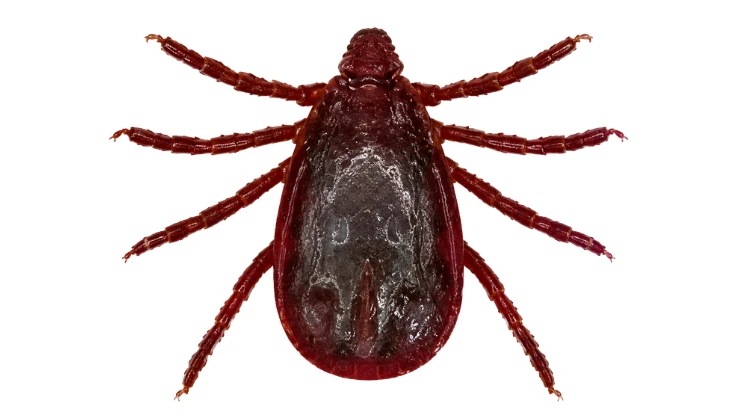
Unlike the ornate American dog tick or the white-spotted lone star tick, the brown dog tick is visually plain. Key features:
Small to medium size, adults are 3-5 mm unfed
Uniformly reddish-brown body with no distinctive markings or patterns
No ornate scutum, the back shield is plain brown, not the silvery-patterned shield you see on Dermacentor species
Narrow at the front (toward the mouthparts) with a slight hexagonal shape when viewed from above
One key field clue: context. If you’re finding ticks inside your home, in baseboards, in your dog’s bedding, in cracks in walls, and you have a dog, brown dog tick infestation is a serious possibility even without a clear outdoor exposure event.
Established infestations in the U.S. are most prominent in the southwestern United States, with the highest-risk focal areas in:
Arizona, focal RMSF clusters have been documented, primarily in reservation communities in Yuma County and surrounding areas
California, including northern California (recent infestation reports) and the eastern Coachella Valley
Texas and other Gulf Coast states
Globally, the brown dog tick is cosmopolitan, it is found wherever dogs are kept in most of the world. In the United States, any household with dogs can potentially support an infestation if the right conditions are present, but the disease transmission risk (RMSF from this vector) is most clinically significant in the Southwest.
Unlike other U.S. ticks that require outdoor vegetation and humidity to survive, the brown dog tick tolerates indoor conditions and can persist in:
Cracks and gaps in walls, floors, and baseboards
Dog bedding and kennels
Furniture
Gaps around window and door frames
To understand why this tick is so hard to eradicate once it settles into a home, it helps to understand how it lives and reproduces.

The brown dog tick is a three-host tick. It feeds on a separate host at each of its three feeding stages, larva, nymph, and adult, dropping off between meals to molt or lay eggs before finding the next host. In most tick species those hosts are wildlife encountered outdoors. The brown dog tick evolved alongside domestic dogs, so each of its three hosts is typically a dog living in or near the same building. That single adaptation is what lets the entire cycle unfold inside four walls.
The reproductive math is the reason a small problem becomes an infestation fast. After a blood meal, an engorged female drops off her host and lays a single large egg batch, commonly 1,500 to about 4,000 eggs [7], tucked into cracks and crevices in walls, floors, and baseboards. She then dies, but those eggs hatch into hundreds of larvae that climb, feed on the dog, drop off, molt, and repeat. Under warm indoor conditions the tick can complete three to four generations in a single year.
Unlike ticks that need outdoor humidity and vegetation to survive between feedings, R. sanguineus tolerates the dry, climate-controlled conditions found indoors, and it is remarkably patient. Unfed adults can survive more than a year and a half without a blood meal (roughly 568 days) [7], and unfed larvae and nymphs can persist for many months. This is why an infested home stays dangerous long after the visible ticks seem to be gone: eggs and hungry, unfed ticks sit dormant in harborage points, waiting for a host to walk by. Missing even a fraction of them, or treating the dog but not the environment, allows the population to rebuild.
In a heavy infestation, ticks may be visible climbing walls, ceilings, and furniture, hundreds or even thousands in severe cases. Most of the population, though, is never on the dog at all. It is hidden in the structure of the home. That is what makes the brown dog tick an indoor pest control problem as much as a medical one.
We have helped thousands of people in Colorado, Oregon, Wyoming, New Jersey, Pennsylvania, Texas, and Wisconsin restore their health and quality of life by diagnosing and treating their Lyme Disease.
In the United States, the brown dog tick’s most significant medical concern for humans is Rocky Mountain spotted fever (RMSF) caused by Rickettsia rickettsii.
Rocky Mountain spotted fever (RMSF) is a severe, fast-moving bacterial illness caused by Rickettsia rickettsii and spread through tick bites. It can be fatal without early antibiotic treatment, which is why it is treated on clinical suspicion rather than waiting for test results.
RMSF is a severe, rapidly progressing illness. Without prompt treatment, case fatality rates can reach 20-25% [3]. With appropriate antibiotic treatment started early, ideally within the first 5 days of illness, outcomes are dramatically better.
In the U.S., brown dog tick-associated RMSF clusters have been documented most prominently in Arizona, particularly in tribal and reservation communities in and around Yuma County, with additional foci reported in California and northern Mexico [1]. These clusters involved severe disease and multiple fatalities, leading to substantial public health investigation and response [1][6].
What makes these clusters distinct is the vector itself. In most of the United States, RMSF is spread by wood ticks and American dog ticks that bite people outdoors. In the Southwest focal areas, the driver is heavy peridomestic brown dog tick populations: dogs and homes carry large numbers of ticks, so people are bitten in and around the house rather than in the wilderness. The same indoor life cycle that lets an infestation build is what turns a neighborhood into an RMSF hotspot, which is why controlling the tick population is a public health measure, not just a comfort one.
RMSF symptoms typically begin 2-14 days after a bite:
Sudden high fever (102°F or above)
Severe headache
Muscle aches and fatigue
A rash that typically starts on the wrists and ankles and spreads inward (though some patients never develop a rash)
Do not wait for a rash to seek care. The classic rash develops in many but not all patients, and by the time the petechial (purple pinpoint) rash of late RMSF appears, the disease has progressed to a dangerous stage. Doxycycline is the treatment of choice and should be started based on clinical suspicion.
Dogs are the primary host for the brown dog tick, and the health implications for dogs are substantial. Two diseases dominate.
Canine ehrlichiosis is a tick-borne bacterial disease of dogs caused by Ehrlichia canis. It infects white blood cells and, if untreated, can advance to a chronic phase marked by bone marrow suppression.
Canine ehrlichiosis. Ehrlichia canis, the cause of canine ehrlichiosis, is transmitted by this tick worldwide. Signs in dogs include fever, lethargy, weight loss, abnormal bleeding, nosebleeds, and enlarged lymph nodes. Left untreated it can progress to a chronic phase with bone marrow suppression that is difficult to reverse.
Canine babesiosis is a tick-borne disease of dogs caused by Babesia protozoan parasites that invade and destroy red blood cells, leading to anemia that can be life-threatening in severe cases.
Canine babesiosis. The brown dog tick also transmits Babesia canis and Babesia vogeli, protozoan parasites that invade and destroy red blood cells. This produces fever, loss of appetite, weakness, pale gums, and anemia, and severe cases can be life-threatening.
These are veterinary diseases, not human ones. A dog cannot pass ehrlichiosis or babesiosis to you directly. But an infested dog is the engine that keeps a household tick population alive, which is why the human risk and the canine risk are inseparable. If you have a dog in a region where brown dog ticks are active, regular tick prevention and veterinary surveillance are part of protecting the entire household, including the people in it.
An indoor infestation can be subtle at first and explosive if left unaddressed. Signs to watch for:
Ticks visible on your dog, particularly around the ears, between the toes, in the groin
Ticks on walls, baseboards, or furniture, the brown dog tick is a climbing species and will be found in locations other ticks wouldn’t reach
Dogs repeatedly bringing ticks in even though outdoor prevention, may indicate an established indoor population
Multiple ticks found in multiple life stages, larvae (the size of a period), nymphs, and adults together indicate an established breeding population
If you’re finding ticks regularly inside your home, this is a pest control situation that requires both environmental treatment and veterinary management of your dog simultaneously. Treating only one without the other leads to reinfestation.
On yourself: Remove with fine-tipped tweezers, grasping as close to the skin as possible and pulling straight out. Clean the bite site. Monitor for symptoms (fever, rash, headache, fatigue) for 14 days. If in an area with confirmed brown dog tick RMSF risk (particularly Arizona), mention the bite to a healthcare provider.
On your dog: Remove the tick and consult your veterinarian. If your dog has tick prevention in place and you’re still finding ticks, discuss whether an infestation may have established indoors.
In your home: Contact a licensed pest control professional experienced with tick infestations. Indoor tick treatment is different from standard pest control and may require multiple treatments. Simultaneously, your veterinarian should treat your dog with an appropriate tick prevention product.
For general guidance on tick prevention for yourself and your family, see our tick prevention guide.
In functional medicine, we think about tick exposure differently than conventional medicine does. A single bite from a brown dog tick in a low-risk area probably warrants watchful waiting. But a patient presenting with an unexplained febrile illness after home exposure, especially in the Southwest, needs brown dog tick-associated RMSF in the differential.
More broadly: patients dealing with tick-borne illness are rarely dealing with just one insult. Tick exposure often occurs in the context of already-stressed immune function, gut dysbiosis, and nutritional depletion that make infections harder to clear. That context shapes how we approach evaluation and treatment.
If you’re dealing with unexplained symptoms and tick exposure has been part of your history, a thorough functional medicine evaluation looks at the whole picture. See how we work with complex tick-borne cases →
We have helped thousands of people in Colorado, Oregon, Wyoming, New Jersey, Pennsylvania, Texas, and Wisconsin restore their health and quality of life by diagnosing and treating their Lyme Disease.
Yes. While dogs are the preferred host, brown dog ticks can and do bite humans, particularly in homes with active infestations where tick numbers are high and dogs are unavailable.
No. Rhipicephalus sanguineus is not a vector for Borrelia burgdorferi, the cause of Lyme disease. The deer tick (Ixodes scapularis) is the primary Lyme vector in the eastern United States.
Brown dog tick infestations require simultaneous treatment of the dog (with veterinarian-approved tick prevention) and the indoor environment (with licensed pest control). Treating only one will result in reinfestation. Multiple treatments may be needed for heavy infestations.
Established infestations with documented RMSF transmission are most common in the southwestern United States, particularly Arizona and California. The tick can be found in any region where dogs are kept, but disease transmission risk is highest in the Southwest.
The American dog tick (Dermacentor variabilis) has distinctive silvery-white ornate markings on the scutum and is found in outdoor habitats. The brown dog tick (Rhipicephalus sanguineus) is plain, uniformly brown, and uniquely capable of living indoors. They carry different diseases and require different management approaches.
American Dog Tick: the most similar species; both bite dogs but the American dog tick cannot complete its cycle indoors
Deer Tick (Black-Legged Tick): carries Lyme disease; different life cycle and habitat from the brown dog tick
Lone Star Tick: another dog-biting species found primarily in eastern and southern states
Gulf Coast Tick: found in overlapping southern geography; affects dogs and livestock
Types of Ticks: full guide to tick identification across all U.S. species
The brown dog tick is the one U.S. tick that can follow your dog inside and establish itself in your home. In the Southwest, it transmits Rocky Mountain spotted fever, a potentially fatal illness that responds well to early treatment. If you live in an affected area, have dogs, and develop unexplained fever or rash, this tick deserves to be in the differential.
Prevention starts with your dog. Consistent veterinary-grade tick prevention is the most effective tool against indoor infestations before they start.
Author: Dr. Diane Mueller, ND, LAc, DAOM
Medical Reviewer: Dr. Diane Mueller, ND, LAc, DAOM
Medical Disclaimer: This content is for educational purposes only and is not a substitute for professional medical advice, diagnosis, or treatment. Always consult a qualified healthcare provider with questions about your specific situation.
We have helped thousands of
people restore their health
and quality of life by diagnosing
and treating their Lyme Disease.
“Dr. Mueller’s approach to medicine is refreshing! There is only so much you can do with western medicine and in my life I was needing a new approach. By addressing the whole body, nutritional diet factors, environmental factors, blood work, and incorporating ideas I had not previously known, I was able to break through with my conditions. I am not only experiencing less pain in my life, but through the process of healing guided by Dr. Diane Mueller, I am now happy to say I have more consciousness surrounding how I eat, what to eat and when things are appropriate. Living by example Dr. Mueller has a vibrancy that makes you want to learn and know more about your body and overall health. I highly recommend her to anyone looking for new answers, a new approach to health, or in need of freedom from pain and limitations.”
-Storie S.
Kihei, HI