
Fibromyalgia and mold exposure can overlap in the same person, but no controlled study has shown that mold causes fibromyalgia. If your pain and fatigue began or worsen around a water-damaged home or workplace, it is reasonable to test whether mold is a driver before assuming fibromyalgia explains everything.
You were told to manage it. You pace yourself, protect your sleep, and take what you were prescribed, and the pain and exhaustion are still there. If your home or workplace has had a leak or a musty smell, asking whether mold is part of this is a fair question. Our guide to fibromyalgia symptoms in women covers the symptom list, so this page stays on the mold question.

The direct research on mold and fibromyalgia is thin, and it does not show that mold causes the condition.
Fibromyalgia is a chronic condition marked by widespread pain, fatigue, sleep problems, and trouble thinking clearly, and it is diagnosed from symptoms because no lab or imaging test confirms it.
The National Institute of Arthritis and Musculoskeletal and Skin Diseases states that the cause of fibromyalgia is not known. It points to altered signaling in the nervous pathways that carry pain. Public health summaries of damp buildings point to other body systems. The 2009 WHO review of dampness and mould found the main effects were respiratory symptoms, allergies, asthma, and immune disruption. The CDC list of mold effects names stuffy nose, sore throat, cough, wheezing, burning eyes, and skin rash. Neither summary lists fibromyalgia.
The closest study looked at chronic fatigue syndrome, not fibromyalgia. In a 2013 study of 112 people with chronic fatigue syndrome, 104 (93%) had at least one mycotoxin in their urine, and over 90% reported exposure to a water-damaged building. The comparison group was 55 healthy people with no exposure history, tested earlier by the same lab. That design shows the toxins were present. It cannot show that mold caused the illness.
CIRS (chronic inflammatory response syndrome) is the term Dr. Ritchie Shoemaker uses for a multi-system illness that he links to living or working in a water-damaged building.
Shoemaker’s 2005 study of 21 volunteers reported symptoms in at least four organ systems. The authors listed their own limits: exposure to specific agents was not demonstrated, participants were not randomly selected, and the study was not double-blinded. You can read more in our explainer on what CIRS is.
A single-author 2017 clinical review in Frontiers in Immunology says some people in damp buildings “may develop rheumatic symptoms resembling fibromyalgia.” It rests on the author’s clinical experience. It also states that there are no accepted diagnostic criteria for the syndrome it describes.
Here is where that leaves you. A link between mold and fibromyalgia-like pain is plausible in some people, it is unproven as a cause, and it can be tested one person at a time.
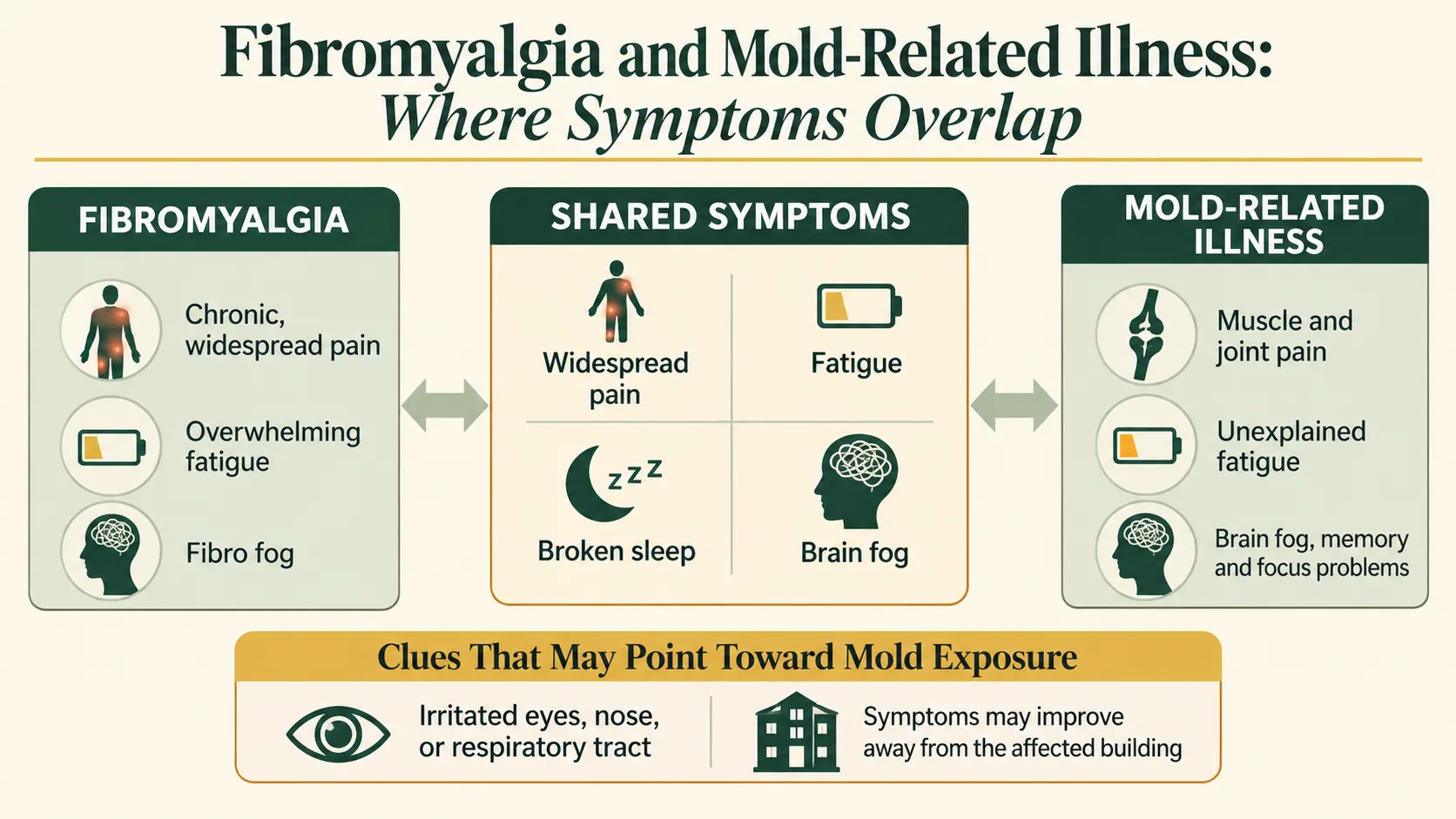
Mold-related illness and fibromyalgia overlap on the four symptoms that bother patients most: pain, fatigue, broken sleep, and brain fog.
| Fibromyalgia (NIAMS) | Mold-related illness (2017 clinical review) | |
|---|---|---|
| Pain | Chronic, widespread pain | Muscle and joint pain resembling fibromyalgia |
| Fatigue | Overwhelming tiredness | Unexplained fatigue, in a minority chronic fatigue syndrome |
| Thinking | “Fibro fog” | “Brain fog” with memory and focus problems |
| Early signs | Not listed on the page | Irritated eyes, nose, and respiratory tract |
| Location pattern | Not described | Symptoms ease away from the building |
| Lab test | None confirms it | No unanimously accepted test yet |
The table comes from the NIAMS fibromyalgia page and the 2017 review above.
Our mold illness symptoms guide lists the full range across body systems.
Overlap in symptoms is not evidence of a shared cause. It is the reason a clinician has to ask about your building. The same overlap is why CIRS symptoms are often mistaken for something else.
If exhaustion is your main complaint, our page on mold and fatigue goes deeper.
A fibromyalgia diagnosis rests on symptoms alone, so another cause can sit underneath it.
NIAMS notes that there are no specific laboratory or imaging tests for fibromyalgia. The 2016 criteria use a widespread pain score and a symptom severity score, with a threshold of 7 and 5, or 4 to 6 and 9. Two referral studies show how often the label shifts once a rheumatologist looks. A 2003 study of 76 rheumatology referrals found the initial fibromyalgia diagnosis was correct in 34%. The authors described “a disturbing inaccuracy, mostly observed to be overdiagnosis.” A 2009 study from Israel found that rheumatologists confirmed 71% of 196 patients referred with fibromyalgia.
These studies are about rheumatology referrals, not mold, and they do not tell you your own diagnosis is wrong. They do show why the label deserves a second look when pain and fatigue do not respond to treatment.
The American College of Rheumatology adds a point that matters here. Its criteria state that a fibromyalgia diagnosis does not exclude other clinically important illnesses. You can have fibromyalgia and a mold problem at the same time. Lyme disease belongs on that list too, and our page on Lyme disease and fibromyalgia covers how the two are told apart.