

On Lyme disease, anxiety and depression, the strongest evidence is a Danish national study of 6,945,837 people that found a measured association between Lyme disease and both mental disorders and mood disorders. In that study, the 12,156 people diagnosed with Lyme disease in hospital had a 28% higher rate of any mental disorder and a 42% higher rate of mood disorders such as depression. An association means the two appear together more often than chance predicts. It does not show that the infection caused the mood symptoms. It does mean your experience has a basis in the medical literature, and your mood symptoms need care while the physical side is investigated.

You told your doctor about the exhaustion, the joint pain, the memory that stopped working, and the dread that arrived with them. The answer was a prescription. One patient described hearing, “Do you think you’re depressed? Let’s try some antidepressants.” Another was told, “If all these tests come back normal, you should really consider Anxiety medication.”
A mood treatment can help, and it can be part of your care. The problem starts when it ends the investigation. Our guide on why a doctor may not believe you covers that gap, and this page covers what the research says about mood.
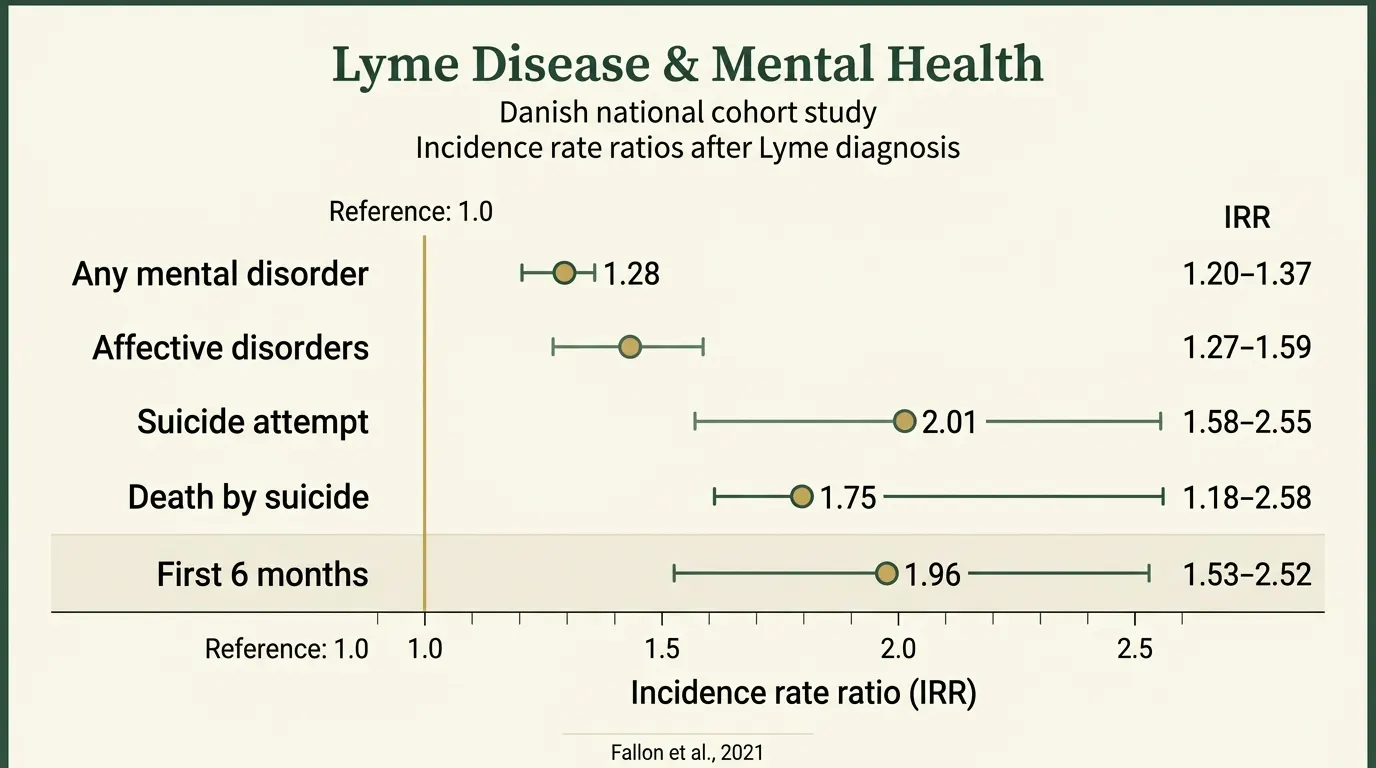
The 2021 Danish national study found higher rates of mental disorders, mood disorders, suicide attempts, and death by suicide after a hospital diagnosis of Lyme disease. Fallon and colleagues followed everyone living in Denmark from 1994 through 2016 using national patient and psychiatric registers, which avoids the self-selection built into patient surveys.
Lyme borreliosis is the medical name for Lyme disease, the tick-borne infection caused by Borrelia burgdorferi.
An incidence rate ratio (IRR) compares how often something happens in one group against another over the same period. An IRR of 1.42 means a rate 42% higher, not that 42% of people were affected.
Affective disorders are mood disorders, a diagnostic category that includes depression.
| Outcome after a Lyme diagnosis | Rate ratio (IRR) | 95% confidence interval | Plain meaning |
|---|---|---|---|
| Any mental disorder | 1.28 | 1.20 to 1.37 | 28% higher rate |
| Affective (mood) disorders | 1.42 | 1.27 to 1.59 | 42% higher rate |
| Suicide attempt | 2.01 | 1.58 to 2.55 | About twice the rate |
| Death by suicide | 1.75 | 1.18 to 2.58 | 75% higher rate |
| Any mental disorder, first 6 months | 1.96 | 1.53 to 2.52 | Nearly double the rate |
Every figure above comes from the abstract of the Danish cohort study. The authors also report that more than one episode of Lyme borreliosis was associated with higher rate ratios for mental disorders, mood disorders, and suicide attempts, but not for death by suicide. The highest rate of suicide came in the first three years after diagnosis.
These patients were diagnosed during hospital contacts, which may mean a more severely ill group than someone treated in primary care. The authors add that “although the absolute population risk is low, clinicians should be aware of potential psychiatric sequelae.”
If you are thinking about suicide or self-harm, call or text 988 in the United States to reach the 988 Suicide and Crisis Lifeline. It is free, confidential, and open 24 hours a day, and you can also chat online. If you are in immediate danger, call 911. Please do not wait for a Lyme answer first.
The abstract reports any mental disorder and mood disorders. It does not report anxiety on its own, so the study cannot say how much of the 28% is anxiety. A 2025 literature review of studies from 2019 to 2024 calls the psychiatric findings “inconsistent,” with some studies suggesting more depression, anxiety, and sleep disturbance and others finding no such association. Its conclusion reads, “There is no strong evidence supporting Lyme disease’s role in long-term cognitive or psychiatric disorders.” The honest summary is a real signal for mood disorders and a thinner one for anxiety.
Depression is reported often in late and post-treatment Lyme disease, and the rates vary widely across studies. A 1994 review in the American Journal of Psychiatry titled “Lyme disease: a neuropsychiatric illness” reported depressive states in late Lyme disease ranging from 26% to 66% across studies. That is a narrative review of older, mixed studies, so read it as a range and not a current rate. The same review lists panic attacks among the psychiatric reactions associated with Lyme disease, alongside major depression and obsessive-compulsive disorder.
Post-treatment Lyme disease syndrome (PTLDS) is the term researchers use for symptoms such as fatigue, pain, and sleep trouble that remain after standard antibiotic treatment for Lyme disease.
In a Johns Hopkins group of 61 people with well-documented PTLDS, Beck Depression Inventory-II scores averaged 15.1, against 2.2 in 26 healthy controls. The Beck Depression Inventory-II is a self-report depression questionnaire. Our guide to post-treatment Lyme disease syndrome covers that diagnosis.
A 2018 study from the New York State Psychiatric Institute compared 81 people with post-treatment Lyme symptoms to 70 HIV-positive patients treated for fatigue. Average depression scores in both groups fell in the mildly depressed range. Suicidal ideation was reported by 19.8% of the Lyme group and 27.1% of the HIV group, a difference that was not statistically significant. Within the Lyme group, it was uncommon with mild or no depression (6.5%) and more common among the 19 people with moderate-to-severe depression (63.2%), a small subgroup that signals depression severity matters.
The Johns Hopkins Lyme Disease Research Center argues that persistent Lyme symptoms are biological. It says new depression and anxiety after chronic Lyme is established are “often consequences of the chronic illness rather than its initial cause.” Years of pain, broken sleep, and disbelief can drive anxiety on their own. The data cannot separate that from a direct effect of infection, and in practice the two can overlap. Among the sources checked for this page, none reports an anxiety rate for post-treatment Lyme using a named questionnaire.
One hypothesis is that Lyme infection triggers inflammation inside the nervous system. Three studies point in that direction, and each is small, old, or done outside a living person.
| Study | What was measured | What it can and cannot show |
|---|---|---|
| Johns Hopkins PET imaging, 2018 | Tracer binding linked to glial activation (brain immune cells) in 12 people with post-treatment Lyme symptoms vs 19 controls | Higher binding pooled across eight regions. Pilot design, unblinded observers, historical controls, and no single region held up after correction. |
| Halperin and Heyes, 1992 | Quinolinic acid in spinal fluid of 16 people with nervous system Lyme and 8 with encephalopathy vs 45 controls | Levels were elevated. The compound acts on receptors involved in learning and memory, and the authors say it “may contribute” to neurologic and cognitive deficits. |
| Ramesh et al., 2008 | Live Lyme bacteria added to slices of rhesus macaque brain tissue | Inflammatory signals and cell death appeared in the tissue. Animal tissue in a lab shows a possible mechanism, not what happens in a person. |
None of the three measured mood. The imaging team framed its finding around cognitive symptoms, and the other two studied neurologic and cognitive problems. They are reasons to keep asking, and they stop short of explaining anyone’s anxiety. Our guide to Lyme disease neurological symptoms covers the nervous system side in more depth.
Many people with Lyme disease receive a psychiatric diagnosis before a Lyme diagnosis, according to one large patient registry survey. In the survey of 3,903 people, 72% reported being misdiagnosed with another condition first. Among those, psychiatric disorder was the most common wrong answer at 52%. More than half (51%) waited more than three years for a diagnosis, and 54% saw five or more clinicians.
Only 18% listed psychiatric symptoms among their three worst symptoms, while neurologic symptoms (84%, a category that also includes cognitive problems and some psychiatric symptoms) and fatigue (62%) topped the list. MyLymeData is a patient registry whose participants chose to join and reported their own histories. It cannot give a population rate, and it is not comparable to the Danish national registers.
The error runs the other way too. A study of 1,261 patients referred to a Mid-Atlantic academic center for possible Lyme disease found that 1,061 (84%) had no findings of active Lyme. Anxiety or depression was the leading diagnosis among them, in 222 patients (21%). Others turned out to have multiple sclerosis, cancer, or Parkinson’s disease. The authors concluded that most patients with long-term symptoms had other new or pre-existing disorders.
Both findings carry weight. A person can have a mood disorder and Lyme disease at the same time, and either one can hide the other. Our guide to Lyme disease misdiagnosis covers both directions.
Mood symptoms warrant treatment in their own right, whatever role Lyme plays. A 2024 systematic review screened 1,274 records and found eight randomized trials in post-treatment Lyme. It reported no statistically significant difference between antibiotics and placebo for quality of life, cognition, or depression, and significantly more adverse events with antibiotics. The 2020 IDSA, AAN, and ACR guideline likewise recommends against additional antibiotic therapy for persistent nonspecific symptoms after treatment when objective evidence of reinfection or treatment failure is missing. It rates that a strong recommendation on moderate-quality evidence. Both sources address antibiotics, not mood care itself. In our reading, that means mood symptoms do not have to wait for an infection answer.
The same guideline recommends against routine Lyme testing in patients with psychiatric illness, rated strong on low-quality evidence. That advice targets routine testing of everyone with a psychiatric diagnosis. In our reading, a person with a tick exposure, a rash, or physical symptoms alongside mood changes is a different situation, and a clinician can weigh it.
Dr. Mueller’s 4-Phase Method builds the body first, then addresses lifestyle and the nervous system, then gentle detoxification, then targeted microbe balancing once the body is ready. Phase two includes limbic dysfunction and nervous system dysregulation, covered in our guide to limbic system retraining.
Her book, It’s Not in Your Mind, lays out the full approach.
We do not tell anyone to stop or change a psychiatric medication. That decision belongs with the prescriber who started it, and treating a suspected infection does not remove the need for mood care.
To raise Lyme disease anxiety and depression with a doctor, bring a written timeline, because it turns “I feel awful” into a pattern a clinician can work with.
Dr. Diane Mueller, ND, LAc, DAOM, treats the mood symptoms and the physical illness as one picture. 99% of our patients come to us with missing root causes others have missed, and some describe being told it was anxiety or depression before anyone looked further. We start with the body and move to targeted treatment when the body can tolerate it. We do not promise outcomes, and we say so when the evidence is thin.
My Lyme Doc sees patients by telehealth in 11 states, and a Lyme disease specialist can review your timeline, labs, and mood history together.
You can book a consultation with Dr. Mueller to start.