


You found a large tick, bigger than you expected, with silvery-white markings on its back. It was on your dog. Or on you, during a hike. And now you’re wondering what it is and whether you should be worried.
That description fits the American dog tick. And while it does not carry Lyme disease, it carries something that can be just as dangerous when missed: Rocky Mountain spotted fever.
The American dog tick (Dermacentor variabilis) is a large, hard-bodied tick found across the eastern and central United States, recognized by the silvery-white markings on its back shield. It is the primary carrier of Rocky Mountain spotted fever in the eastern U.S., can also transmit tularemia, and in rare cases causes a temporary, reversible paralysis through its bite. It does not spread Lyme disease.
Here is what you need to know.
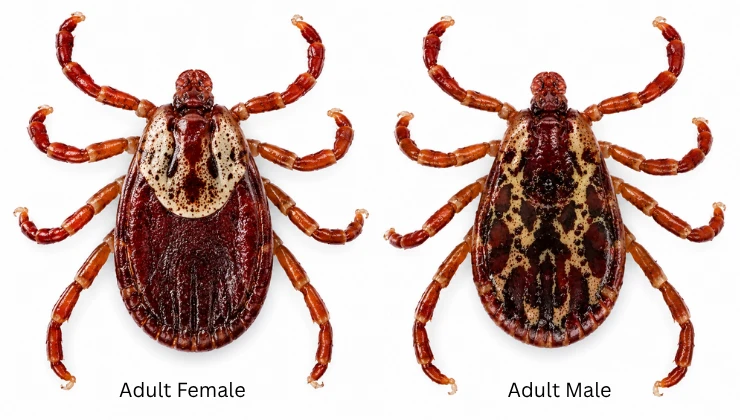
The American dog tick (Dermacentor variabilis) is identified by its relatively large size and distinctive silvery-white markings on the scutum (back shield)
It does not transmit Lyme disease, which is one of the most important distinctions from the deer tick
It is a primary vector for Rocky Mountain spotted fever (RMSF) and tularemia in the eastern and central United States
Its bite can, in rare cases, cause tick paralysis, a toxin-driven weakness that reverses once the tick is removed
It is a three-host tick: a single female lays 4,000 to 6,500 eggs, and unfed adults can survive up to two years while waiting for a host
Prompt tick removal and awareness of RMSF symptoms are the key protective actions
We have helped thousands of people in Colorado, Wyoming, New Jersey, Pennsylvania, Texas, Wisconsin restore their health and quality of life by diagnosing and treating their Lyme Disease.
The American dog tick is one of the more visually distinctive ticks in North America. Unlike the small, dark deer tick, this species has:
Distinctive silvery-white or grayish markings on the scutum (the hard plate at the back)
A relatively large body compared to other U.S. ticks, adult females are roughly 5 mm unfed, and can expand to 15 mm when fully engorged
A reddish-brown body on the unfed female, with the ornate scutum in clear contrast
Males are smaller and have more extensive pale markings covering more of the back. Both sexes are identifiable to trained eyes by the ornate pattern.
If the tick you found is larger than you expected and has a distinctive pale patterned shield, as opposed to the plain dark appearance of a deer tick or the lone white spot of a lone star tick, you are likely looking at an American dog tick.
The term “dog tick” can be confusing because it applies loosely to multiple species. The American dog tick (Dermacentor variabilis) refers specifically to the eastern and central U.S. species discussed here.
A note for patients in the western United States: taxonomy has recently split what was called the western form of the American dog tick into a separate species, Dermacentor similis. If you’re in the West and received this article in a search, some of the geographic information applies differently to your region.
Dermacentor variabilis is found primarily in the eastern and central United States. Its distribution includes:
The entire eastern seaboard from Maine to Florida
The Midwest and central states through the Great Plains
Parts of the Pacific Northwest (though the western taxonomy split now separates some of these populations into D. similis)
This tick prefers grassy areas, meadows, shrubby fields, and woodland edges, habitats where both its preferred hosts (dogs, humans, large mammals) and its immature-stage hosts (small mammals like meadow mice) are present.
Unlike the deer tick, which is strongly associated with forest interior and leaf litter, the American dog tick tends to be found in more open or transitional habitat. Trails through tall grass, park edges, and suburban areas with unmowed vegetation are common exposure points.
We have helped thousands of people in Colorado, Wyoming, New Jersey, Pennsylvania, Texas, Wisconsin restore their health and quality of life by diagnosing and treating their Lyme Disease.
Adult American dog ticks are the primary stage that bites humans. They are large enough to be visible and are the stage most commonly found on dogs and people.
Nymphs can also bite humans, though they more often feed on smaller hosts. Larvae typically feed on very small mammals and are less relevant for human exposure.
This is meaningfully different from the deer tick, where the tiny nymph stage is responsible for the majority of human disease. With the American dog tick, the adults you’re more likely to spot are the main concern.
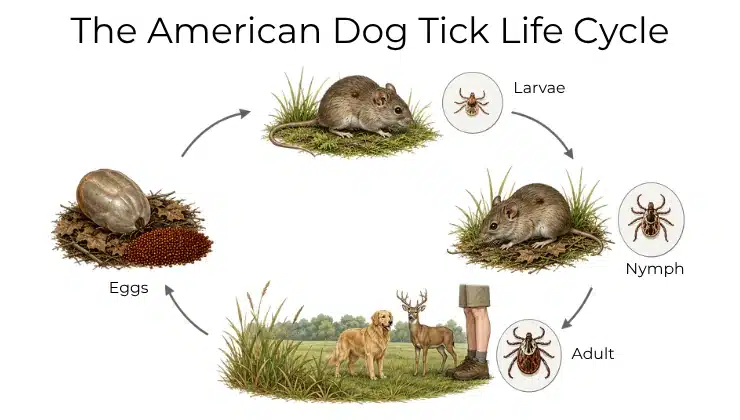
The American dog tick is a three-host tick, meaning it feeds on a different animal at each of its three feeding stages. This detail helps explain why the tick is so persistent in a given area, and why simply removing one host does not clear it out.
The cycle runs like this:
Eggs. After a female finishes her single adult blood meal, she drops to the ground and lays a large batch of eggs: 4,000 to 6,500 in one clutch, then dies. [8]
Larvae (first host). Six-legged larvae hatch and feed on small mammals, most often meadow mice and other rodents.
Nymphs (second host). After molting, eight-legged nymphs again feed on small mammals.
Adults (third host). Molted adults seek out larger animals such as dogs, deer, and humans. This is the stage most likely to bite you.
Two facts about this life cycle matter for prevention. First, the tick is built to wait. Unfed larvae can survive up to 11 months without a meal, unfed nymphs about 6 months, and unfed adults can persist for up to two years waiting for a host to pass by. Second, the full cycle takes at least 54 days but can stretch to two years depending on temperature and how readily hosts are found. [6][8] A tick population, once established in a field or yard, does not disappear over a single season.
Rocky Mountain spotted fever (RMSF) is a bacterial infection caused by Rickettsia rickettsii and spread through the bite of an infected tick. It is the most dangerous tick-borne illness in the United States and can be fatal within days if it is not treated early.
This is the disease that makes the American dog tick medically important, and it is one that deserves to be taken seriously.
Rocky Mountain spotted fever (RMSF) is caused by the bacterium Rickettsia rickettsii. Despite its name, RMSF is found throughout the continental United States, not primarily in the Rocky Mountains. The majority of cases occur in the Southeast, South Central states, and Mid-Atlantic regions, with the American dog tick as the primary eastern vector.
RMSF is one of the most clinically dangerous tick-borne illnesses in the United States. The case fatality rate without treatment can reach 20 to 25%. With prompt, appropriate treatment, it drops to roughly 5% or lower. [2][3] The difference is largely about speed of diagnosis and treatment.
The American dog tick usually has to stay attached for 6 to 8 hours or longer before it transmits Rickettsia rickettsii, which is one more reason a same-day tick check and prompt removal matter so much. Once symptoms begin, the treatment window is short. Untreated RMSF most often turns fatal between the 7th and 9th day of illness, with a median time from first symptom to death of about 8 days, and in some cases it can kill within 3 to 5 days. [3][9]
This is why the timing of antibiotics is decisive. Doxycycline is the treatment of choice, and it is most effective at preventing death when it is started within the first 5 days of symptoms. Starting it that early drops mortality from roughly 20% to about 5%. [4][9] Waiting for a rash, or for lab confirmation, can push treatment past the window where it saves lives.
Symptoms typically begin 2-14 days after a bite:
Sudden-onset high fever (often above 102°F)
Severe headache
Muscle aches and fatigue
Rash, a critical diagnostic clue. The RMSF rash typically starts as small flat red spots on the wrists and ankles (in contrast to Lyme, which starts at the bite site). It spreads to the trunk within days, and in late disease may appear petechial (pinpoint purple spots indicating blood vessel involvement).
The window for effective treatment is narrow. Doxycycline is the treatment of choice and should be started based on clinical suspicion. Do not wait for laboratory confirmation if RMSF is being considered. Rocky Mountain spotted fever can progress to multiorgan failure within days.
If you developed a fever and rash after a tick bite and are in an area where the American dog tick is present, this diagnosis needs to be in the room. If it has been missed, the consequences can be severe.
Tularemia is a bacterial infection caused by Francisella tularensis that a tick bite can transmit, and it can also spread through contact with infected animals, inhalation, or contaminated water. It often causes a skin ulcer, swollen lymph nodes, and fever.
Tularemia (Francisella tularensis) is another bacterial infection the American dog tick can transmit, along with the Rocky Mountain wood tick and other species. It can also be acquired through contact with infected animals, inhalation, or contaminated water.
Tick-transmitted tularemia typically presents with a skin ulcer at the bite site and enlarged regional lymph nodes (ulceroglandular form), often with fever and fatigue. Other forms affect the respiratory system and can be severe.
Tularemia responds to antibiotics (doxycycline or streptomycin depending on severity) when diagnosed promptly.
We have helped thousands of people in Colorado, Wyoming, New Jersey, Pennsylvania, Texas, Wisconsin restore their health and quality of life by diagnosing and treating their Lyme Disease.
Tick paralysis is a temporary, reversible muscle weakness caused by a neurotoxin in the saliva of an attached, feeding female tick, not by any infection. It resolves once the tick is removed.
Not every danger from the American dog tick comes from a germ it carries. This species is one of the most common causes of tick paralysis in the United States, and the mechanism is completely different from RMSF or tularemia. There is no bacterium involved. Instead, an attached, feeding female tick releases a neurotoxin in her saliva that interferes with the signals traveling along motor nerves, blocking normal transmission to the muscles. [7]
The result is a flaccid, ascending paralysis. Weakness usually starts in the legs and climbs upward over hours to a day or two, moving into the trunk, arms, and eventually the muscles of the face and breathing. If it is not recognized, it can progress to respiratory failure. Children are affected most often, in part because a small tick hidden in the scalp or behind an ear is easy to miss, and the early loss of coordination can be mistaken for other neurological conditions.
The reassuring part is the fix. Because the paralysis is driven by an ongoing supply of toxin, removing the tick reverses it. Once the tick is off, most people begin improving within hours and recover completely within one to three days, usually with no lasting effects. [7] That is exactly why a careful, head-to-toe tick check matters when someone develops unexplained weakness after time outdoors: finding and removing the tick is both the diagnosis and the cure.
Many patients come in after an American dog tick bite worried about Lyme disease. This is understandable, tick bites generate anxiety, and Lyme is the tick-borne illness most people have heard of.
The American dog tick is not a vector for Borrelia burgdorferi. It does not transmit Lyme disease in any of the scientific literature I’m aware of.
If you were bitten by an American dog tick and developed illness afterward, Lyme disease is not the primary concern. RMSF and tularemia are. This distinction matters because the clinical presentation, the testing approach, and the monitoring priorities are different.
For help distinguishing tick-borne conditions that can produce overlapping symptoms, see our co-infection comparison resource.
Adults are most active in late spring through early summer, peak activity runs from May through July in most of the United States. This aligns with peak outdoor recreational activity, which partly explains the timing of most RMSF diagnoses.
Activity falls off in midsummer heat and picks up again in a smaller fall peak in some regions. Winter outdoor exposure carries lower risk, but ticks can be active on warm days above approximately 35-40°F.
We have helped thousands of people in Colorado, Wyoming, New Jersey, Pennsylvania, Texas, Wisconsin restore their health and quality of life by diagnosing and treating their Lyme Disease.
Remove promptly. Use fine-tipped tweezers, grasp the tick as close to the skin surface as possible, and pull upward with steady, even pressure. Do not twist or jerk. Do not apply petroleum jelly, nail polish, or heat, these delay removal and may increase disease risk.
Observe for symptoms. For 14 days after the bite, monitor for fever, rash, severe headache, or muscle aches. If any develop, seek medical care immediately and mention the tick bite.
Do not wait. If you develop fever and rash together within two weeks of a tick bite and there is any possibility of RMSF, seek care that day, not in a few days. This is the one tick-borne illness where delay can be fatal.
For guidance on tick prevention and post-bite protocols, see our tick prevention resource.
No. The American dog tick does not transmit Borrelia burgdorferi, the bacterium responsible for Lyme disease. If you are concerned about Lyme disease, the relevant tick in the eastern United States is the deer tick (Ixodes scapularis).
Early RMSF often feels like a severe flu: sudden high fever, bad headache, muscle pain, and fatigue. A rash typically develops 2-5 days after fever onset, starting on the wrists and ankles. Not all patients develop a rash, which is part of what makes this disease clinically challenging. If you were bitten by a tick and develop high fever within two weeks, seek care promptly.
Yes. The American dog tick is one of the primary vectors for RMSF in the eastern and central United States. The Rocky Mountain wood tick is the primary vector in the western U.S.
Unfed adult females are approximately 5 mm long, roughly the size of a watermelon seed. Fully engorged females can reach 15 mm. Adult males are smaller. Nymphs are considerably smaller and may be more difficult to spot.
Yes, though it is uncommon. A feeding female tick can release a salivary neurotoxin that causes tick paralysis, a flaccid weakness that starts in the legs and moves upward. Children are most often affected. The paralysis is not an infection, and it reverses on its own once the tick is found and removed, usually with full recovery in one to three days. Any unexplained weakness after time outdoors should prompt a thorough tick check and medical evaluation.
The American dog tick is larger and has distinctive silvery-white markings on its scutum. The deer tick is small (nymphs are poppy-seed sized), dark, and lacks ornate markings. They carry different diseases, the deer tick carries Lyme, babesiosis, and anaplasmosis; the American dog tick carries RMSF and tularemia.
Deer Tick (Black-Legged Tick): smaller than the American dog tick; the primary Lyme disease vector
Brown Dog Tick: the only U.S. tick species that can complete its life cycle entirely indoors
Lone Star Tick: also active in the eastern U.S.; carries alpha-gal syndrome and ehrlichiosis
Rocky Mountain Wood Tick: shares RMSF transmission but is the western counterpart
Types of Ticks: full guide to tick identification across all U.S. species
The American dog tick may not carry Lyme disease, but it carries Rocky Mountain spotted fever, a fast-moving illness that can be fatal without prompt treatment. Understanding the distinction between tick species matters for what you watch for after a bite and how urgently you act on early symptoms.
If you had a tick bite and are experiencing unexplained fever, rash, or other symptoms, don’t wait. Early treatment is the difference between a difficult week and a life-threatening complication.
Author: Dr. Diane Mueller, ND, LAc, DAOM
Medical Reviewer: Dr. Diane Mueller, ND, LAc, DAOM
Medical Disclaimer: This content is for educational purposes only and is not a substitute for professional medical advice, diagnosis, or treatment. Always consult a qualified healthcare provider with questions about your specific situation.
We have helped thousands of
people restore their health
and quality of life by diagnosing
and treating their Lyme Disease.
“Dr. Mueller’s approach to medicine is refreshing! There is only so much you can do with western medicine and in my life I was needing a new approach. By addressing the whole body, nutritional diet factors, environmental factors, blood work, and incorporating ideas I had not previously known, I was able to break through with my conditions. I am not only experiencing less pain in my life, but through the process of healing guided by Dr. Diane Mueller, I am now happy to say I have more consciousness surrounding how I eat, what to eat and when things are appropriate. Living by example Dr. Mueller has a vibrancy that makes you want to learn and know more about your body and overall health. I highly recommend her to anyone looking for new answers, a new approach to health, or in need of freedom from pain and limitations.”
-Storie S.
Kihei, HI