


By Dr. Diane Mueller, ND, LAc, DAOM
Peptides are safe for most people when they are prescribed by a physician, sourced through a licensed compounding pharmacy, and matched to the right condition, but the honest answer has conditions attached. The same peptide bought from an unregulated online research-chemical supplier carries real risks: contamination, incorrect dosing, and no physician oversight if something goes wrong. Where a peptide comes from and who is supervising its use matter more than the peptide itself.
If you have been told your labs are normal while you still feel unwell, you already know how frustrating it is to get a straight answer about anything in this space. Peptides get marketed with the same overconfidence as everything else in the wellness world, and that does a disservice to a genuinely useful class of therapies. Here is the direct version.
A peptide is a short chain of amino acids that acts as a signaling molecule, telling a specific cell or system to start, stop, or change a biological process.
Peptides are not drugs in the way most people picture drugs, and they are not hormones themselves even when they affect hormone production. A growth hormone peptide like tesamorelin does not put growth hormone into your body. It signals your pituitary gland to release more of the growth hormone you already make. Tesamorelin itself is FDA-approved under the brand name Egrifta, but only for one specific use: reducing excess abdominal fat in HIV-associated lipodystrophy. Every other use, including the pain-reduction and sleep applications discussed later on this page, is off-label. That distinction matters clinically: the mechanism of “asking your body to do more of what it already does” carries a different profile than injecting a hormone directly, though it still requires real oversight.
This signaling function is why peptides show up across so many systems: immune modulation, tissue repair, cognitive function, gut lining integrity, and metabolic regulation. It is also why a blanket “peptides are safe” or “peptides are dangerous” answer misses the point. A peptide that calms an overactive gut lining and a peptide that stimulates immune activity carry different safety considerations entirely. That is exactly why the peptide therapy hub treats each compound as its own decision rather than one blanket category.
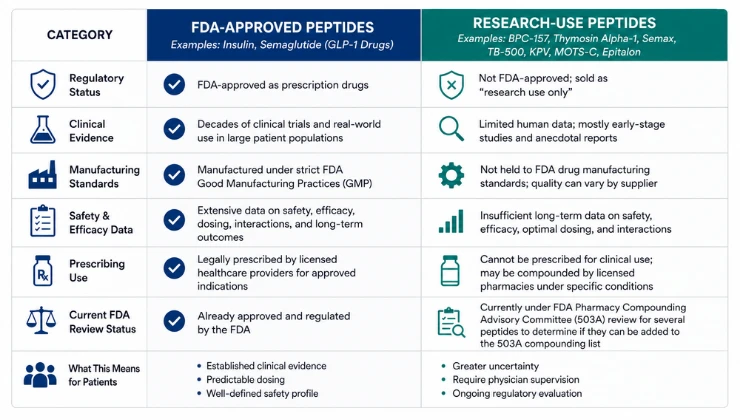
Some are, and most of the ones patients ask about are not, which is the single most important distinction in this conversation. Insulin and GLP-1 medications like semaglutide are FDA-approved drugs with decades of clinical trial data behind them.[1] The peptides generating the most buzz right now, including BPC-157, thymosin alpha-1, semax, and several others, are not FDA-approved drugs. They exist in a regulatory category sometimes called “research use only.” As of July 2026, the FDA’s Pharmacy Compounding Advisory Committee is actively reviewing several of them, including BPC-157, KPV, TB-500, MOTS-C, Semax, and Epitalon. The question on the table is whether each one should be added to the official list of substances a licensed pharmacy is permitted to compound.[5]
That review is happening right now, not in some abstract future. It tells you two things. First, the compounding-pharmacy pathway for these peptides depends on an evolving regulatory decision, which is one more reason a physician who tracks this closely should be guiding your use. Second, “not FDA approved” does not automatically mean “unsafe.” It means the manufacturing, dosing, and long-term outcome data that exists for an approved drug does not yet exist for these compounds at the same scale. That gap has to be managed with more caution, not less.
I tell every patient the same thing before we start a peptide protocol: sourcing is not a technicality, it is the safety plan.
There are two very different paths to getting a peptide. One runs through a licensed compounding pharmacy, on a physician's prescription, with quality-control standards the pharmacy is accountable to. The other runs through an online research-chemical vendor, no prescription required, no physician checking your history, and often no meaningful quality testing on what actually arrives in the vial. The label can say the exact same peptide name. What is actually in the bottle, and what it might be carrying alongside the peptide, can be very different.
Multiple physician-facing sources make the same point in less specific language: unregulated peptide products may be manufactured "under murky circumstances, often overseas," and quality concerns around impurities and label accuracy are common enough to warrant real caution.[2] Knowing exactly where a peptide comes from and how it was manufactured is described by the American Medical Association as one of the most important safety questions a patient can ask before starting any injectable peptide.[3]
We have helped thousands of people in Colorado, Wyoming, New Jersey, Pennsylvania, Texas, Wisconsin restore their health and quality of life by diagnosing and treating their Lyme Disease.
Lipopolysaccharide, or LPS, is a bacterial endotoxin found in the cell walls of gram-negative bacteria, and it is the contamination risk that gets skipped almost everywhere else in the peptide-safety conversation.
It is not supposed to be in a peptide vial. But research-only peptide manufacturing, especially facilities that skip pharmaceutical-grade purification and depyrogenation steps, can leave LPS behind as a contaminant. When that happens, you are not just injecting a peptide. You are injecting a peptide plus an inflammatory trigger. This is the reason sourcing matters as much as it does.
The manufacturing-quality literature backs this up directly. A 2025 review in the Journal of Peptide Science identifies production-related impurities, including the kind introduced during synthesis and purification, as a direct driver of immunogenicity, an unwanted immune response that can undermine both safety and effectiveness.[4] Separately, a 2021 review in Frontiers in Cellular and Infection Microbiology found that LPS damages the blood-brain barrier through multiple mechanisms, contributing to brain inflammation and disease.[6] That is exactly the kind of exposure a chronic illness patient, already managing an inflamed and sensitized system, does not need added on top.
For my patients dealing with Lyme disease, mold illness, or chronic infection, this is not a theoretical concern. Many of you are already managing leaky gut, immune dysregulation, or neuroinflammatory symptoms. A contaminated peptide can make every one of those worse. This is exactly why I only prescribe peptides through compounding pharmacies that meet a real standard of care, never through a research-chemical website, no matter how convincing the packaging looks.
Most reported peptide side effects are mild and localized, but a smaller set are serious enough that you should know them before starting.
| Side effect category | What it looks like | How common |
|---|---|---|
| Injection site reactions | Redness, swelling, itching, mild pain at the injection point | Common |
| Gastrointestinal | Nausea, bloating, diarrhea, constipation (more common with oral forms) | Common |
| Fatigue or headache | Temporary tiredness or head pain, especially early in a protocol | Common |
| Herxheimer-type flare | Temporary worsening of symptoms as immune activity increases | Uncommon, specific to immune-stimulating peptides |
| Allergic reaction | Hives, swelling, difficulty breathing | Rare, requires immediate medical attention |
| Cardiovascular changes | Elevated heart rate, blood pressure changes | Rare, more associated with unregulated products |
A widely reported 2025 case involved two women hospitalized after receiving peptide injections at a wellness event, with symptoms including a swollen tongue and difficulty breathing.[1] That case did not happen in a physician's office with a documented protocol. It happened at an unsupervised injection event, which is precisely the scenario that oversight is designed to prevent.
Here is a rule I do not bend: growth hormone peptides are never used with active or recent cancer. Not “used cautiously.” Not used at all.
Growth hormone peptides like tesamorelin, CJC-1295, and ipamorelin work by signaling your body to increase its own growth hormone output, which raises IGF-1, a growth factor involved in cell replication. In a healthy system, that is part of how these peptides support recovery, body composition, and, based on what I see clinically, meaningful pain reduction and deeper sleep in chronic infection patients. Researchers have flagged cancer risk as a real concern with long-term growth hormone peptide use.[1] Clinically, my read on why is straightforward: elevated IGF-1 signaling can theoretically support the growth of existing cancer cells, so in a system with active cancer that risk outweighs any potential benefit.
This is not a peptide-specific quirk. It is the same reason growth hormone itself is contraindicated in active cancer. If you have a personal or recent cancer history, tell your provider before any growth hormone peptide protocol is even discussed. This is one of the few places in functional medicine where the answer is a flat no, not a nuanced “it depends.”

A Herxheimer reaction is a temporary worsening of symptoms that happens when the body clears dying pathogens and the inflammatory byproducts faster than it can process them. If you have been through Lyme disease treatment before, you may already know the term.
Immune-stimulating peptides carry this same pattern, because they work by turning immune activity up. LL-37, an antimicrobial peptide often used for chronic infections including Lyme co-infections, and thymosin alpha-1, used for immune and antiviral support in EBV and CMV reactivation, both stimulate the immune system directly. That is exactly what makes them useful for chronic infection, and exactly why they can trigger a Herxheimer-style flare when the immune system suddenly has more resources to fight with.
There is a second caution layered on top of this. If you have an autoimmune condition, your immune system is often already in a state of overactivation. Adding a peptide designed to stimulate immune function further needs to be approached carefully, with a provider who is watching for that specific interaction, not guessing at it after the fact.
The honest answer is that long-term safety data is limited for most peptides outside the FDA-approved category, and anyone who tells you otherwise with total confidence is overstating the evidence.
Peptide treatment safety depends on the compound, the dosage, and the quality of medical supervision. That is a genuinely different statement from "peptides are unsafe long term." Some peptides, particularly FDA-approved ones like insulin and GLP-1 drugs, have decades of long-term outcome data behind them. Most of the peptides discussed in chronic illness care, including the ones covered on this site, have a much shorter track record at scale. Clinical use of many of them goes back further than the current wellness-market attention suggests, but not at the same scale as an approved drug.
What this means practically: long-term peptide use should be monitored, not set-and-forget. That means periodic labs, a provider tracking how you respond over months, and a willingness to adjust or stop a protocol if something changes. It does not mean avoiding peptides altogether. It means treating them the way you would treat any therapy without a 20-year track record, with real oversight instead of assumptions.
We have helped thousands of people in Colorado, Wyoming, New Jersey, Pennsylvania, Texas, Wisconsin restore their health and quality of life by diagnosing and treating their Lyme Disease.
Certain situations call for extra caution, a different peptide choice, or medical supervision that goes beyond a standard consultation.
If any of these apply to you, that is not a reason to rule out peptide therapy entirely. It is a reason to have this conversation with a physician who will actually walk through your history before writing a prescription, rather than a checkout page that will not.
Peptides are not interchangeable. One of the most common mistakes I see is a patient asking about “peptides” as a single category when the right question is which peptide, for which symptom, with which precaution in mind. Here is the full picture across the peptides most relevant to Lyme disease, mold illness, and chronic infection recovery.
| Peptide | Primary use | Key caution |
|---|---|---|
| Semax | Cognitive enhancement, brain fog, BDNF support | Intranasal only; start low if sensitive to stimulation |
| Selank | Anxiety, nervous system calming | Intranasal only; sedation possible if combined with other calming agents |
| Thymosin Alpha-1 | Immune and antiviral support, EBV/CMV reactivation | Herxheimer potential; caution in autoimmune disease |
| SS-31 | Mitochondrial support, tissue repair, fatigue | Newer compound; limited long-term human data |
| GHK-Cu | Skin, hair, collagen (topical); gut healing (oral) | Topical and oral forms serve different purposes; do not assume interchangeable |
| Larazotide | Leaky gut, tight junction repair | Nausea and headache possible |
| Tesamorelin | Growth hormone signaling, pain reduction, deeper sleep | Never use with active or recent cancer |
| LL-37 | Antimicrobial, immune support for Lyme co-infections | Herxheimer potential; caution in autoimmune disease |
| BPC-157 | Gut healing (oral), tissue and pain repair (injection) | Delivery method changes the use case |
For the full picture of how peptides fit into chronic infection recovery, including how we sequence them against the rest of a treatment plan, see the peptide therapy hub.
When patients ask me directly, “are peptides safe,” my answer always starts with sequencing, not the peptide itself. Peptides are not a first move in our practice, and that is intentional.
Our care follows a 4-phase method, and peptides for microbe balancing and repair sit in Phase 04, only after the body has been built back up in Phases 01 through 03. Most clinics jump straight to targeted interventions like peptides before addressing the foundation: nutrient status, adrenal and thyroid function, blood sugar regulation, and nervous system dysregulation. That is why patients crash on protocols that looked reasonable on paper. A peptide asked to do repair work in a body that is not ready for it is set up to underperform. Worse, it can trigger a reaction that gets blamed on the peptide when the real issue was sequencing.
When peptides are the right tool at the right phase, we prescribe them through a compounding pharmacy that meets a genuine standard of care. We monitor for the specific cautions each peptide carries, and we never use growth hormone peptides in anyone with active or recent cancer. That is the difference between a peptide protocol and a peptide gamble.
If you want to know whether a peptide protocol fits where you are right now, schedule an initial visit and we will walk through your history before recommending anything.
Some peptides are FDA-approved prescription drugs and fully legal to prescribe, like insulin and GLP-1 medications. Many other peptides exist in a research-use category that a physician can currently prescribe through a compounding pharmacy, though the FDA is actively reviewing several of them for formal compounding status as of July 2026. Buying peptides directly as a consumer from an online research-chemical seller sits in a legal and safety gray area regardless of the peptide.
Ask whether it comes from a licensed compounding pharmacy on a physician’s prescription, not a research-chemical website. A safe source will have quality-control documentation, will not require you to self-diagnose your own dosing, and will connect back to a provider who reviewed your history first.
Some do, particularly growth hormone peptides and anything affecting blood sugar or blood pressure regulation. This is one of the reasons a physician review of your full medication and supplement list matters before starting any peptide.
Peptides are signaling molecules that ask your body to do more of a process it already performs, such as releasing its own growth hormone. Anabolic steroids introduce a synthetic hormone directly. The mechanisms and safety profiles are different, though both require medical oversight.
Sometimes, when it makes clinical sense and each one is monitored, but this is not a stack-them-yourself decision. Combining peptides multiplies the number of interactions and side effect possibilities a provider needs to track, which is exactly why this should be planned with your physician rather than assembled from online forums.
We have helped thousands of
people restore their health
and quality of life by diagnosing
and treating their Lyme Disease.
“Dr. Mueller’s approach to medicine is refreshing! There is only so much you can do with western medicine and in my life I was needing a new approach. By addressing the whole body, nutritional diet factors, environmental factors, blood work, and incorporating ideas I had not previously known, I was able to break through with my conditions. I am not only experiencing less pain in my life, but through the process of healing guided by Dr. Diane Mueller, I am now happy to say I have more consciousness surrounding how I eat, what to eat and when things are appropriate. Living by example Dr. Mueller has a vibrancy that makes you want to learn and know more about your body and overall health. I highly recommend her to anyone looking for new answers, a new approach to health, or in need of freedom from pain and limitations.”
-Storie S.
Kihei, HI