

Mold toxicity treatment starts with removing the mold exposure, then treating whatever the exposure caused, and the strongest published evidence supports that first step. Binders (medicines or supplements that hold substances in the gut so they leave in the stool) and other treatments have much thinner evidence.
If your labs came back normal and you are still sick after moving out, you have probably heard “everything looks normal.” Dr. Mueller treats Lyme disease and mold illness by video visit.
The first job in mold toxicity treatment is naming the problem the exposure caused, because the treatment depends on it.
Mold toxicity is a popular name for several conditions that can follow time in a water-damaged building, including allergy, asthma, lung infection, and the inflammatory illness some clinicians call CIRS (chronic inflammatory response syndrome).
The symptoms of mold illness overlap across allergy, asthma, lung infection, and CIRS.
Sources disagree about whether mycotoxins cause illness. One skeptical view is a 2019 review titled “The Myth of Mycotoxins and Mold Injury,” which disputes that airborne mycotoxins (toxic compounds some molds make) are enough to cause disease. Dooley and colleagues (2024), whose review treats CIRS as an acquired medical condition, describe the Shoemaker protocol as the CIRS treatment with documented efficacy in the literature they searched.
Same-day medical care is the right first step for trouble breathing, new wheezing, chest tightness, or fever with lung symptoms.
Removing the exposure is the best-supported step in mold toxicity treatment, ahead of binders and supplements. The CDC says that if mold is growing in your home, “you need to clean up the mold and fix the moisture problem.”
In the 2015 Cochrane review of 12 studies (8,028 people), two studies found moderate-quality evidence that repairing houses lowered asthma-related symptoms in adults. Home repair was linked to lower odds of two outcomes:
The 2015 Cochrane review’s authors rated the evidence across all 12 studies moderate to very low quality and call for better research.
The EPA says that for a patch of less than about 10 square feet, you can in most cases handle the job yourself. Its page adds, “If you have health concerns, consult a health professional before starting cleanup.” If mold has made you sick, talk with a health professional before cleaning up.
Germany’s 2024 S2k guideline on indoor mold (a consensus-based medical guideline from German medical societies) agrees that the most important measures are to identify the cause and carry out proper remediation. If you cannot see the source, our guide to hidden mold in walls covers where to look.
In Shoemaker and House’s 2005 series of 21 volunteers who had occupied water-damaged buildings, reexposure “resulted in illness reacquisition in all participants within 1 to 7 days.”
Participants in Shoemaker and House’s 2006 time series reoccupied the water-damaged buildings for 3 days without the binder, and “all participants reported relapse.”
Moving out is sometimes not enough, and many people say, “I moved out but I’m still sick.” Environmental medicine clinician Janette Hope wrote in a 2013 review that complete removal from exposure and contaminated items “cannot be emphasized enough although it is often not sufficient” for some people.
ERMI testing is a lab test that identifies mold species in settled dust, and it measures the building, not you.
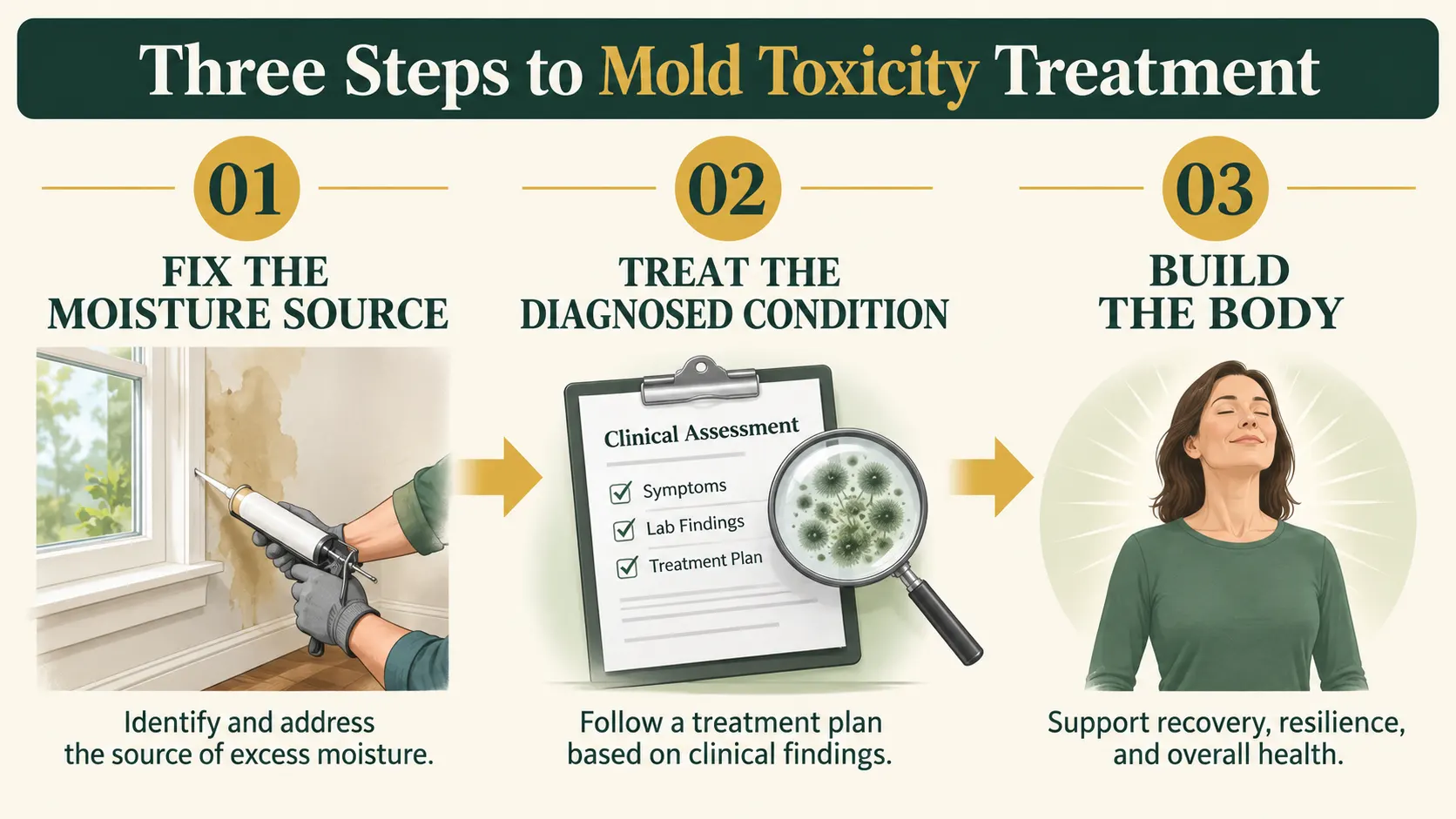
Each step in mold illness treatment rests on a different amount of research, from a systematic review in 2015 to a 13-person randomized binder trial in 2006.
| Treatment step | What was found | Size and design | Source |
|---|---|---|---|
| Repair the moisture source | Fewer asthma-related symptoms and respiratory infections in adults | Adult house-repair result from 2 studies, moderate quality; one children’s study: no difference in asthma days or ER visits | Sauni and colleagues, 2015 |
| Treat the diagnosed condition | Avoidance, antihistamines, nasal sprays, allergy shots | Standard allergy care from a medical society | AAAAI |
| Prescription binder | In the 2006 trial, symptoms and a vision screen improved on the binder, and not on placebo; German S2k guideline: not recommended for lack of evidence | 2006 trial in people who had occupied water-damaged buildings: 13 people, 7 binder and 6 placebo, double-blinded (patients and testers did not know who got the binder), 2 weeks | Shoemaker and House, 2006; German S2k guideline, 2024 |
| The whole Shoemaker protocol | Documented efficacy in the literature the authors searched | 13 articles, a non-systematic review, authors disclose expert witness work | Dooley and colleagues, 2024 |
| Sauna, glutathione, antioxidants | Hope says glutathione use plays a large part in treatment and that induced sweating will likely support recovery | Narrative review (one author summarizing the literature), one bundled 28-person series, more research needed | Hope, 2013 |
| Mycotoxins as a cause of illness | Disputed | One review article | Chang and Gershwin, 2019 |
| Dr. Mueller’s 4-Phase sequence | Clinical method | Her own sequence; the other rows cite studies of other steps | Dr. Mueller’s practice |
Shoemaker and House 2006, the one randomized binder trial this page cites for people in water-damaged buildings, included 13 people from its 26-person time series: 7 took cholestyramine and 6 took placebo for 2 weeks.
The 6 placebo participants in Shoemaker and House’s 2006 trial also improved after a subsequent 2-week course of cholestyramine.
Prescription binders are covered separately.
Germany’s S2k guideline on indoor mold lists detoxification therapy such as cholestyramine among treatments without sufficient scientific evidence and says these treatments are not recommended due to a lack of evidence.
Dooley and colleagues (2024) declare no conflicts of interest and also disclose that two authors give expert witness testimony in CIRS cases for both plaintiffs and defense, and thank Dr. Shoemaker for reviewing the manuscript.
Sauna, glutathione, and antioxidants have weaker evidence than the steps above. Hope’s review cites a 28-person series that bundled sauna with IV antioxidants, oxygen therapy, and immunotherapy, so no single piece can be credited. That review concludes that “much more research is needed to identify the best treatment options.”
Dr. Mueller treats mold illness with her 4-Phase Method, and the order is the point: body first, then liver, kidney, and lymphatic support, then targeted microbe work.
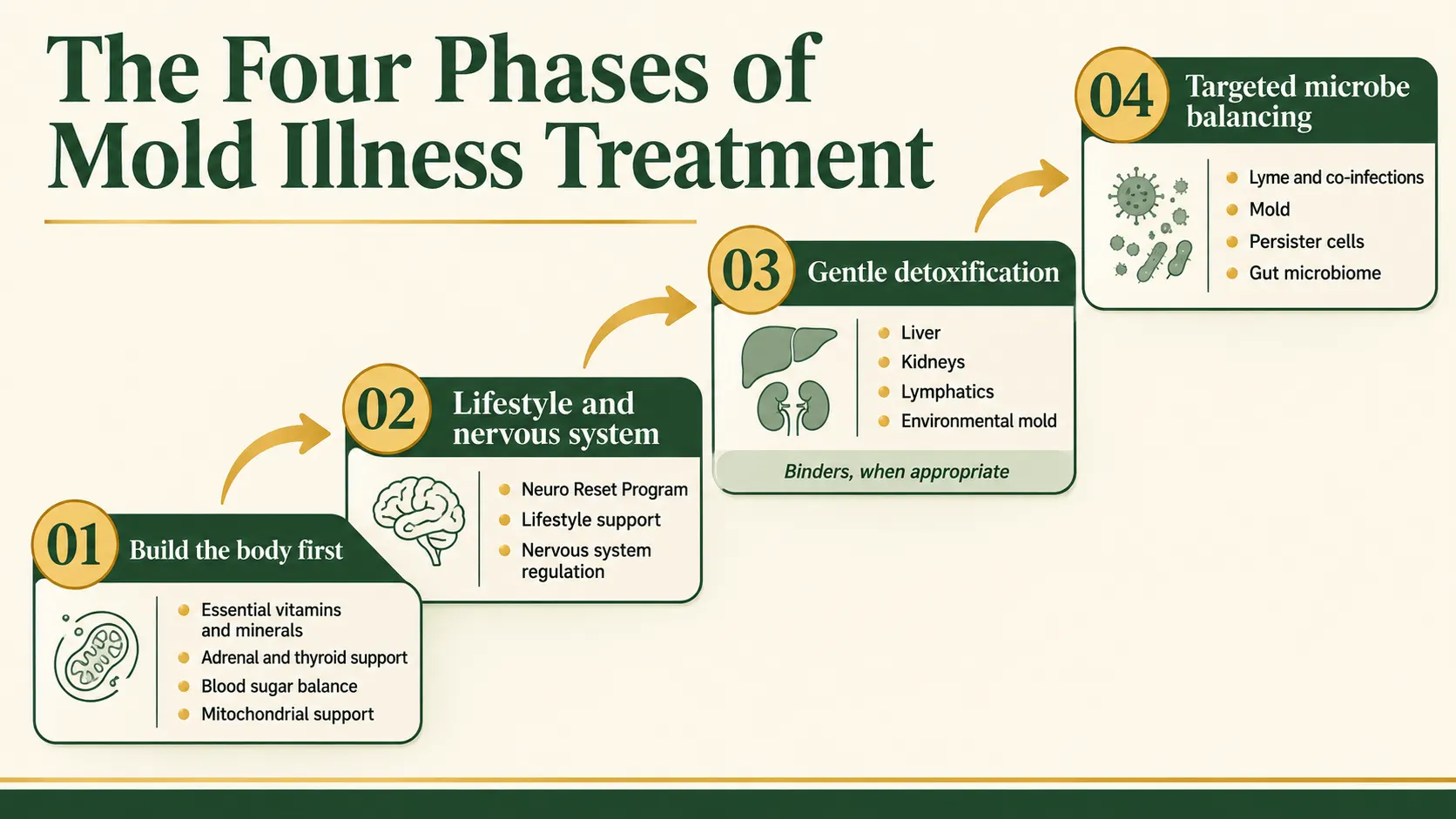
Dr. Mueller’s view is that many patients crash when treatment jumps straight to the target, and the Cochrane review, the Dooley review, and the Shoemaker and House papers did not test her 4-Phase Method.
A herx, short for Herxheimer reaction, is a temporary, uncomfortable response during treatment, as Herxheimer reaction detox describes.
Dr. Ritchie Shoemaker’s CIRS protocol is a published treatment sequence whose first step is avoiding the exposure, followed by medicines such as cholestyramine.
Shoemaker protocol is the published CIRS treatment sequence developed by Dr. Ritchie Shoemaker.
The 2024 Dooley review found 13 articles on CIRS treatment, and 11 described the Shoemaker protocol, which the review says has documented clinical efficacy in the literature it searched.
This 2024 CIRS review by Dooley and colleagues calls itself not systematic, searched four databases, and lists cholestyramine among its treatment steps. Cost, adherence challenges, and side effects are the limits it lists for the Shoemaker protocol. In its words, “the first step of the Shoemaker Protocol is avoidance of exposure.”
What is CIRS gives a plain definition of the illness.
Dr. Mueller’s 4-Phase Method is her own clinical sequence, separate from Shoemaker’s protocol, and the CIRS treatment protocol guide lays out the published steps.
Symptom counts fell after two weeks of binder therapy in the 2005 and 2006 Shoemaker and House papers. Shoemaker and House’s 2006 time series of 26 people in water-damaged buildings found a group average that went from 23 of 37 symptoms to 4. The authors call it a case-series study (a report on a group of patients with no comparison group).
Twenty-one volunteers enrolled in the 2005 series, and 19 completed all five assessments. In Shoemaker and House’s 2005 series, the group average symptom count fell from 14.9 to 1.2 after two rounds of binder therapy, with a relapse after re-exposure in between. The authors list these limits: exposure to specific agents was not demonstrated, and participants were not randomly selected or double-blinded.
“I used to lose up to 2 days a week to migraines and intense fatigue … but Dr. Diane … changed my life by treating the ROOT of the problem.” Janet H., Colorado patient with CIRS symptoms (from mold exposure). Individual results vary.
For how mycotoxin illness develops and why some people stay sicker, see our mycotoxin illness guide.
Mold illness treatment can stall for four reasons: continued exposure, a missed diagnosis, too fast a pace, and other infections still in the picture.
Starting mold toxicity treatment takes five steps, beginning with a check for anything urgent.
If you are choosing a clinician, our guide to doctors who treat mold illness explains what to look for.
When you are ready, you can book a video visit with Dr. Mueller to talk through your history and where treatment should start.