


Written and medically reviewed by Dr. Diane Mueller, ND, DAOM, LAc, founder of My Lyme Doc. Last reviewed August 24, 2026.
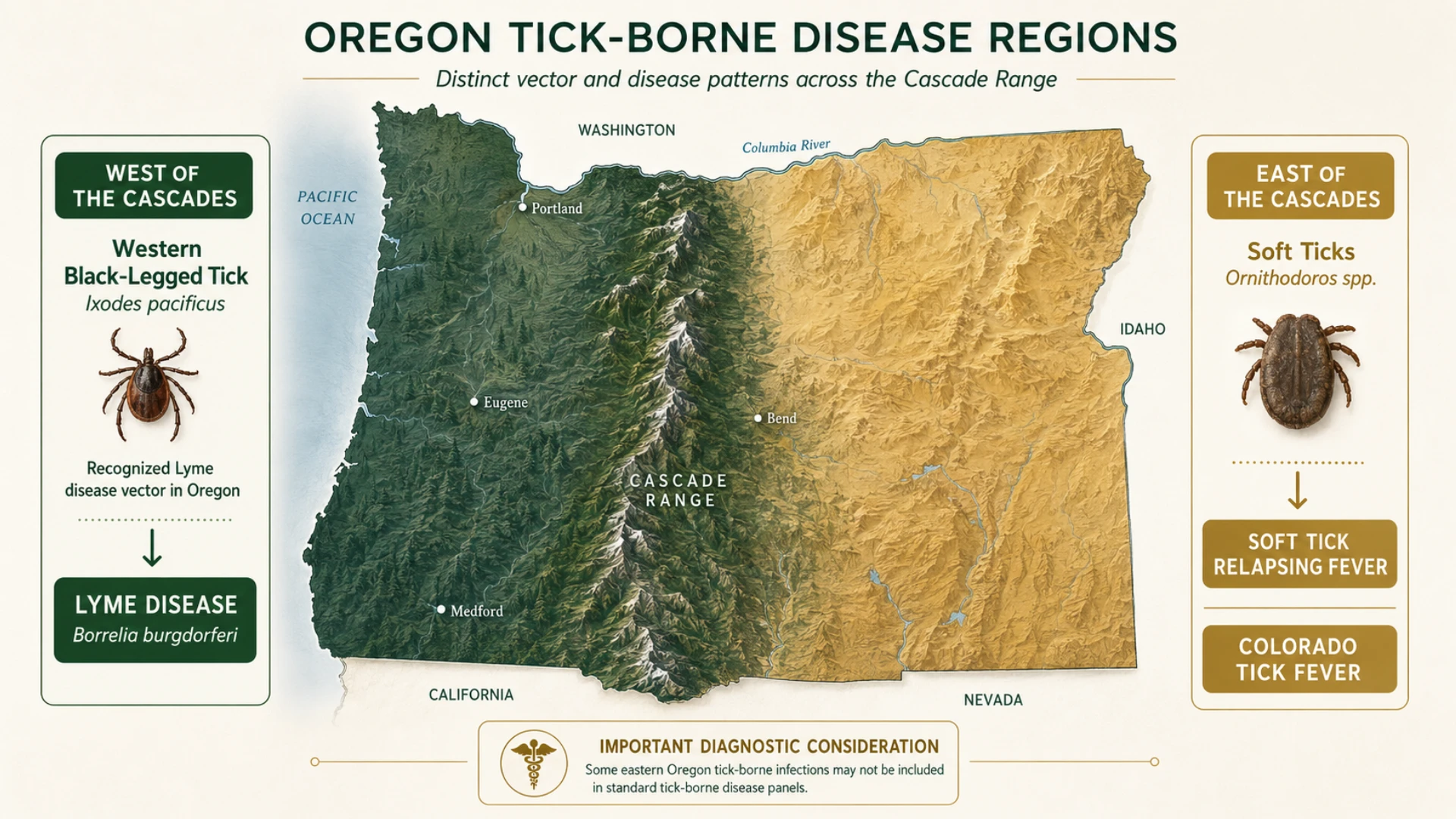
Anyone searching for a Lyme disease doctor in Oregon should know one thing about this state first. The Oregon Health Authority puts it plainly. Oregon is home to Borrelia bacteria “transmitted by two species of ticks that inhabit distinct geographic areas in Oregon separated by the Cascades Mountain range.” West of the Cascades, the western black-legged tick carries Lyme disease. East of the Cascades, above roughly 1,500 feet, a soft tick carries relapsing fever instead. Those are different illnesses, found in different places, and standard testing does not cover both equally. My Lyme Doc provides telehealth care for Lyme disease, co-infections and mold-related illness to Oregon residents.
Lyme disease is an infection caused by Borrelia burgdorferi bacteria, transmitted to humans in Oregon by the bite of the western black-legged tick.
Soft tick relapsing fever is an illness caused by Borrelia hermsii, a relative of the Lyme bacterium, transmitted by a nesting soft tick and marked by fevers that recur in cycles.
We have helped thousands of people in Colorado, Oregon, Wyoming, New Jersey, Pennsylvania, Texas, Wisconsin, New Hampshire, Alabama, South Dakota, and Vermont restore their health and quality of life by diagnosing and treating their Lyme Disease.
Most people who reach this page have already been somewhere else. They have had blood work that came back normal, been told their symptoms are stress or depression, and left without an explanation that fits what they are living with.
That experience is common in Oregon for a specific reason, and it is worth reading alongside chronic Lyme disease symptoms. Reported Lyme disease is uncommon here compared with the Northeast, which means many local clinicians see it rarely and are not looking for it. When a patient raises the possibility, the reasonable-sounding response is that Lyme is not really an Oregon problem.
The Oregon Health Authority’s own guidance is more careful than that. Its guidelines note that “the risk of LD is highest in southwestern Oregon, notably Coos, Curry, Josephine, and Jackson counties.” The same document places Ixodes pacificus “throughout Oregon west of the Cascades and around the mouth of the Deschutes River.” Uncommon is not the same as absent.
One line in that guidance matters especially if you have been dismissed. “Ixodid tick bites are generally painless, and many LD patients have no recollection of a tick bite, so the absence of a tick bite history is not inconsistent with a diagnosis of LD.”
You do not need to remember a tick bite for this to be worth investigating.
This is the single most useful thing to understand about tick-borne illness in this state.
| West of the Cascades | East of the Cascades, above 1,500 ft | |
|---|---|---|
| Tick | Western black-legged tick (Ixodes pacificus) | Nesting soft tick (Ornithodoros hermsi) |
| Transmits | Lyme disease (Borrelia burgdorferi), hard tick relapsing fever (Borrelia miyamotoi) | Soft tick relapsing fever (Borrelia hermsii) |
| Habitat | Wetter climates west of the Cascades, plus the mouth of the Deschutes River | Higher elevations, often near cabins and rodent nesting sites |
| On a standard tick panel? | Panels are geared toward Ixodes-borne disease | Often not included |
| Counties OHA names | Coos, Curry, Josephine, Jackson | Deschutes and other high-elevation areas |
Both illnesses are caused by Borrelia bacteria. They are not the same disease, they are not found in the same places, and they are not caught by the same tests.
One more detail worth knowing: Dermacentor ticks are common across Oregon, and the Oregon Health Authority states plainly that they “are not known to be competent vectors” for Lyme. If you found a tick, had it identified as a Dermacentor, and were reassured, that reassurance was correct about that tick. It said nothing about the poppy-seed-sized nymph you never saw.
This is the gap that catches Oregon patients, and it comes directly from the state health authority.
Oregon Health Authority guidance notes that commercial tickborne disease panels “are typically geared toward diseases transmitted by Ixodes species.” It then says what that costs eastern Oregon patients. The diseases found east of the Cascades, “namely Colorado tick fever and soft tick relapsing fever are not typically included in tickborne disease panels, which makes diagnosis via lab testing challenging.”
Read that again if you live east of the Cascades. The standard panel may not test for the tick-borne illnesses most likely where you live. A negative result means the panel did not find what it looked for. It does not mean nothing is there.
There is a second complication. The same guidance states that “all serologic tests for Borrelia species have the potential to cross-react.” Borrelia burgdorferi, Borrelia miyamotoi and Borrelia hermsii are related organisms, and antibody tests can blur between them. That cuts both ways: a positive result needs careful interpretation, and so does a negative one.
None of this means testing is useless. It means results have to be read alongside where you live, where you have traveled, when you got sick, and what your symptoms actually look like. That is the work of a Lyme-literate doctor.
There is no single presentation, which is a large part of why it gets missed.
Hard tick relapsing fever is an illness caused by Borrelia miyamotoi, carried by the same western black-legged tick that carries Lyme disease.
Erythema migrans is the expanding rash that can appear at the site of a tick bite. It is the most recognizable sign of early Lyme disease, and its absence does not rule the diagnosis out.
A relapsing pattern of fever deserves particular attention in Oregon. Relapsing fever is named for exactly that rhythm, and it is the eastern Oregon presentation most likely to be attributed to a virus.
More detail on the organisms involved is on types of ticks.
My Lyme Doc uses a four-phase approach, and the order is deliberate.
Most clinics reverse this and go after the pathogen immediately. That is a common reason patients crash during treatment. More detail is on Lyme disease treatment.

What that means in practice. Chronic Lyme and mold illness are worked up largely through history, symptom pattern, exposure timeline and laboratory testing. A long conversation and a careful review of your records is most of the diagnostic work, and none of it requires being in the same room. Lab orders go to a draw site near you. Prescriptions go to your pharmacy.
What telehealth cannot do. A video visit cannot include a hands-on physical examination. Where one is genuinely needed, that gets coordinated with a local clinician rather than skipped.
What you need. A private space, a reliable connection, and an Oregon address.
Oregon is one of eleven states where My Lyme Doc sees patients. The full list is on where we practice.
Patients arrive having seen twenty or more clinicians on average, and most arrive with root causes nobody has looked for. What they usually say they want is not a new protocol. It is someone who takes the pattern seriously and looks properly.
The initial visit is $300 and runs long deliberately, because most people arrive with a stack of results that has never been read together in one sitting. Ongoing care runs as a membership between $400 and $1,100 per month depending on the level of support your case needs. Labs, supplements and treatments are billed separately.
Yes, though it is less common than in the Northeast. Oregon Health Authority identifies Ixodes pacificus as the only recognized Lyme vector in the state. It is found throughout Oregon west of the Cascades and around the mouth of the Deschutes River. Risk is highest in Coos, Curry, Josephine and Jackson counties.
Yes. Oregon Health Authority guidance states that Ixodid tick bites are generally painless and that many patients have no recollection of a bite, so absence of a bite history does not rule out the diagnosis.
Not necessarily, particularly east of the Cascades. Oregon Health Authority notes that Colorado tick fever and soft tick relapsing fever are not typically included in standard tickborne disease panels, which makes diagnosis by lab testing challenging.
Both are caused by Borrelia bacteria but by different species carried by different ticks in different parts of the state. Lyme comes from the western black-legged tick west of the Cascades. Soft tick relapsing fever comes from a nesting soft tick usually above 1,500 feet east of the Cascades.
For Lyme specifically, that tick was not a vector. Dermacentor ticks are common in Oregon and are not known to transmit Lyme. It does not rule out a second bite you never noticed, and nymphs are very small.
No. Oregon patients are seen by telehealth.
Official state and university sources for Oregon residents who want to verify any of the above.
Written and medically reviewed by Dr. Diane Mueller, ND, DAOM, LAc. Dr. Mueller is a naturopathic doctor and licensed acupuncturist, and the founder of My Lyme Doc, which has worked with more than 1,000 patients across the eleven states My Lyme Doc serves. Read more about the team.
Last reviewed: August 24, 2026
Oregon residents can book an initial visit and have their full history and prior results reviewed properly.
My Lyme Doc sees patients in eleven states, all by video visit from home. If you live in one of the others, start here. Live somewhere else? You can still be a patient if you can travel to one of these states at least once a year and have your appointments there.
A full breakdown of how care is delivered state by state sits on the states where we see patients page.
This page is for general educational purposes and is not medical advice. It does not create a doctor and patient relationship, and it is not a substitute for diagnosis or treatment from your own clinician. Always talk with a qualified healthcare provider before starting, stopping, or changing any treatment. If you are experiencing a medical emergency, call 911 or go to the nearest emergency room.
We have helped thousands of people in Colorado, Oregon, Wyoming, New Jersey, Pennsylvania, Texas, Wisconsin, New Hampshire, Alabama, South Dakota, and Vermont restore their health and quality of life by diagnosing and treating their Lyme Disease.
We have helped thousands of
people restore their health
and quality of life by diagnosing
and treating their Lyme Disease.
“Dr. Mueller’s approach to medicine is refreshing! There is only so much you can do with western medicine and in my life I was needing a new approach. By addressing the whole body, nutritional diet factors, environmental factors, blood work, and incorporating ideas I had not previously known, I was able to break through with my conditions. I am not only experiencing less pain in my life, but through the process of healing guided by Dr. Diane Mueller, I am now happy to say I have more consciousness surrounding how I eat, what to eat and when things are appropriate. Living by example Dr. Mueller has a vibrancy that makes you want to learn and know more about your body and overall health. I highly recommend her to anyone looking for new answers, a new approach to health, or in need of freedom from pain and limitations.”
-Storie S.
Kihei, HI