


By Dr. Diane Mueller, ND, LAc, DAOM | Medically reviewed by Dr. Diane Mueller, ND, LAc, DAOM | Last reviewed: August 3, 2026
A tick identification chart is a side-by-side comparison of size, coloring, scutum markings, range, season, and disease risk for the tick species most likely to bite a human in the United States. Nine species account for nearly all medically significant tick bites in this country. They are the blacklegged (deer) tick, American dog tick, lone star tick, brown dog tick, Gulf Coast tick, Rocky Mountain wood tick, Asian longhorned tick, western blacklegged tick, and soft ticks. Each carries a different set of diseases, so identifying which one bit you narrows what to watch for.
This page is the tick identification chart. Look up a tick fast by what you can see: size, color, markings, and where and when you found it.
Every row below links to a full species guide with detailed biology, testing guidance, and what to watch for after a bite. This table is the fast-reference version.
| Tick | Size | Key Visual Marking | Geographic Range | Active Season | Diseases Carried |
|---|---|---|---|---|---|
| Deer Tick (Blacklegged Tick) | Nymph 1 to 2 mm; adult 3 to 5 mm unfed | Dark, nearly black legs; solid dark scutum; reddish-brown body (female), uniformly dark (male); no white markings | Northeast, Upper Midwest, Mid-Atlantic, expanding range | Nymphs May through July; adults fall through early spring | Lyme disease, babesiosis, anaplasmosis, Powassan virus, Borrelia miyamotoi |
| American Dog Tick | Adult about 5 mm unfed, larger than the deer tick | Ornate silvery-white marbled pattern on the scutum; reddish-brown body | Eastern and central United States | Late spring through early summer (May to July) | Rocky Mountain spotted fever, tularemia |
| Lone Star Tick | Adult about 4 to 5 mm unfed | Female has a single bright white dot in the center of the scutum; brown, rounded body | Southeast through the Midwest, expanding into the Northeast | Spring through early fall; all life stages bite | Alpha-gal syndrome, ehrlichiosis, STARI, tularemia |
| Brown Dog Tick | Adult 3 to 5 mm unfed | Plain, uniformly reddish-brown body, no ornate markings | Southwestern U.S. (disease risk); any region (indoor infestations) | Year-round indoors; outdoor peak in summer | Rocky Mountain spotted fever (Southwest), canine ehrlichiosis |
| Gulf Coast Tick | Adult 3 to 7 mm | Ornate reddish-brown patterned body | Southeast, Great Plains, expanding into the Mid-Atlantic and Northeast | Spring and summer | Rickettsia parkeri rickettsiosis (a milder spotted fever) |
| Rocky Mountain Wood Tick | Adult 4 to 5 mm unfed | Ornate scutum with pale, grayish markings | Rocky Mountain states, 4,000 to 10,500 feet elevation | Spring and early summer (April to June) | Rocky Mountain spotted fever, Colorado tick fever, tularemia, tick paralysis |
| Western Blacklegged Tick | Similar to the deer tick: nymph 1 to 2 mm, adult 3 to 5 mm unfed | Dark legs, reddish-brown to dark body, no ornate scutum pattern | Pacific Coast states (California, Oregon, Washington) | Late fall through spring, opposite the eastern deer tick’s calendar | Lyme disease, anaplasmosis |
| Asian Longhorned Tick | Adult 2 to 3 mm unfed, one of the smallest on this list | Plain reddish-brown, no ornate markings | 21+ eastern states and expanding [3] | Spring through fall, often found in large numbers on one host | Theileria orientalis Ikeda in cattle; SFTS under active U.S. surveillance |
| Soft Tick | Variable, generally 5 to 10 mm, round and leathery | No hard scutum, no visible mouthparts from above | West of the Mississippi, mountain and high-desert regions | Active year-round in shelters; bites typically occur at night | Tick-borne relapsing fever |
The lone star tick does not spread Lyme disease, and neither does the American dog tick, the brown dog tick, or the Gulf Coast tick. A white dot or an ornate silvery pattern rules out Lyme, but another disease on this chart may still apply.
Our types of ticks guide is the full read: biology, hard tick versus soft tick differences, and a disease-by-disease breakdown. This tick identification chart is the fast-answer version. Use the guide to understand tick-borne illness; use this chart when you have a tick in a bag and need an answer in the next thirty seconds.
We have helped thousands of people in Colorado, Oregon, Wyoming, New Jersey, Pennsylvania, Texas, Wisconsin, New Hampshire, Alabama, South Dakota, and Vermont restore their health and quality of life by diagnosing and treating their Lyme Disease.
Size alone identifies a tick’s life stage, not its species, but it tells you how long it has likely been feeding and how easily it went unnoticed. A tick that fed for days looks nothing like the one that just climbed aboard.

| Life Stage | Approximate Size | Common Comparison | Legs | Notes |
|---|---|---|---|---|
| Larva | About 0.5 mm | A grain of ground pepper | 6 | Rarely a human-biting concern; usually feeds on small mammals first |
| Nymph | 1 to 2 mm | A poppy seed | 8 | The highest-risk stage for Lyme and several other diseases; easy to miss on skin |
| Adult, unfed | 3 to 5 mm | A sesame seed | 8 | Larger and easier to spot; still capable of full disease transmission |
| Adult, engorged (fed) | 10 to 15 mm | A grape or a raisin | 8 | A tick this size has been attached long enough for meaningful transmission risk |
The scutum, the hard shield on a tick's back, stays a fixed size no matter how much the tick engorges [2]. Measuring the shield, not the whole body, is the most reliable way to confirm an engorged tick's species.
Nymphs drive most human Lyme disease cases for a specific reason. They carry infection picked up from an earlier blood meal, they are active during peak outdoor season, and at poppy-seed size, they are nearly impossible to feel [1]. A tick you never notice is a tick that stays attached long enough to transmit disease.
An unfed tick on skin looks like a small dark speck, flat, with visible legs if you look closely. Ticks do not jump or fly onto skin. They wait on grass or brush with front legs outstretched, a behavior called questing, then grab a passing host. From there, the tick crawls to find a place to bite, often taking an hour or more to settle in.
Once attached and feeding, the tick’s body swells and changes color, from flat and dark to round, gray-blue, or translucent tan. An engorged tick can look more like a small bean than an insect, which is why so many bites go unnoticed until symptoms start.
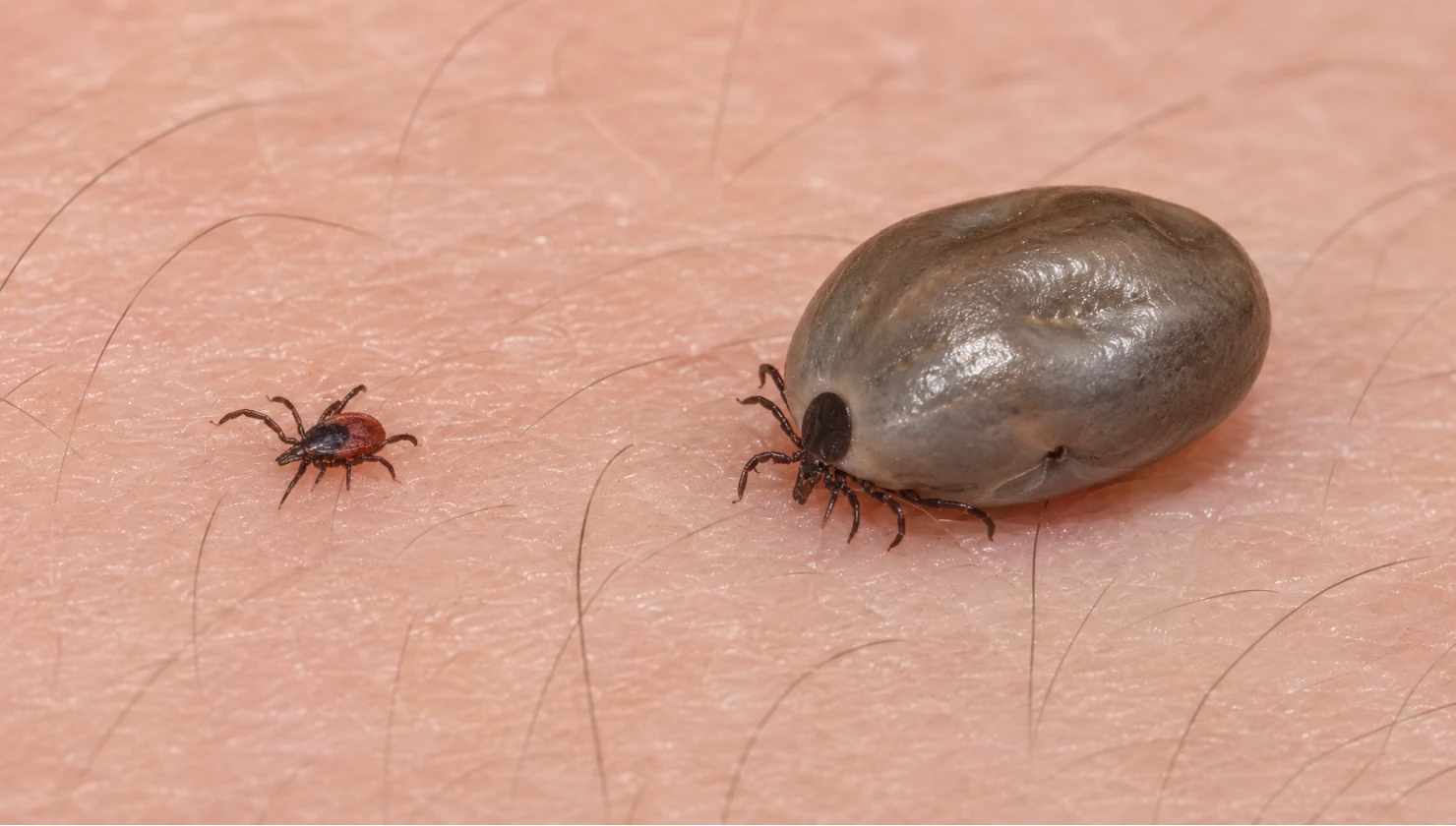
Ticks favor warm, moist, concealed areas of the body: the scalp, behind the ears, the neck, armpits, groin, and behind the knees. Our full guide on how to check for ticks walks through a complete body check.
If you find one already attached, do not twist, burn, or smother it. Our guide to how to remove a tick covers safe removal step by step.
We have helped thousands of people in Colorado, Oregon, Wyoming, New Jersey, Pennsylvania, Texas, Wisconsin, New Hampshire, Alabama, South Dakota, and Vermont restore their health and quality of life by diagnosing and treating their Lyme Disease.
These three species cause the most confusion because they overlap in range and season across much of the eastern United States.
| Feature | Deer Tick | American Dog Tick | Lone Star Tick |
|---|---|---|---|
| Size | Smallest of the three | Largest of the three | Between the other two |
| Scutum | Solid dark, no markings | Ornate silvery-white pattern | Brown; female has one white dot |
| Transmits Lyme? | Yes | No | No |
| Signature risk | Lyme disease, babesiosis | Rocky Mountain spotted fever | Alpha-gal syndrome |
The single white dot is the fastest way to rule out Lyme disease from a lone star tick bite. But ruling out Lyme does not rule out everything else. A lone star tick bite can trigger alpha-gal syndrome, a delayed reaction that most patients never connect back to a tick bite months earlier.
Alpha-gal syndrome is a delayed food allergy to mammalian meat (beef, pork, lamb) and other mammal-derived products, triggered by a sugar molecule introduced through certain tick bites, most often the lone star tick.
Rocky Mountain spotted fever is a bacterial infection spread by several hard tick species, including the American dog tick and Rocky Mountain wood tick, that can become life-threatening without prompt antibiotic treatment.
STARI (Southern Tick-Associated Rash Illness) causes a Lyme-like circular rash after a lone star tick bite but is a distinct condition without a confirmed bacterial cause.
Eight of the nine species on this chart are hard ticks (family Ixodidae): visible scutum, slow feeders over hours to days, questing on vegetation for a host. Soft ticks (family Argasidae) are the exception, with no scutum, living in rodent burrows and cabin walls, and feeding for minutes rather than days, often while a person sleeps.
Tick-borne relapsing fever is a bacterial infection transmitted by soft ticks, causing recurring fever episodes separated by days of feeling normal.
This matters clinically: prompt removal protects against most hard-tick diseases, including Lyme, because transmission takes hours. It offers far less protection against soft-tick relapsing fever, which research shows can transmit within a minute [4]. See our types of ticks guide for the full biology of both families.
A chart tells you what species bit you. It does not tell you whether you are actually at risk. That depends on three things this chart cannot show: how long the tick was attached, whether it was carrying a pathogen, and where you live.
Attachment time matters most for Lyme disease specifically. Public health guidance often cites a 36- to 48-hour window before Borrelia burgdorferi transmission becomes likely. But a review of the underlying transmission-time data found that a firm minimum has never been established, and documented transmission in under 24 hours in some cases [5]. Prompt removal still matters at any attachment time.
Powassan virus is a rare but serious tick-borne virus that can cause brain or spinal cord inflammation; unlike Lyme disease, it has no established grace period before transmission.
Powassan virus, carried by the same deer tick, can transmit in as little as 15 minutes [6], the fastest known window of any tick-borne pathogen studied. Two diseases, one tick, two different clocks: species identification is the starting point for risk assessment, not the whole assessment.
Regional infection rates also vary considerably within a single species. A deer tick nymph in a high-endemic Connecticut county carries higher Lyme odds than one from a low-density county. Our resource on which ticks carry Lyme disease breaks this down further.
We have helped thousands of people in Colorado, Oregon, Wyoming, New Jersey, Pennsylvania, Texas, Wisconsin, New Hampshire, Alabama, South Dakota, and Vermont restore their health and quality of life by diagnosing and treating their Lyme Disease.
This is something I see often in practice: a patient correctly identifies the tick, gets a standard test, and the result comes back negative. That does not close the case.
The standard two-tier Lyme test (ELISA followed by Western blot) misses a meaningful share of early infections. It was also never designed to detect co-infections like babesiosis, anaplasmosis, or the diseases carried by dog ticks and lone star ticks. If your bite matched a species on this chart and symptoms still do not fit a clean negative, a tick-borne illness panel, not just a repeat ELISA, is often the next right step. This is a documented testing limitation, not an unusual opinion.
Keeping ticks away from you is the best way to avoid tick bites in the first place, and our page on best tick repellent does a deep dive on which evidence-based repellent is most effective.
Matching a tick to this chart is the fastest way to know what you are dealing with: which diseases are realistically on the table, and which you can rule out. But the chart is a starting point; attachment time, your region, and your symptoms finish the picture a photo alone cannot.
If you were bitten, developed unexplained symptoms later, or received a negative test that does not match how you feel, you deserve a full evaluation, not just a repeat of the same inconclusive test.
Schedule a functional medicine consultation →
Medical Disclaimer: This content is for educational purposes only and is not a substitute for professional medical advice, diagnosis, or treatment. Always consult a qualified healthcare provider with questions about your specific situation. This page does not constitute a patient-provider relationship.
Author: Dr. Diane Mueller, ND, LAc, DAOM, Naturopathic Doctor and Doctor of Acupuncture & Oriental Medicine specializing in Lyme disease and tick-borne illness.
Medical Reviewer: Dr. Diane Mueller, ND, LAc, DAOM
Last reviewed: August 3, 2026
Compare its size, scutum pattern, and body color against the chart above. Save it in a sealed bag or on tape if possible, markings are easiest to confirm before it dries out.
The American dog tick is among the most common in the eastern United States, but the deer tick carries the greatest disease burden because of Lyme disease.
A nymph is roughly the size of a poppy seed, about 1 to 2 mm. An unfed adult is closer to a sesame seed, 3 to 5 mm, and an engorged adult female can swell to the size of a grape.
Species identification narrows the risk (a lone star tick cannot give you Lyme disease, for example), but it cannot tell you whether that tick was infected or how long it was attached. Both matter as much as the species.
No. Infection rates vary widely by species, region, and life stage. Not every deer tick carries Borrelia burgdorferi, but regional rates can run high enough that a nymph bite in an endemic area still warrants close monitoring.
We have helped thousands of
people restore their health
and quality of life by diagnosing
and treating their Lyme Disease.
“Dr. Mueller’s approach to medicine is refreshing! There is only so much you can do with western medicine and in my life I was needing a new approach. By addressing the whole body, nutritional diet factors, environmental factors, blood work, and incorporating ideas I had not previously known, I was able to break through with my conditions. I am not only experiencing less pain in my life, but through the process of healing guided by Dr. Diane Mueller, I am now happy to say I have more consciousness surrounding how I eat, what to eat and when things are appropriate. Living by example Dr. Mueller has a vibrancy that makes you want to learn and know more about your body and overall health. I highly recommend her to anyone looking for new answers, a new approach to health, or in need of freedom from pain and limitations.”
-Storie S.
Kihei, HI